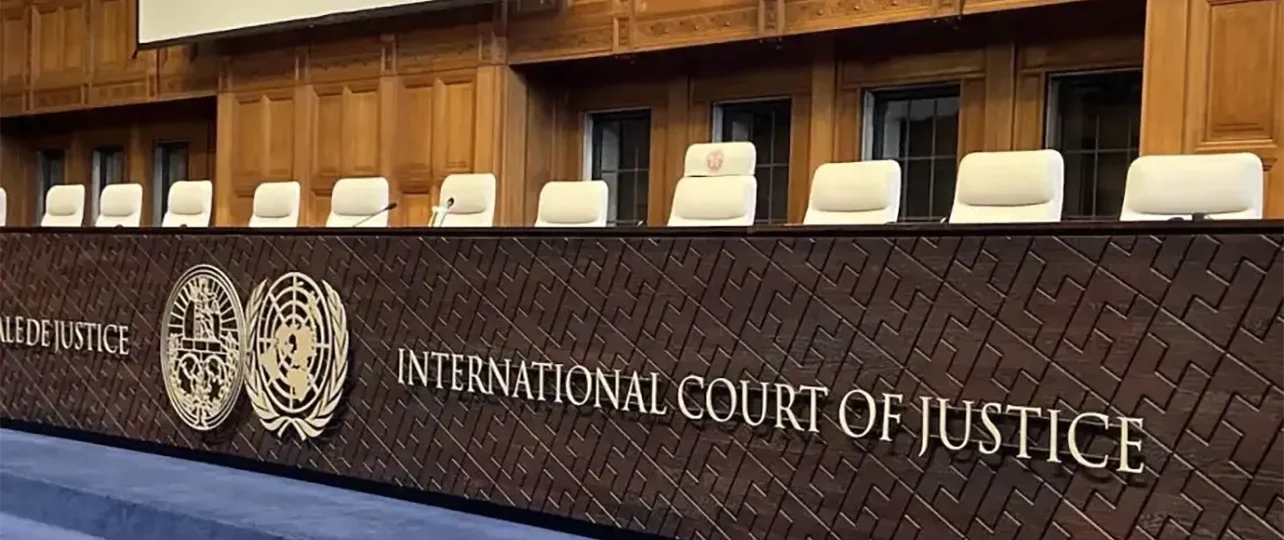

THE INTERNATIONAL COURT OF JUSTICE became the latest arena for the fracture lines of global power when four countries — the United States, Namibia, Fiji, and Hungary — filed formal declarations of intervention in South Africa’s genocide case against Israel, just as Israel submitted its counter-memorial to the world court after months of extensions.
The filings, made under Article 63 of the ICJ Statute, bring the total number of states seeking to participate in the landmark proceedings to 22 — an exceptional figure for a case that has drawn more sustained international legal attention than any dispute in the court’s modern history.
The four nations joined the Netherlands and Iceland, which had filed their own declarations on Wednesday 11 March, completing a week in which the geometry of international opinion around the case snapped into sharp relief: three states — Namibia, the Netherlands and Iceland — throwing their legal weight behind South Africa’s arguments, and three — the United States, Hungary and Fiji — filing submissions that align closely with Israel’s defence.
“The allegations of ‘genocide’ against Israel are false. They are also unfortunately nothing new.”
United States declaration of intervention, ICJ, 12 March 2026
THE UNITED STATES: A DECLARATION OF WAR ON THE CASE
Washington’s 11-page declaration is the most politically charged document filed in the case since South Africa launched proceedings in December 2023. In terms that go far beyond the conventional scope of Article 63 interventions — which are technically limited to questions of treaty interpretation — the Trump administration mounted a direct defence of Israel and a frontal attack on South Africa’s legal theory.
The US submission argues that genocidal intent can only be inferred when it is the sole reasonable explanation for the conduct in question, and insists that civilian casualties resulting from urban combat cannot in themselves establish that intent. It warns that lowering the evidentiary threshold for genocide would dilute the very meaning of the term and transform the Genocide Convention into a vehicle for political disputes.
Unusually for an Article 63 submission, the US filing also invokes history, recalling what it describes as a pattern of bad-faith attempts to deploy genocide allegations against Israel at international forums since at least 1976, and connecting South Africa’s case to what it characterises as a broader delegitimisation campaign against the Israeli state.
The filing represents the most direct legal intervention by a Western great power in the case, and analysts say it will substantially complicate the court’s task in maintaining a posture of judicial independence from geopolitical pressures.
HUNGARY: THE CONVENTION’S SCEPTIC
Budapest’s declaration takes a structuralist approach, arguing that international courts have increasingly been weaponised as forums for political contestation rather than legal adjudication. Hungary warns that South Africa’s case risks expanding the definition of genocide beyond its original meaning, blurring the distinction between mass atrocity — however grave — and the specific, intent-driven crime of genocide.
Hungary’s submission emphasises that the exceptionally high legal threshold for genocidal intent must be strictly maintained, and that the destruction or deaths of civilians in the context of armed conflict cannot be conflated with the deliberate design to destroy a group as such. The filing broadly aligns with Israel’s legal strategy of emphasising the lawful character of its military campaign as a response to the Hamas-led attacks of 7 October 2023.
FIJI: EVIDENTIARY CAUTION IN URBAN WARFARE
The Pacific island state’s intervention focuses on the specific legal challenges of applying the Genocide Convention to the conditions of modern urban warfare. Fiji urges the court to set and maintain an extremely high evidentiary bar when adjudicating genocide claims, and warns against over-reliance on reports produced by international organisations and non-governmental bodies in establishing the factual record.
Fiji’s submission has attracted attention for its caution around the kinds of evidence South Africa has placed at the centre of its case — including documentation from UN agencies and human rights organisations — and is seen by legal observers as an attempt to pre-emptively challenge the probative weight the court may assign to that material.
“Genocide can be committed through omissions — including a refusal to allow or facilitate life-saving humanitarian assistance to civilians under a state’s control.”
Namibia declaration of intervention, ICJ, 12 March 2026
NAMIBIA: THE AFRICAN VOICE FOR ACCOUNTABILITY
Namibia’s intervention stands in pointed contrast to those of its Thursday co-filers. Windhoek has aligned itself squarely with South Africa’s legal framework, advancing a broad reading of the Genocide Convention’s prohibition on deliberately inflicting conditions of life calculated to bring about the destruction of a protected group.
The Namibian declaration argues that genocidal intent may be inferred from cumulative patterns of conduct — including repeated forced displacement, the systematic denial of food, water and medical care, and the weaponisation of humanitarian access. It also breaks important legal ground by asserting that genocide can be committed through omission: a state that has full control over humanitarian assistance to a captive civilian population and withholds it may, in Namibia’s submission, be guilty of genocide regardless of whether it takes direct lethal action.
Namibia’s intervention carries particular moral and historical weight. The country is itself a survivor of one of history’s first acknowledged genocides — the Herero and Nama genocide perpetrated by German colonial forces between 1904 and 1908. Namibia’s President Hage Geingob, before his death in 2024, had explicitly drawn the parallel between that history and Israel’s conduct in Gaza, criticising Germany for supporting Israel in the very case that Namibia now formally backs.
Windhoek’s legal position reinforces that of the Netherlands and Iceland, filed the previous day, which similarly argued that the withholding of humanitarian aid, starvation, and mass displacement could serve as indicators of genocidal intent and that third states carry independent obligations to prevent genocide from occurring.
ISRAEL’S COUNTER-MEMORIAL: THE DELAYED RESPONSE
The wave of third-party interventions coincides with what is, procedurally, the most significant development in the case since the ICJ’s landmark provisional measures order of January 2024: Israel’s submission of its counter-memorial, the formal written response to South Africa’s allegations.
The counter-memorial was due in July 2025 but was extended twice by the court — first to January 2026, then to 12 March 2026. Its contents remain sealed under the ICJ’s rules governing written proceedings, but it is expected to contest South Africa’s factual record comprehensively, argue that Israel’s military campaign constitutes lawful self-defence under international law, and challenge the applicability of the Genocide Convention to the conduct described by Pretoria.
Legal experts note that the process will now move to a further round of written exchanges: South Africa will be given the opportunity to file a reply addressing Israel’s counter-memorial arguments, after which Israel may submit a rejoinder. Only once that process is exhausted will the court schedule oral hearings in The Hague, likely no earlier than 2027, with a final ruling not expected before 2028 at the earliest.
THE STATE OF PLAY: 22 COUNTRIES, TWO LEGAL CAMPS
The interventions filed this week crystallise a pattern that has been building since Colombia became the first third state to file under Article 63 in April 2024. The 22 interventions now lodged span nearly every inhabited region of the globe and reflect the degree to which the Gaza conflict has become a defining test of the post-World War II international legal architecture.
INTERVENTIONS AT A GLANCE: MARCH 2026
| NAMIBIA FOR SA | Broad reading of Genocide Convention; genocidal intent may be inferred from cumulative patterns of conduct including denial of aid, displacement and deprivation. |
| NETHERLANDS FOR SA | Forced displacement, starvation and withholding of humanitarian aid can demonstrate genocidal intent; third states have obligations to prevent genocide. |
| ICELAND FOR SA | Deprivation of food, shelter and medical care threatening the survival of a group may constitute conditions of life under the Genocide Convention. |
| USA AGAINST SA | Genocide allegations are ‘false’; strict evidentiary threshold must be maintained; civilian casualties in urban conflict do not prove genocidal intent. |
| HUNGARY AGAINST SA | Narrow interpretation of genocide required; international courts being politicised; case risks inappropriately expanding the Convention’s definition. |
| FIJI AGAINST SA | Extremely high evidentiary threshold required; caution against relying on NGO/international organisation reports; urban warfare context must guide analysis. |
Colombia, Libya, Mexico, Palestine, Spain, Turkey, Chile, Maldives, Bolivia, Ireland, Cuba, Belize, Brazil, the Comoros, Belgium and Paraguay have all filed earlier interventions supporting South Africa’s case to varying degrees.
ANALYSIS: WHAT THE INTERVENTIONS MEAN FOR THE CASE
The third-party interventions do not determine the outcome of the case — only the 17 sitting judges of the ICJ will do that. But they matter in several ways. They shape the interpretive environment within which the judges deliberate, potentially influencing how the court reads contested provisions of the Genocide Convention. They also function as political signals, indicating to the court which of its interpretive choices will be seen as legitimate by the international community.
The US intervention is in a category of its own. Washington is not merely offering an interpretation of the Genocide Convention; it is mounting a political and historical defence of Israel that goes well beyond what Article 63 formally permits. Legal scholars have noted that Article 63 interventions are supposed to be confined to questions of treaty interpretation, and that the US filing’s explicit assertion that genocide charges are false crosses into territory more appropriate for amicus briefs or political statements. Whether the court accepts the full scope of the US submission is itself a question with significant implications.
For South Africa, the interventions from Namibia, the Netherlands and Iceland are a meaningful consolidation. They provide judicial authority — countries whose legal and factual analyses the court may draw on — for the core propositions in Pretoria’s case: that genocidal intent can be inferred from patterns of conduct, that the withholding of humanitarian aid can constitute a genocidal act, and that third states have independent legal responsibilities to prevent genocide.
Namibia’s contribution in particular may prove the most analytically potent. Its argument that genocide can be committed through omission — not merely through active killing — extends the Convention’s reach into territory that has not been extensively litigated before the ICJ, and could prove decisive if the court is ultimately persuaded that Israel’s control over humanitarian access was deliberate and systematic.
The final ruling, when it comes, will not only resolve the immediate question of Israeli culpability. It will also set precedents about the meaning of genocide, the standard of intent, the role of third states, and the scope of the court’s jurisdiction that will shape international law for decades. The intensity of this week’s filing flurry reflects the understanding, by capitals across the world, that the stakes are that high.