By Hanna Davis
NEARLY 40,000 people have fled Syria’s sectarian violence for neighbouring Lebanon over the past three months. With many fearful of returning anytime soon, their arrival adds a new layer to Lebanon’s protracted humanitarian crisis at a moment when aid groups are badly underfunded and overstretched.
Most of the new arrivals are Alawites, a religious minority who were the target of an early March wave of killings that saw forces affiliated with the new Syrian government carry out retaliatory massacres in Alawite-majority areas. This came after groups loyal to the former regime of President Bashar al-Assad attacked security forces – al-Assad is an Alawite, and Syria’s coastal provinces of Latakia and Tartous were once seen as his strongholds.
At least 800 people are believed to have been killed in early March, although the exact death count is still not clear. When the violence began, thousands of people, mostly Alawites, sought safety in Lebanon, and people are still crossing the border. Most are staying in Alawite villages in Lebanon’s northern Akkar province, in places like the tiny northern border village of Massoudiyeh, which has nearly doubled in size to around 11,380 people.
“There are more and more people coming every week,” said Massoudiyeh mayor Ali al-Ali, speaking to The New Humanitarian in between back-to-back meetings with aid groups and people who came to his office seeking help.
“Many towns and villages – including Massoudiyeh – are no longer able to adequately accommodate [the new arrivals],” he said. “There are no proper reception centres. People are sleeping in garages, shops, out on the streets, and in the municipal hall.”
Growing needs and funding shortfalls
Below al-Ali’s office, mattresses were sprawled out on the cement floor. A 14-year-old girl lay next to her mother, gripping onto a stuffed teddy bear. Her mother, Noor – who asked that a pseudonym be used instead of her real name because of security concerns – explained that she had to leave her paralysed daughter’s wheelchair and most of her medication when they fled their home in the Syrian city of Homs in mid-May.
The family had just arrived in Massoudiyeh, and Noor didn’t know where to get medical help for her daughter. She explained that they had felt increasingly unsafe as Alawites in Homs due to a rise in kidnappings and killings targeting members of the religious sect. “We were afraid and wanted a better life,” she said.
Noor reached down to pull out two empty packages of her daughter’s medication – anticonvulsants used to treat her seizures and muscle spasms. “She needs to take the medication daily. If she stops, her condition will worsen,” she said, worriedly.
However, resources to help the new arrivals are few and far between, especially as assistance for refugees and displaced communities has already been stretched. In addition to the nearly 93,000 people who remain internally displaced due to the recent war between Israel and Hezbollah, Lebanon hosts more than 722,000 officially registered Syrian refugees (the government estimates the real number is around 1.5 million).
The war ended in a ceasefire in late November, but Israel continues to occupy part of the country and bomb regularly in Lebanon, and some areas have been so thoroughly destroyed by Israeli bombing that entire villages are no longer habitable.
This comes as aid funding is down, both in Lebanon and globally. Lisa Abou Khaled, spokesperson in Lebanon for the UN’s refugee agency, UNHCR, told The New Humanitarian that “UNHCR, alongside the entire humanitarian community, is experiencing an overall unexpectedly large and swift downturn in funding in 2025.”
She said the recent US funding freeze – compounded by other donor shortfalls – had “severely impacted the ability to deliver essential services to both refugees and vulnerable Lebanese communities”. This means people are now arriving from Syria “in dire conditions, while the current response is greatly overstretched, insufficient to the growing needs and increasingly unsustainable due to the lack of funding and support”, Abou Khaled added.
No place to go
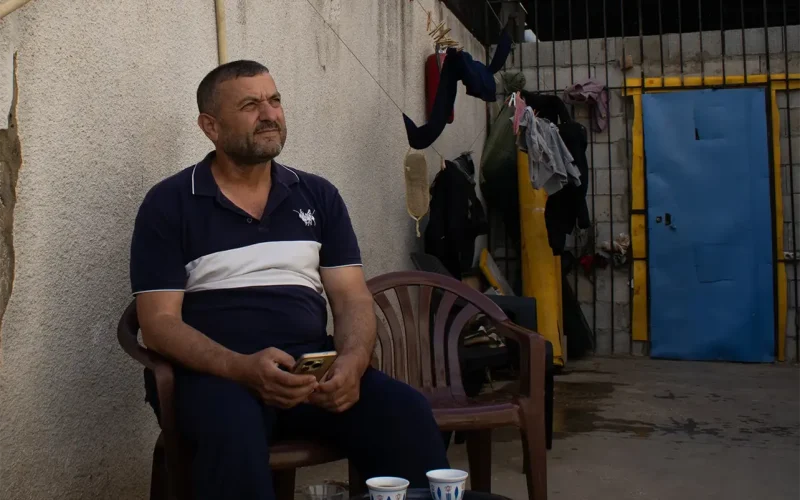
Down the road from the municipal building and Mayor al-Ali’s office, a Massoudiyeh mosque was packed with mattresses, suitcases, and around 410 people. Imad Ibrahim, 44, has been organising aid for the people staying in the mosque, many of whom – including Ibrahim – had been sleeping there for over two months.
“People cannot go outside the village, they don’t have work, and they don’t have money to leave,” Ibrahim said, as a group of men and women gathered around him, voicing their concerns about their inability to move out of Massoudiyeh.
Lebanese police and army officers patrol checkpoints around the village, stopping passersby and checking identification documents
The Lebanese authorities began a campaign to deport Syrian refugees without papers in 2023, forcibly, and have continued the crackdown ever since. The risk of deportation has left many fearful of venturing too far afield of Massoudiyeh and other places that are home to Syrian refugees, meaning job opportunities are slim and their reliance on humanitarian aid is high.
A large truck pulled up to the mosque’s gate and began to unload boxes printed with UNICEF’s blue letters. They were loaded with hygiene and cleaning products, which Ibrahim said were critical for the mosque because viruses and conditions like scabies were spreading due to the overcrowded conditions.
Aid agency deliveries like this one were rare, Ibrahim said, noting that the hygiene boxes arrived once a month. “There’s not a lot of services from international organisations,” Ibrahim continued. “There’s not enough bread… and there’s still no school.”
Local resources stretched
In the centre of Massoudiyeh, past the mosque, newly arrived Syrian refugees have already opened a new salon and a falafel shop. Some others sat behind roadside stands, selling chips, cookies, and candy.
Down one lane, a former school building has been converted into a shelter. Samir Ismail, 53, who fled the village of Arzeh in Syria’s Hama province in early March, sat outside one of the rooms. Beside the door, a trough was planted with fresh mint, and empty plastic water bottles were turned into flower pots.
Ismail, like Ibrahim, was organising aid to the 346 people staying at the school. He echoed many of Ibrahim’s concerns, saying he had noticed a decline in aid starting in mid-April. “The situation has worsened,” he said. “It’s a constant struggle.”
When Alawites began to flee to Lebanon in early March, Ismail said much of the initial help came from local community members in Massoudiyeh. But these donations have largely ceased. “The local community no longer has the ability to help; many of them don’t even have a penny,” he said.
In addition to the lack of basics such as food, cleaning supplies, clothing, and bedding, Ismail said education and medical care were emerging as major concerns, adding that a local educational foundation had come to record the names of the children in the shelter but he hadn’t heard anything since.
Healthcare barriers
Last week, UNHCR announced it was phasing out primary and secondary healthcare assistance – meaning hospitalisation fees – for Syrian refugees by the end of the year. Abou Khaled said funding limitations meant that primary healthcare aid, such as support to access clinics and consultations, had already been cut in April.
Even before these changes, healthcare for refugees – including the new arrivals – was often prohibitively expensive. In a tiny cinder block room behind the school, a 31-year-old mother – who asked to go by Umm Yayha (mother of Yahya) because of security concerns – gently held her rounded belly. Seven months pregnant with her second child, she had not been able to afford a check-up since she arrived at the Massoudiyeh shelter in early April.
“What if I give birth suddenly?,” Umm Yahya said. “What would I do? I don’t have transportation, and I can’t cover [medical] expenses.”
The nearest hospital is in Halba, a town about a 20-minute drive away. Umm Yahya said she also feared the Lebanese army checkpoints along the way, concerned she could be arrested or deported. “We didn’t come here legally,” she explained
“Many of the newly arrived refugees in the north and Akkar are afraid to go far from their shelters, posing additional barriers to them seeking healthcare.”
Umm Yahya added that UNHCR had said it would cover 60% of her hospital fees when she delivers. This support will not be available to other refugees by the end of this year.
Simone Innoco, advocacy manager for Médecins Sans Frontières (MSF), which has been providing medical support in Massoudiyeh and surrounding villages since mid-March, said Umm Yayha’s situation – both in terms of fear and funding – is fairly common.
“Many of the newly arrived refugees in the north and Akkar are afraid to go far from their shelters, posing additional barriers to them seeking healthcare,” Innoco told The New Humanitarian.
“There’s no one organisation or agency that can step in to cover what UNHCR is covering,” he added. “Every other medical provider is going to have to step up.”
Hospitalisation fees are swallowing up an increasing part of MSF’s budget, especially, Innoco explained, since the US aid cuts. “For every [humanitarian] organisation, every agency, the global funds were already declining – the US [aid cuts] were just the last, hard blow,” he said. While MSF does not receive funding from the US, it has been impacted by the organisation given “the large gap this decrease in global aid is creating”.
‘Unprecedented’ aid reduction
The new refugees from Syria are only one part of the picture of people who need aid in Lebanon. At the opposite end of the country, near Lebanon’s southern border, nearly 93,000 people are still displaced, the UN’s migration agency reports,994 of whom are still staying in collective shelters.
“The needs across the region – particularly in Lebanon and Syria – are at their highest levels in years,” UNHCR’s Abou Khaled said. “In Lebanon, this is driven by the recent and sporadic conflict, new waves of displacement of new arrivals from Syria, and the persistent weakness of national structures already under significant strain.”
In addition to the phase out of healthcare assistance, UNHCR also had to completely end support for those affected by the war with Israel and for projects in refugee-hosting areas, as well as undergo a “major reduction” in staffing, Abou Khaled said.
Other humanitarian agencies, such as the World Food Programme (WFP), have also been forced to make dramatic cuts.
WFP’s country director in Lebanon, Matthew Hollingworth, told The New Humanitarian there had been an “unprecedented level of [aid] reduction”, adding: “There is a downturn in support from multilateral organisations through multiple countries.”
Hollingworth said the agency has reduced its cash assistance programme in Lebanon and is now only supporting 30,000 Lebanese (down from 162,000 in February) and 666,000 Syrians (down from 830,000 in February).
He said a reduction of aid within any humanitarian sector has a “knock-on effect” on the others. “Families are left to take tough decisions,” he continued, “If they receive a [cash] transfer for food, but they have a health crisis, and no other means to cover it, they go short on food to cover that cost.”
Meanwhile, back in Massoudiyeh, people were continuing to arrive. Next to Umm Yayha’s room at the school-turned-shelter, Houria Barakat was searching for a place in the village for his young daughter and wife to stay. They had crossed into Lebanon just a few hours earlier, after fleeing their homes in the Homs countryside.
But all the rooms in the shelter were full. “We just want a room to stay in, where there is peace,” he said, sighing.
Edited by Annie Slemrod.
–––––
The New Humanitarian puts quality, independent journalism at the service of the millions of people affected by humanitarian crises around the world. Find out more at www.thenewhumanitarian.org.