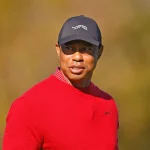
HERE is a number worth considering before we go any further: one billion dollars. That is, give or take a yacht, the estimated net worth of Eldrick Tont “Tiger” Woods – fifteen-time major champion, cultural colossus, and, as of Friday afternoon, a man who had just crawled out of the passenger window of an overturned Land Rover four miles from his own front door.
For the second time in nine years, one of sport’s most storied figures sat in the back of a police cruiser rather than the back of a limousine. One must ask – with a sincerity that is rapidly curdling into exasperation – why?
| “He was lethargic on scene,” said Martin County Sheriff John Budensiek. Woods blew 0.00 on the breathalyzer. Then he refused the urine test. Cooperative, said the Sheriff – “just not trying to incriminate himself.” |
The Crime Scene: Jupiter Island, 2 p.m. Friday
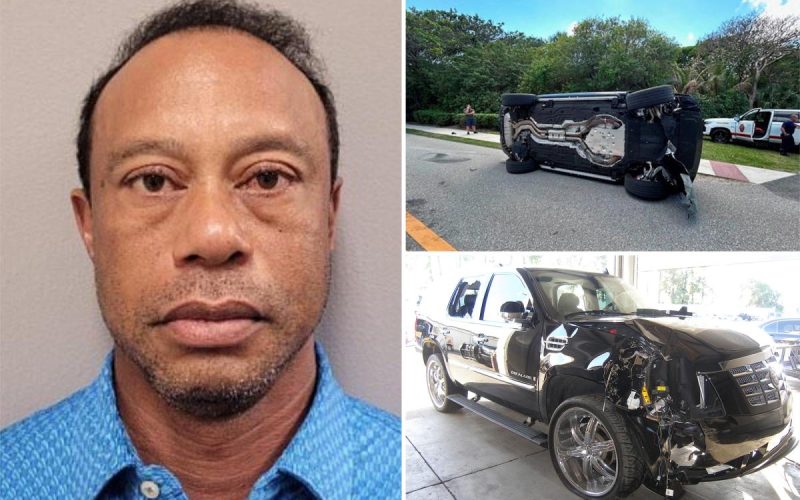
According to Martin County Sheriff John Budensiek, Woods was travelling at speed along South Beach Road – a two-lane stretch barely a sand wedge from his island estate – when he attempted to pass a pressure-cleaning truck that had slowed to turn into a driveway. The Land Rover clipped the trailer, rolled onto its driver’s side, and slid to an unglamorous halt on the tarmac.
Woods, 50, crawled out through the passenger window. No one was seriously hurt — not Woods, not the truck driver, not the dignity of professional golf, which has long since learnt to absorb these particular indignities with a practised grimace.
The breathalyzer reading was a clinical 0.00. Not a drop of alcohol in the man’s blood. And yet: lethargic, impaired-looking, and sufficiently suspicious to earn three charges — DUI with property damage, and refusal to submit to a lawful test. Woods declined the urinalysis. His legal team, one imagines, was already speed-dialling from the moment the Range Rover stopped sliding.
Déjà Vu on the Blacktop: The Class of 2017
This is not, let us be perfectly clear, Tiger’s first rodeo in this particular arena. In May 2017, police in Jupiter, Florida – yes, the same postcode, the same man, a slightly different car – found Woods slumped unconscious behind the wheel of his vehicle, engine running, two flat tyres, damage to both bumpers. He was not drunk. He was, toxicology would later confirm, carrying a cocktail of five prescription drugs in his system: Vicodin, Dilaudid, Xanax, Ambien and THC.
Woods pleaded guilty to reckless driving, accepted a year’s probation, and enrolled in a DUI diversion programme. The world exhaled, wished him well, and assumed that was that. It was not that.
| Vicodin. Dilaudid. Xanax. Ambien. THC. Five drugs in 2017. Now, in 2026, the breathalyzer reads zero — and yet the man can barely stand. Tiger Woods has a pharmaceuticals problem wearing a painkillers costume. |
The Billion-Dollar Question
Let us return to the number. One billion dollars. The man captains a TGL team – Jupiter Links GC, no less – in which he has invested significantly. He owns real estate across multiple states. His Nike deal alone, before it ended, generated hundreds of millions. He played three days ago in the TGL finals. He has a phone. Jupiter Island has roads. Those roads have cars on them that will take you wherever you wish to go, driven by someone who is neither medicated nor attempting to pass a pressure-cleaning truck at speed on a two-lane road.
A five-star Uber Black from his front gate to any restaurant, bar, pharmacy, or friend’s home on the island costs roughly forty dollars. Tiger Woods earns more than that per second from his business interests. And still, not once but twice, he has chosen to pilot a vehicle in circumstances that have led to his arrest.
The question is not whether he could afford a taxi. The question is why a man who has spent his adult life calibrating every variable – the angle of his backswing, the grain of a putt, the drape of a Nike polo – cannot calibrate this one.
Pain, Pills and the Performance of Invincibility
The uncomfortable truth that floats just beneath the surface of every polished press release and every carefully worded legal statement is this: Tiger Woods has been in serious, chronic physical pain for the better part of a decade. The 2021 crash outside Los Angeles – where his SUV rolled multiple times at speeds between 84 and 87 miles per hour on a 45 mph road – left him with open fractures to his lower right leg, requiring a rod in the tibia and pins and screws in his foot and ankle. He was hospitalised for three weeks.
He has had, by various counts, seven back surgeries. He ruptured his Achilles tendon as recently as March 2025. He missed the entirety of last season. He played competitive golf for the first time in over a year on Tuesday in the TGL finals. By Friday afternoon, he was face-down in a crumpled Land Rover.
A man carrying that pharmaceutical burden – the painkillers, the sedatives, the muscle relaxants that necessarily accompany that level of physical reconstruction – should not be behind the wheel of a vehicle. The law agrees. His own prior experience agrees. One assumes, in quieter moments, that Tiger Woods himself agrees.
| This is not a morality tale about a fallen hero. This is a story about a man who cannot ask for help — and a culture of celebrity that never required him to learn how. |
The Legal Picture: Shakier Than His Ankles
Florida attorneys consulted by American sports media were quick to note the practical fragility of these charges. Without the urinalysis – which Woods refused – proving impairment by a controlled substance under Florida law is a considerably more difficult task. The refusal charge itself is a second-degree misdemeanour carrying a maximum of 60 days in jail, but in reality, for a first-time refusal backed by expensive legal talent, it is unlikely to result in incarceration.
Woods will lawyer up, as is his right. The charges may well be reduced or dropped, as happened before. He will issue a statement that balances accountability with opacity. Sponsors will exhale. The Masters, which begins on April 9 at Augusta National, will quietly proceed without him.
The institution of professional golf will do what it always does with Tiger: it will wait. It has always waited. It will wait again.
A Man Who Cannot Afford to Ask for a Ride
There is, woven through all of this, a very human tragedy – though one that deserves to be examined without sentimentality. Tiger Woods was raised to be exceptional, to be self-sufficient, to be, in his father Earl’s formulation, a figure who would transcend sport and change the world. He was also raised, by the brutal logic of elite performance, never to show weakness, never to admit limitation, never to flag down a car.
That psychology – the one that drives you to the first tee at the Masters on a surgically rebuilt leg, that makes you crawl out of a wrecked window rather than wait to be carried – is the same psychology that makes you drive yourself four miles home rather than make a phone call that would take thirty seconds and cost forty dollars.
It is the psychology of a man who has never permitted himself to be dependent on anyone, even when dependency is both sensible and safe.
That is not an excuse. It is, however, an explanation — and one that the industry of professional sport, which built this man into an icon and then watched him crumble in pieces for fifteen years, might do well to sit with.
What Comes Next
Woods has yet to confirm his status for the Masters. His Achilles and his back – and now his legal team – will all have a say in that. The PGA of America was waiting on his decision about the 2027 Ryder Cup captaincy; that conversation has, one suspects, been deferred.
The mug shot – his second – was released Friday night. He looked tired. He looked, in all honesty, like a man who has been carrying too much for too long and has not yet found a way to put it down.
Whether he ever does is, of course, up to him. But if Tiger Woods ever finds himself weighing the options at the end of a difficult day – the keys in his hand, the door of a very expensive vehicle within reach – one can only hope that on some level, perhaps the level that still remembers two flat tyres and a Jupiter Island roadside in the small hours of a 2017 morning, he decides to call the car.
The Uber rating in his area is, by all accounts, excellent.
Key Facts at a Glance
• 27 March 2026: Tiger Woods arrested for DUI with property damage and refusal to submit to lawful test, Jupiter Island, Florida
• Breathalyzer result: 0.00 (zero alcohol). Urinalysis: refused
• 2017: Woods found asleep at the wheel; five prescription drugs detected; pleaded guilty to reckless driving
• 2021: Single-vehicle crash outside Los Angeles; multiple leg fractures; vehicle travelling at 84–87 mph in a 45 mph zone
• Woods, 50, had returned to golf three days earlier in the TGL Finals
• Masters 2026 begins April 9 at Augusta National. Woods’ participation now in serious doubt