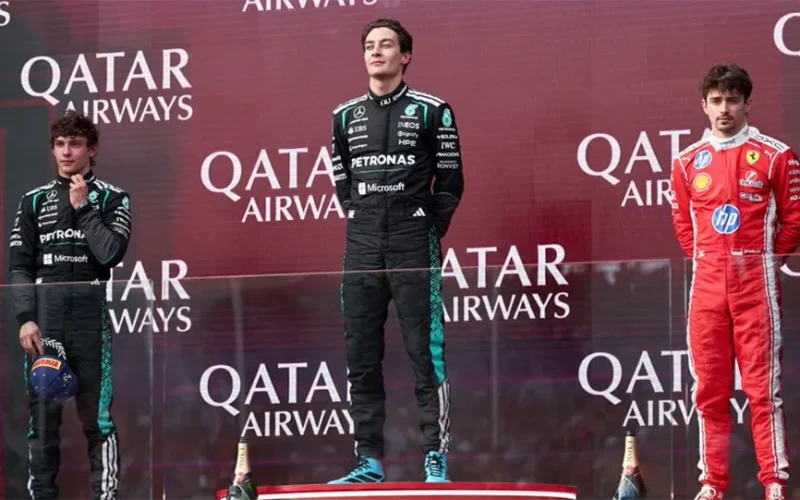
THEY said Formula 1 was entering a brave new world. What they didn’t mention was that, in this brave new world, George Russell would be standing on the top step of the podium with a grin wider than the Flemington straight, while the rest of the paddock stood around in varying states of bewilderment, blaming their batteries, their power units, and, in one particularly spectacular case, a kerb. Welcome to 2026. The Silver Arrows are back. God help us all.
Under a mild Melbourne sky – the weather, mercifully, being one of the few things that behaved normally this weekend – the 2026 Australian Grand Prix delivered everything you could possibly want from a season opener: lead changes galore, breathtaking new-era machinery, strategic treachery at 300 kilometres per hour, a rookie who looked born to it, a four-time world champion who started from last place muttering about Formula E, and a home hero who didn’t even make it to the starting grid. You really could not write it. And yet, here we are.
The Silver Resurrection
For those who spent the last decade watching Mercedes get fat on dominance before falling into a prolonged, sometimes painful, period of mediocrity – watching the Silver Arrows crawl back to the front of the field in 2026 has the delirious quality of something you thought you’d imagined. They sandbagged like professionals during testing, kept their cards so close to their chests that even their own garage staff were reportedly unsure what they were dealing with. Then, in Melbourne, they simply… unleashed it.
George Russell put his W17 on pole position on Saturday with a lap that left jaws on the garage floor – nearly eight tenths clear of the next non-Mercedes car. Eight. Tenths. On a street circuit where hundredths are usually the currency of greatness. Lando Norris, for his part, sat in the press conference and stared at the floor for a full seven seconds when asked if there was anything about the new cars he actually enjoyed. He then looked up and said, simply: “No. Not really.” That, ladies and gentlemen, is a man watching someone else win before the season has even started.
The race itself was no procession, mind you. The new 2026 machinery — with its radical 50-50 hybrid power split between combustion and electrical – threw up drama in the opening laps that had commentators reaching for superlatives and drivers reaching for excuses. Charles Leclerc catapulted his Ferrari from fourth on the grid to the lead before the first corner had even been fully negotiated, and the Monegasque and Russell then spent the first nine laps swapping the lead in a breathless, chaotic, thoroughly modern tango that no one had quite predicted. Seven times the lead changed hands. Seven. It was extraordinary.
Then Ferrari blinked. When Isack Hadjar’s Red Bull retired on lap 11, triggering a Virtual Safety Car, Mercedes pitted both Russell and Kimi Antonelli – smartly, decisively, with the confidence of a team that knows exactly what it’s doing. Ferrari, convinced it was too early for a one-stop strategy to work, kept Leclerc and Lewis Hamilton out. Martin Brundle summarised it neatly from the Sky Sports commentary box: “What Ferrari gave up was track position and they lost control of the race.” When the Scuderia’s men finally pitted under normal racing conditions laps later, they lost a vast chunk of time and, with it, any realistic hope of victory.
Russell crossed the line to win the first Grand Prix of Formula 1’s new era, leading Antonelli home in a one-two that had the Mercedes garage — and presumably Toto Wolff — making the kind of noises last heard circa 2020. “Feeling incredible,” Russell told the assembled media, which was rather an understatement. “It was a hell of a fight at the beginning. I got on the grid, I saw my battery level, I had nothing in the tank, made a bad start.” He then won the race regardless. Classic George.
“I like this car, I like this engine” — George Russell, crooning over team radio on his cool-down lap, like a man who has just found his soulmate.
The Boy Wonder Does the Business
If George Russell was the headline, Kimi Antonelli was the story that would keep F1 editors busy all season. The 19-year-old Italian – placed in one of the most scrutinised seats in motorsport, inheriting the car of a seven-time world champion – spent Saturday smashing his car into the wall during final practice, getting it rebuilt in what can only be described as a Drive to Survive-worthy mechanical miracle, then qualifying second behind his team-mate. Sunday was little calmer. Antonelli made a poor start, dropped to seventh, clawed his way back to fourth, and then, when the Virtual Safety Car deployed at just the right moment, found himself vaulted into a position from which he would never be shifted.
“What a start to the year,” Antonelli said afterwards, which may be the most composed sentence ever uttered by a teenager who had, forty-eight hours earlier, been fishing gravel out of his visor. The kid has ice in his veins, a racing brain that seems to operate on a different temporal plane to the rest of us, and a team behind him that clearly believes in him without reservation. He’s the real deal. Ferrari, Red Bull, and McLaren have been warned.
Ferrari: Fast, Beautiful, and Strategically Puzzling as Ever
Leclerc finished third. Hamilton finished fourth. The Ferraris were genuinely quick – fast enough, in truth, to win the race if strategy had played differently. Leclerc set the early pace with characteristic verve and showed that the SF-26 has genuine weaponry under the hood. Hamilton, making his Ferrari debut race in the opening round of his second Ferrari season, was sufficiently energised to be chasing down Leclerc in the closing laps before the flag fell.
“Of course, we are not as fast as Mercedes and we have work to do,” Hamilton said afterwards, displaying the cheerful stoicism of a man who has been here before and emerged on the other side with seven championships. “But we are right in the fight. It was a really fun race and it felt good for me. A couple more laps and I would have had Charles.” That last line, delivered with a raised eyebrow and the ghost of a smile, suggested the Hamilton-Leclerc dynamic at Ferrari is one of the season’s more tantalising subplots. Lewis had the pace. Lewis was catching his team-mate. Lewis didn’t get there. For now.
Ferrari’s strategy team, meanwhile, will be reviewing their VSC decision with the particular intensity that only comes when you know, deep in your soul, that you had the race and gave it away. “I’ve known more fun,” Leclerc said of the new cars’ characteristics during the weekend – which, as driver quotes go, is magnificently ambiguous. Whether he means the car, the race, or the moment his pit wall told him to stay out, we shall never quite know.
McLaren: The Reigning Champions Have Homework to Do
Before we get to the race itself, we must pause and acknowledge what happened forty minutes before the lights went out. Oscar Piastri – Melbourne native, local idol, the man for whom an entire grandstand had been named and filled to capacity – drove his McLaren out of the pit lane on his formation lap, clipped the exit kerb at Turn 4, received what he described as “about 100 kilowatts extra power I didn’t expect,” and deposited his MCL40 into the wall at speed. The damage was terminal. The race was over before it had begun.
The sold-out Piastri grandstand fell silent in one collective, heartbroken intake of breath. McLaren boss Zak Brown stood on the pit wall with his hands on his head. Piastri walked back to the paddock and spent the rest of the afternoon watching the race from the sidelines, looking like a man processing something that will take some time to fully process. “Just shock and surprise, really,” he said. “I was backwards before I’d even really had a chance to react.” And then, when asked about the famous curse that has kept Australian drivers off the podium at their home race since the dawn of time: “Clearly, it still lives.”
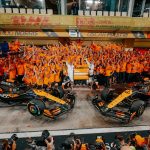
His team-mate Norris, at least, was spared such indignity – finishing fifth, having defended brilliantly against Verstappen in the closing laps. “P5 is a good result, I think we maximised what we could achieve today,” Norris said, with the weary pragmatism of a man who spent the entire weekend glaring at his steering wheel. The gap to the leaders was, in his own words, “pretty big.” He was not wrong. McLaren, last season’s dominant force, find themselves in the unusual position of being the chasing pack. The papaya faithful will be hoping this is a temporary inconvenience rather than a structural problem.
Verstappen: The Greatest Last-to-Sixth Drive No One Will Remember
Let us briefly acknowledge the extraordinary: Max Verstappen, four-time world champion, started this race from the back row of the grid. He’d crashed out of qualifying on Saturday after his car “swung around under braking” – a car-related drama, he confirmed, not a driver error – and spent the entire race scything through the field like a man with something to prove. He finished sixth. Which, given where he started, is genuinely impressive. It is also, given the competitive landscape, genuinely worrying for Red Bull.
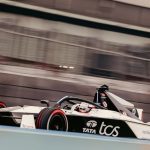
Verstappen has spent the pre-season describing the new cars as Formula E “on steroids” – a label that haunts the paddock – and in Melbourne, he was not having fun. “Not having fun at all driving them,” he confirmed with characteristic directness, later telling Dutch media he felt “no emotion” in the cockpit. He also had battery issues off the start line and struggled with tyre graining on the hard compound. “I think where our pace is lacking is half and half – so half car, half engine,” he said, which is Red Bull’s polite way of saying: everything needs work.
His team-mate, rookie Isack Hadjar, was having a rather better time of it until his Red Bull retired with what was described as a “terrible” engine sound. That one will haunt the RB engineers on the flight home to Milton Keynes.
The Class of 2026: New Faces, Mixed Fortunes
The true revelations of the weekend arrived not from the established giants but from the fresh blood. Arvid Lindblad, Racing Bulls’ 18-year-old British debutant, scored points in eighth place on his Formula 1 debut. Eighteen years old. Points on debut. He battled Oliver Bearman of Haas for position, was told over the radio to conserve, and radioed back to say he’d rather have another go at the Haas, thank you very much. The audacity. The absolute audacity. This young man is going to be a problem for people. In the very best sense.
Bearman himself took seventh for Haas — his compatriot Esteban Ocon finishing just outside the points in eleventh — and all five British drivers in the field scored points. The Union Jack contingent of Russell, Antonelli (technically Italian, but let’s not split hairs), Norris, Bearman, and Lindblad occupying five of the top eight positions is the sort of statistic that will be deployed in heated arguments in British pubs for some time.
Cadillac and Audi: American Dreams and German Ambitions, Still Aspirational
The new teams were, as expected, at the sharp end of nothing competitive, but present and somewhat accounted for. Cadillac – the American outfit that represents F1’s first new constructor entry in decades – managed to get Sergio Perez to the finish line in sixteenth place. Valtteri Bottas, their other driver and a man who appears to be enjoying himself enormously simply by being back in an F1 car, retired after his car shed debris that prompted a Virtual Safety Car. One step at a time.
Cadillac’s Perez was philosophical about proceedings: “We’re lacking performance, but it’s a work in progress, which will come. We had to start somewhere.” Somewhere, in this case, being roughly four seconds a lap off the pace leaders, which, for a brand new team on day one of a brand new regulations era, is not a catastrophe. It is, however, a long road.
Audi’s situation was rather more complicated. Gabriel Bortoleto, the Brazilian rookie, fought admirably to ninth place – a genuine points finish on the German manufacturer’s works debut in Formula 1. His team-mate Nico Hulkenberg, however, didn’t start the race at all, wheeled off the grid with a technical issue before the formation lap had been completed. For a manufacturer that built its entire entry around the appeal of the new hybrid power regulations, failing to get both cars to the starting line on race day is not the memo you want circulating in Ingolstadt on Monday morning.
Bortoleto, at least, extracted maximum value from his day. At 21, racing a brand new car for a brand new team in Formula 1’s first race under new regulations, ninth place represents not just a result but a statement of intent. The German marque has a driver worth building around. Now they need to build around him.
The Elephant in the Room: Everyone Hates the New Cars (Except George)
It would be remiss to report on the 2026 Australian Grand Prix without addressing what has become, in a matter of days, the central conversation of the new era: the drivers, with the conspicuous exception of one George Russell, absolutely loathe their new cars. The 50-50 hybrid power split, designed to attract new manufacturers and usher in a more sustainable future, has introduced what the paddock has taken to calling “super clipping” – a phenomenon where the energy harvesting system kicks in mid-corner and slows the car dramatically despite the driver pushing the throttle to the floor. The footage that went viral during Friday practice – cars visibly losing speed at full throttle — was not what the FIA’s marketing department had ordered for the season launch.
Leclerc said he’d “known more fun.” Verstappen said he felt “no emotion.” Norris stared at the floor for seven seconds. Russell, perched at the top of the podium, beamed broadly and said the car was “super fun to drive” and “much more agile.” One of these men had just won the race. Draw your own conclusions about the correlation between happiness and machinery.
The Championship Picture: Silver Leads, Everything Else Is Noise (For Now)
After one race, it is of course absurd to speak in certainties. The 2026 season has twenty-three rounds remaining, the regulations are new enough that teams will find gains in unexpected corners, and this is Formula 1 — the sport that once watched a dominant champion become a midfield runner inside eighteen months. All of this is true and reasonable and should be borne in mind.
And yet. Mercedes leads the Constructors’ Championship. George Russell leads the Drivers’ Championship. The Silver Arrows have — for the first time since the ground-effect era swept them aside – the fastest car on the grid by a margin that cannot be explained away as circuit-specific quirk or fortunate circumstance. Toto Wolff, we are told, has been reacting with a stony face to events all weekend. That stony face, for the record, broke on Sunday afternoon when his team crossed the line one-two in the most consequential race in years.
Ferrari has pace and a strategic lesson to learn. McLaren has a champion in Norris who will not stay fifth for long, and a devastating incident to process in Piastri. Red Bull has Verstappen – which, on its own, means no one should write them off — but a car and engine combination that currently conspires against him. The new teams are where the new teams are in race one. And somewhere in the Racing Bulls garage, an eighteen-year-old named Arvid Lindblad is probably already asleep, having scored points on his debut as casually as if he’d been doing it for years.
Formula 1 moves on to Shanghai next weekend. George Russell will be there. His battery will be charged. His grin, if Sunday’s evidence is anything to go by, will be incandescent.
RACE RESULT — 2026 AUSTRALIAN GRAND PRIX
P1 George Russell (Mercedes)
P2 Kimi Antonelli (Mercedes)
P3 Charles Leclerc (Ferrari)
P4 Lewis Hamilton (Ferrari)
P5 Lando Norris (McLaren)
P6 Max Verstappen (Red Bull)
P7 Oliver Bearman (Haas)
P8 Arvid Lindblad (Racing Bulls) — DEBUT POINTS
P9 Gabriel Bortoleto (Audi) — DEBUT POINTS
P10 Pierre Gasly (Alpine)
DNS Oscar Piastri (McLaren) — pre-race crash
DNF Nico Hulkenberg (Audi) — technical, did not start