THERE are promises made in boardrooms, sealed with NDAs and handshake deals over mineral water. And then there are promises made in the presence of giants — the kind that lodge themselves somewhere between the conscience and the soul, and refuse to be filed away under ‘pending’.
Lewis Hamilton, it turns out, made the second kind.
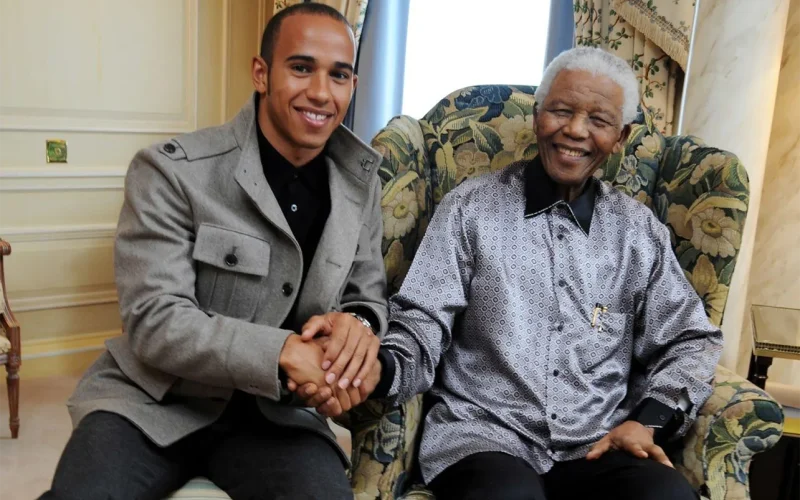
It was June 2008. A fresh-faced, one-time world champion — barely a year into his career at the pinnacle of motor racing — found himself seated at a birthday table in London alongside Bill Clinton, Denzel Washington, and one Oprah Winfrey, celebrating a man Hamilton would later describe as being ‘like God’. The occasion was Nelson Mandela’s 90th birthday celebration, a concert in Hyde Park whose proceeds went toward the late statesman’s 46664 AIDS charity — the number a haunting reference to Mandela’s prisoner designation on Robben Island.
Hamilton, by his own account, walked into the room and felt something shift. The aura, the smile, the silk shirt. He asked the great man for advice. Mandela told him: ‘I’m 90 years old and I’m still learning.’
What Hamilton did not say in public — but what his subsequent career of relentless advocacy has loudly implied — is that somewhere in that evening, between the famous faces and the profound wisdom, a quieter resolution was forming: Formula One had to go back to Africa. And somehow, Hamilton was going to help make it happen.
“I don’t want to leave this sport without having a Grand Prix there. I’m chasing them. They’re setting certain dates; I’m like, Damn, I could be running out of time.”
THE PROMISE, RESTATED
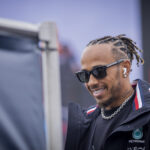
Fast forward to this week, and the Albert Park paddock ahead of the 2026 Formula One season opener in Melbourne. Hamilton, now 41, now a Ferrari driver, now in his 20th season in the sport — and still, apparently, not going anywhere — stood before reporters and delivered what can only be described as a State of the African Grand Prix Address.
He told them he had been ‘fighting in the background’ for six or seven years, lobbying stakeholders, sitting with powerbrokers, asking the question, in his words, ‘Why are we not there?’ He told them he had visited ten countries across the continent. He singled out Rwanda — ‘spectacular’ — and South Africa — ‘stunning’. He mentioned Kenya with the wistful optimism of a man who knows how these things work.
And then, as if the motorsport angle were merely an aperitif, Hamilton broadened the canvas in the way only Hamilton can: he called on African nations to ‘unite and take Africa back’ from its former European colonial masters. ‘Take it back from the French, take it back from the Spanish, take it back from the Portuguese and the British,’ he said, apparently untroubled by the slight irony of a British man issuing the instruction while representing an Italian car manufacturer.
The crowd, one imagines, did not know quite whether they had attended a press conference or a pan-African sovereignty rally. The answer, with Hamilton, is almost always: both.
THE RACE WITHIN THE RACE
The backdrop to Hamilton’s renewed campaigning is, by any measure, genuinely extraordinary. Formula One — a sport that has somehow managed for 33 years to grace every inhabited continent except Africa, despite the continent accounting for 1.4 billion people and a rapidly expanding middle class — is now confronted with a rather embarrassing abundance of suitors.
South Africa, the land of Mandela’s birth, is arguably the sentimental frontrunner. It’s Sports, Arts and Culture Minister Gayton McKenzie, a man whose enthusiasm for this project could power a V10 engine, has declared flatly that a Grand Prix is ‘definitely coming in 2027, no doubt about that.’ His committee is deliberating between two options: the historic Kyalami circuit north of Johannesburg, which last hosted the sport in 1993 and carries the not-inconsiderable distinction of being where Niki Lauda once led a drivers’ strike, and a proposed street circuit through Cape Town, recently anointed the world’s best city by Time Out magazine and apparently keen to remind everyone of the fact.
McKenzie’s government has asked six private firms to pledge a combined $100 million toward the effort and is briefing President Cyril Ramaphosa at regular intervals. ‘Lewis Hamilton,’ McKenzie said with the theatrical confidence of a man who has watched too many motivational sports documentaries, ‘you said you had a dream to race in South Africa. I’m standing here to tell you we will not rest until your dream comes to a realisation.’
Kyalami’s CEO, Toby Venter, for his part, declared the track ‘ninety percent there’, which in the arcane, expensive, and perpetually optimistic language of F1 circuit upgrades, is understood to mean: ‘Bring your chequebook and your patience.’
“Why is it that when it comes to Africa, we are treated like we can only get one? Italy has two Formula One races.”
Rwanda, meanwhile, is making no secret of its ambitions. President Paul Kagame — who has demonstrated a particular fondness for sport as a tool of national branding, with Arsenal, Paris Saint-Germain, and the NBA all bearing his country’s ‘Visit Rwanda’ livery — attended the Singapore Grand Prix in September to meet personally with the FIA and Liberty Media. His country is proposing a $1.2 billion Bugesera mega-circuit, designed by Alexander Wurz’s engineering firm to full FIA Grade 1 specification, with an international airport conveniently nearby.
Rwanda’s bid does, however, carry complications that no paddock presenter has yet managed to address with the breezy confidence of a tyre compound comparison. Its ongoing involvement in the conflict in eastern Democratic Republic of Congo has prompted DR Congo’s foreign minister to write to F1, urging the sport to end talks with Kigali lest its brand be ‘smeared by a blood-stained association.’ Formula One said it was ‘monitoring the situation.’ The sport that races in Bahrain and Azerbaijan — and does so without excessive moral hand-wringing — is presumably monitoring with a high threshold for concern.
Morocco, completing the triumvirate of serious contenders, has assembled a $1.2 billion complex near Tangier — a marina, a hotel, a theme park, a racetrack, and, one presumes, a very good espresso — under the stewardship of Éric Boullier, the former McLaren and French Grand Prix director who is plainly determined to bring Gallic organisational flair to the project. Boullier has the good grace to acknowledge that without governmental approval, ‘it stays on paper’, which is where a great many African infrastructure projects have historically remained. Morocco also has a historical form: it hosted the 1958 Moroccan Grand Prix, making it one of only two African nations — alongside South Africa — ever to have staged a world championship round.
F1’S EMBARRASSING ABSENCE
The statistics, when assembled together, carry a certain accusatory force. Formula One last raced in Africa in 1993 — the year before South Africa’s first democratic elections, the year Alain Prost beat Ayrton Senna to win at Kyalami, the year the world was, if only briefly, paying attention to the right things. Since then, the sport has added Las Vegas. It has added Qatar. It has returned repeatedly to the Gulf states while continental Africa — home to the world’s youngest population, its fastest-growing consumer markets, and an increasingly connected fanbase — has received precisely nothing.
F1 CEO Stefano Domenicali, a man who has honed the art of the diplomatically calibrated statement to a near-competitive level, told Autosport in 2024: ‘We want to go to Africa, but we need to have the right investment, and the right strategic plan.’ That ‘strategic plan’ apparently takes longer to develop than circuits in Saudi Arabia, which materialised with considerable speed once the cheques were presented.
Hamilton, who does not have Domenicali’s diplomatic constraints, has been rather more direct. ‘There’s one on every other continent,’ he said this week. ‘Why not Africa? I know they’re really trying.’
The ‘they’ is doing considerable work in that sentence.
THE GHOST AT THE TABLE
None of this, of course, happens in a vacuum. Mandela died in December 2013 at the age of 95. He never saw Formula One return to the continent he embodied. He never saw a Black driver stand on the top step of a podium — a milestone Hamilton delivered, with characteristic timing, at the 2008 Brazilian Grand Prix, just months after that London birthday party.
Whether Hamilton made Mandela any explicit promise about a Grand Prix that evening in Hyde Park is not recorded. Hamilton has spoken about the advice — the lifelong learning, the grace, the humility — but not, in any public account, about motor racing. The promise, if it exists, appears to live in the space between what was said and what was felt; in the kind of commitment that doesn’t require words because it is simply understood.
What is documented is the trajectory: a young driver meets his hero, absorbs something ineffable about dignity and persistence and the obligation to use one’s platform, and spends the next eighteen years becoming the most vocal advocate in the sport’s history for a race on the continent that shaped so much of who he is. Hamilton has spoken of his Togolese and Beninese ancestry. He has called Africa ‘the most beautiful part of the world.’ He has, with some force and not a little poetry, called it ‘the motherland.’
“That would be amazing, given that I’m half African. They have all the resources to be the greatest and most powerful place in the world.”
The child who went karting in the English Midlands, who was told by his father to ‘never give up’, who shook the hand of the world’s most beloved statesman and received a lesson about the inexhaustibility of learning — that child is now 41, driving a red car for a team that has not won a constructors’ championship since 2008, and holding out the possibility of retirement like a negotiating chip against an entire sport’s administrative apparatus.
‘I’m going to be here for a while until that happens,’ he said this week. One almost imagines Mandela, had he been in the Melbourne paddock, offering a quiet nod of recognition. Still learning, still fighting. Ninety years old and still at it.
THE STARTING GRID
So, where does this leave us, as the 2026 season fires its first ceremonial shot? With four African nations — South Africa, Rwanda, Morocco, Nigeria — variously armed with billions of dollars, presidential mandates, and varying degrees of FIA paperwork. With an F1 CEO who wants Africa but needs ‘the right strategic plan.’ With a governing body that held its 2024 prize-giving ceremony in Kigali and a sport whose commercial owners at Liberty Media have explicitly committed to visiting ‘every continent.’
And with Lewis Hamilton, who will not retire. Not yet. Not until the cars go back.
The South African sports minister has publicly promised him it will happen. The Rwandan president has flown to Singapore to make the case. The Moroccan project manager has vowed to build a theme park and a marina to sweeten the deal. The continent is, in short, trying. Visibly, expensively, sometimes controversially, but unmistakably trying.
It has been 33 years. Mandela’s prisoner number was 46664. The last race was won by a Frenchman in a Williams. The whole story has the quality of something that has been building too long, the tension of a race that somehow hasn’t reached its finish line, a promise made in a silk-shirted room on a summer evening in London that the sport itself doesn’t yet know it is obliged to keep.
Hamilton knows. He has always known.
And he is, as Mandela once advised, still learning — still watching the calendar, still chasing the stakeholders, still waiting for the dates to align. A man who has won 103 races and seven world championships, who has redefined what Formula One can look like and who it can belong to, left with one item still unchecked on the ledger.
He will be there when it happens. He has said so. And in the strange, thunderous, glamorous, occasionally absurd world of Formula One, when Lewis Hamilton says something with that particular quality of quiet certainty, it tends, eventually, to come true.