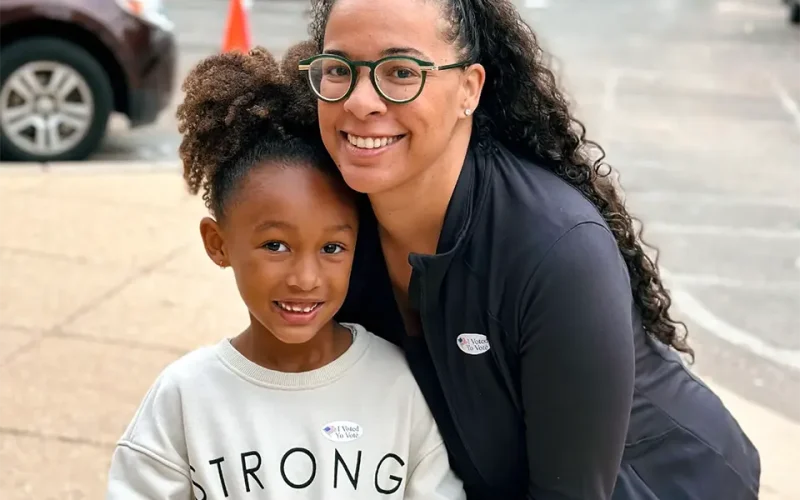
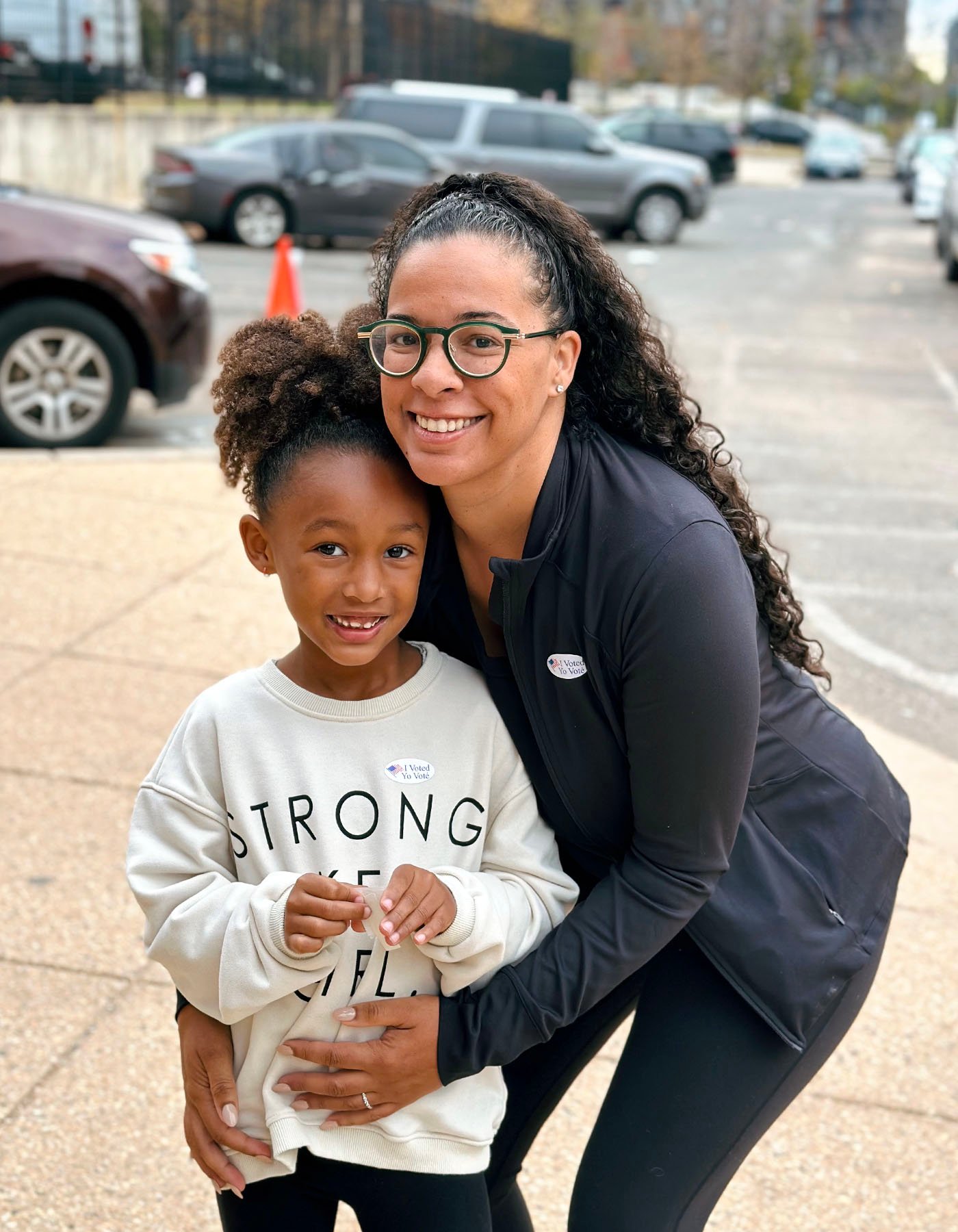
JUST as she’d done as a little girl with her mom, Elle Arlook walked up to a voting precinct in Washington, D.C., Tuesday morning — but this time with her own daughter, 6-year-old Mariama.
She counted six other moms with their daughters already in line.
Arlook’s mother, Karen Nussbaum, was the head of the Department of Labor’s Women’s Bureau in the Clinton administration and an ardent labour leader who brought little Elle to picket lines and ballot boxes. “I always got my sticker,” said Arlook, who works in diversity, equity and inclusion. Now a mother of two, this was Arlook’s first time taking one of her girls.
As they waited, she explained to Mariama the importance of registering to vote and walked her through the process. Mariama has been asking questions in recent weeks about the candidates, including about former President Donald Trump.
“There’s a lot of people that are having a really hard time, and they tend to vote for people that they think are speaking to them, and he speaks to a lot of people. It’s an important perspective to understand,” Arlook told her in the lead-up to Election Day. “Our job is to figure out: How do we get everybody talking together?”
Inside the polling booth Tuesday, Mariama stood with Arlook as she selected Kamala Harris’ name on the screen. Mariama fed the ballot into the machine when they were done.
Like many other parents who are voting with their kids in tow on Tuesday, Arlook’s vote was for her kids.
Arlook is supporting Harris because she believes the candidate is pushing “policies that feel like the average person is going to feel the impact of them.” She cited Harris’ proposal to tamp down on corporations that price gouge on grocery items, as well as her support for expanding reproductive rights.
This is the first election where politicians are starting to speak more directly to the needs of caregivers and addressing the high cost of being a parent in the United States. Issues like inflation and its impact on family budgets have taken on added urgency for caregivers in the four years since the last presidential election cycle. And abortion is expected to be a powerful motivator that drives decisions for many women this presidential election, the first since Roe v. Wade was overturned. Abortion access is on the ballot in 10 states this year.
It’s also the first election where a Black woman is at the top of the presidential ticket. Arlook couldn’t help but get choked up when she thought about the symbolism behind her vote.
She told Mariama: ‘This is the first time in my life, or in anybody’s life, we’ve been able to vote for somebody that looks like you and me. Who is Brown like us and has a kind of funny-sounding name like yours,’”
Mariama got her sticker — and one for her little sister — and stuck it to her sweatshirt, which bore the words: “Strong like a girl.”
In Atlanta on Friday, doctoral student Victoria Lindsay and her 9-year-old daughter, Lindsay Marie, got their long-awaited stickers, decorated with a Georgia peach in the middle, at a library on the east side of Atlanta. Lindsay wore her green-and-pink Alpha Kappa Alpha sweatshirt, honouring the sorority that also boasts Harris as a member.
A few weeks ago, her daughter had the opportunity to meet Harris and former President Barack Obama during an event in Dekalb County.
“It’s extremely important that she sees history in the making,” Lindsay said. “Lindsay’s been with me throughout my accomplishments — she was right alongside me as I finished my bachelor’s, my master’s, and now, my Ph.D program.
“It only seems fitting to have her be a part of something so important to all of us.”
It was lucky for Laura Klarich, really, that Election Day lands on a Tuesday — it’s one of the only days in the week that she’s not working part-time as a marketing consultant. Mid-morning, with her 18-month-old daughter, Olivia, in a stroller, she waited in an hourlong line to vote at a local church in the suburbs of Columbus, Ohio. She got the idea to vote with her baby from another mom she knows who took her child to vote in a wearable carrier last year. Klarich thought she could also show someone it’s possible to do both: be a parent and be a voter.
Klarich wants people to “see more moms out and about bringing their kids and realize this is allowed — it’s even encouraged — to show the next generation how to participate,” she said.
Klarich recently started working part-time in an effort to regain some work-life balance. She was working up to 70 hours a week as a marketing director, a job that was keeping her from Olivia and her 4-year-old, Mya. After she went part-time, Klarich had to cut back on daycare for her youngest to manage the cost.
When she voted for Harris this morning, it was not because she had heard a “great fix-all solution” on child care from the vice president, who has given only a few details on how she’d tackle the larger issue outside of repeatedly expressing support for a federal solution, but because Klarich feels Harris “is trying harder to understand the actual core issues for people like me.”
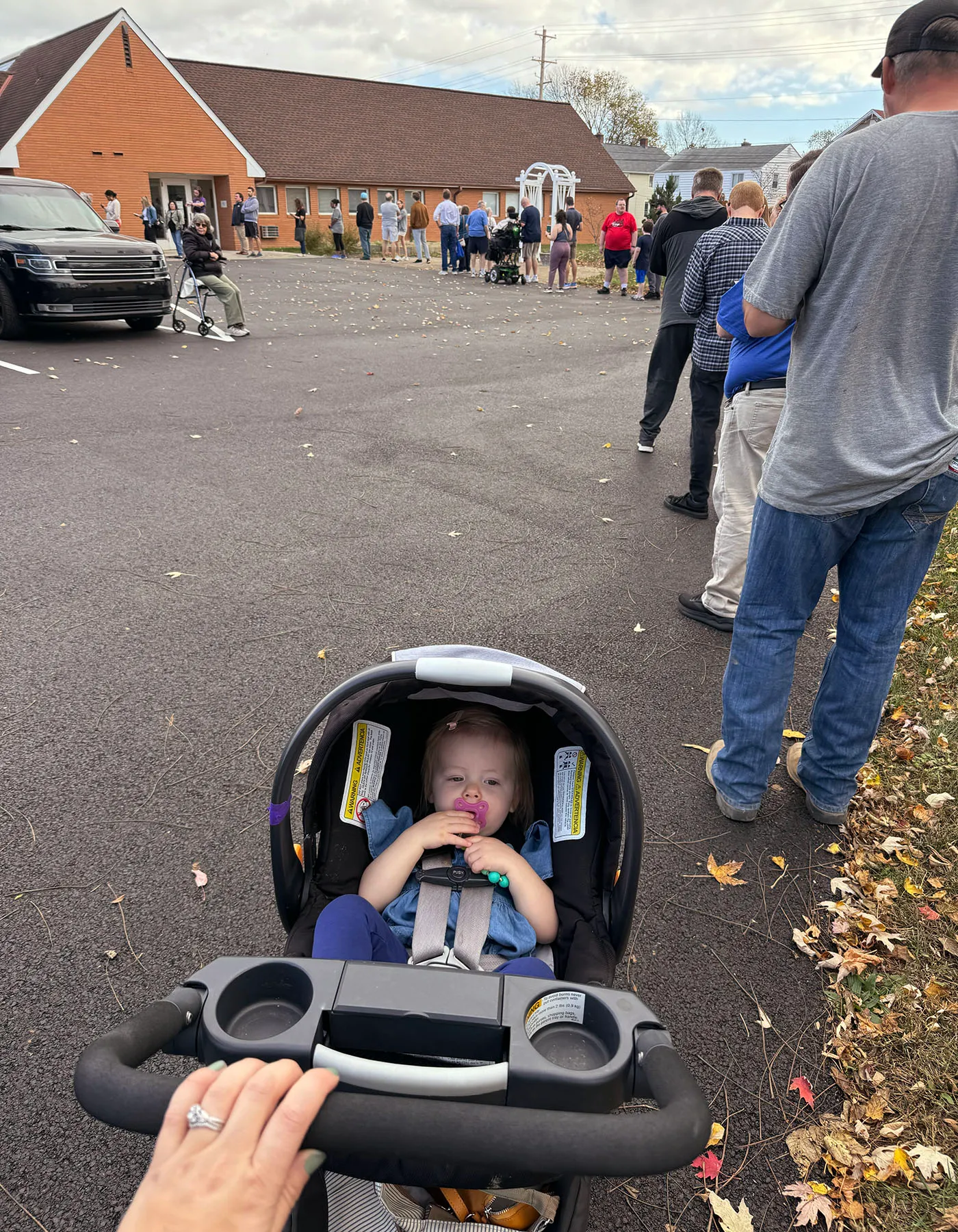
Reaching caregiver voters like Klarich has been a challenge in the past because politicians have routinely struggled to speak to the difficulties of raising children in America — and have rarely felt the need to. As a result, caregivers are one of the largest groups of non-voters in the country. So while some parents who turned out Tuesday did it for personal or symbolic reasons, others did it because they had no choice — schools were closed or they had no child care.
Witnessing a presidential cycle where candidates have taken the realities of the country’s childcare crisis seriously has been remarkable for Deanna Jhaveri, a writer who has spent the past couple of months speaking to moms through the South Bay Area chapter of Chamber of Mothers, a nonpartisan group advocating for moms. Jhaveri started the chapter in July; some moms drive an hour and a half to attend. They talk about childcare a lot.
“It makes women feel so unseen. These women are working at Apple and Facebook and Google, literally, and they’re thinking, ‘How can I have another child?’ That’s crazy,” Jhaveri said.
She brought her 3-year-old son along with her to vote Tuesday at a Buddhist temple, a precinct near her home in Palo Alto. Jhaveri feels “very anxious, but also very hopeful because we have seen candidates be asked about child care and paid leave and maternal health in ways they’ve never been asked before, which proves these conversations are working.”
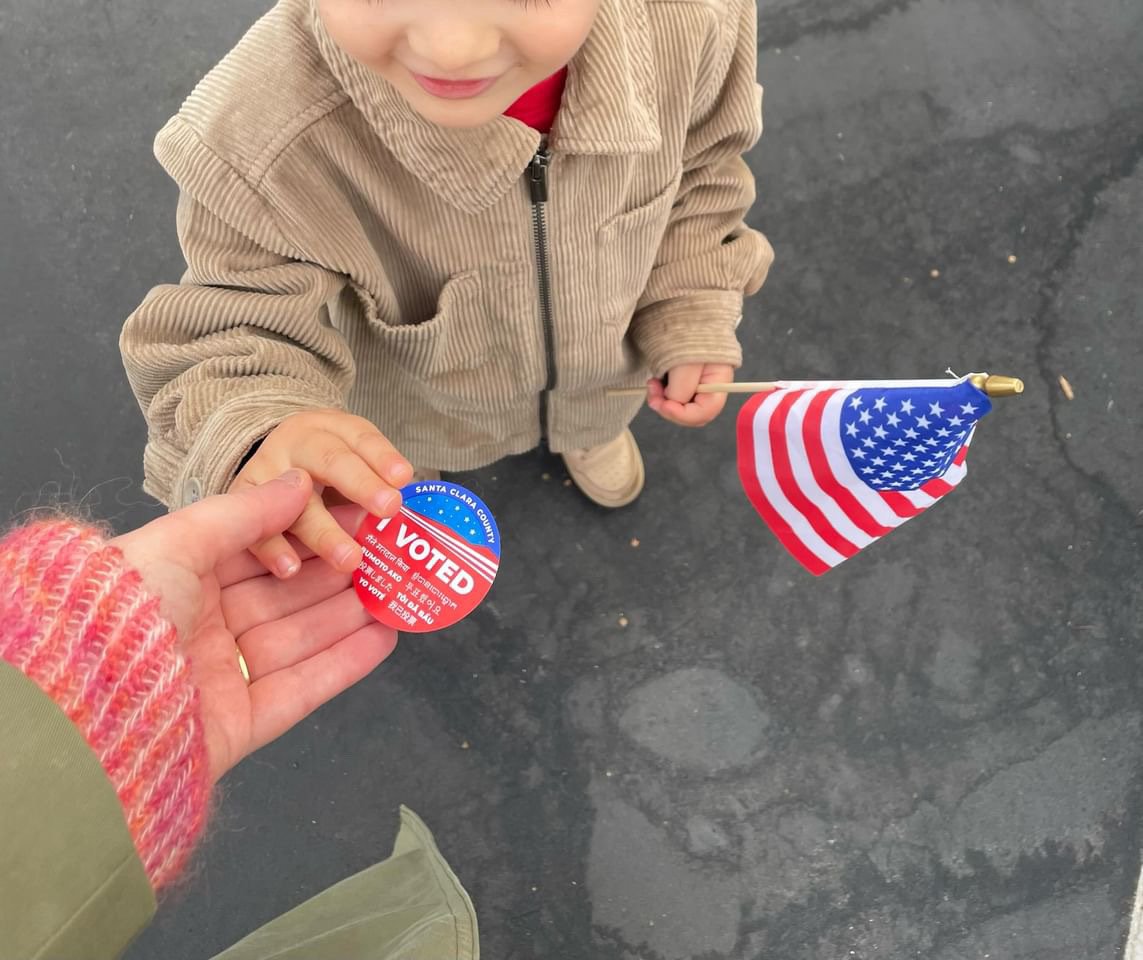
Jhaveri said it also felt important to her to have her son there when she voted for those values, particularly when it comes to reproductive freedom and supporting a candidate who has vowed to expand access to abortion care. Jhaveri voted for Harris.
When her son hit the “cast” button on the ballot machine, the poll workers cheered.
“I want my son to see me in places of power and that includes at the ballot box,” she said. “And I want my son to see me using my vote, not only for him, but for me. I think as mothers we always go to: ‘We are voting for a better future for our children,’ and I think that’s always true. But I’m also voting for a better future for me.”
When he arrived, the newborn dressed as a silver ballot box drew the admiration of just about everyone at a voting precinct in the suburbs of Chicago on Monday, the last day of early voting there. Edward is just 8 weeks old, but his mom wouldn’t have let him miss his first election — even if it meant standing in line for an hour and a half. It was a pretty irresistible photo op.
Eleanor Grano has spent two years navigating infertility, enduring five rounds of in vitro fertilization and a miscarriage before she had her little boy. She did it while working as a communications professional for abortion funds in Texas and Illinois.
Over the past several years, Grano has experienced the duality of choice when it comes to reproductive rights in America. Her own choice to become a mother; others’ choice to not. In Texas, so much of that choice was stripped: The state put a ban on abortion after six weeks — before many people realize they are pregnant — in 2021.
Grano doesn’t agree with Harris on everything, but she believes Harris will work to protect reproductive care and Trump would likely further claw it back. On a personal level, that will only make her job harder. Living without the anxiety that another Trump term is all but certain to bring to her work will allow her to be there for her child more, she said.
“It’s going to help me be a better parent,” Grano said.
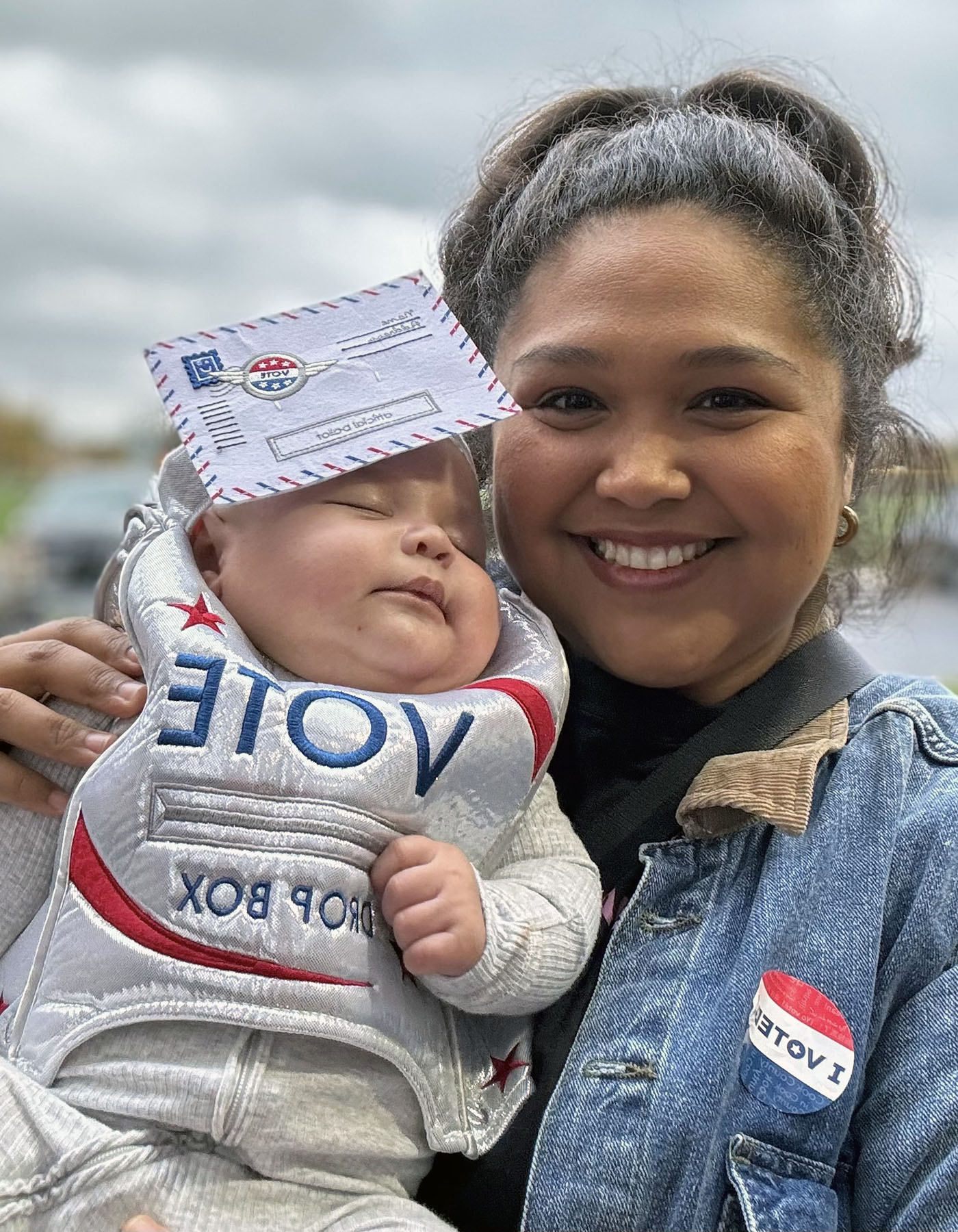
For her, it only made sense, then, to have her son there, the word “vote” embroidered across the front of his costume, as she filled in the bubble next to Harris’ name and in support of a state ballot referendum gauging public interest to even further expand IVF coverage in Illinois.
Maybe one day Edward will come to treasure the photos of him as a little ballot box on Election Day 2024.
“I hope he’ll look back at it and be excited,” she said, “that his parents were so involved in getting out to vote.”
For now, though, Edward mostly slept in his stroller.
Eden Turner, Marissa Nelson and Grace Panetta contributed to this story.