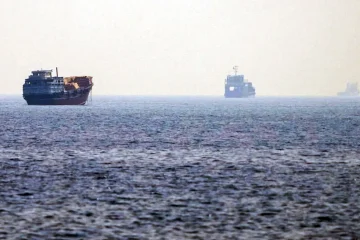
PRESIDENT Donald Trump has announced a total blockade of all sanctioned oil tankers entering or leaving Venezuela, while designating the government of Nicolás Maduro as a foreign terrorist organisation.
“Venezuela is completely surrounded by the largest Armada ever assembled in the History of South America,” Trump wrote on Truth Social. “It will only get bigger, and the shock to them will be like nothing they have ever seen before.”
The president demanded that Venezuela return what he characterised as stolen U.S. assets. “Until such time as they return to the United States of America all of the Oil, Land, and other Assets that they previously stole from us,” Trump wrote in his post.
Trump accused the Maduro government of using oil revenue to fund criminal activity. “The illegitimate Maduro Regime is using Oil from these stolen Oil Fields to finance themselves, Drug Terrorism, Human Trafficking, Murder, and Kidnapping,” he stated.
“Therefore, today, I am ordering A TOTAL AND COMPLETE BLOCKADE OF ALL SANCTIONED OIL TANKERS going into, and out of, Venezuela,” Trump declared in capital letters.
Deadly Boat Strikes Precede Blockade
The blockade announcement comes amid a controversial U.S. military campaign that has killed at least 95 people in strikes on 26 vessels since September. The U.S. began deploying Navy warships and personnel to the Caribbean in mid-August, with Trump announcing the first airstrike on September 2 that killed all 11 people aboard.
The first attack involved more than one strike, including one that killed survivors of the initial attack, prompting Democratic lawmakers and human rights groups to accuse the administration of war crimes.
Trump has defended the strikes as necessary to combat drug trafficking. “We’ve taken a very hard stand on drugs…the water drugs—the drugs that come in through water, they’re not coming—there are no boats anymore, frankly, there are no fishing boats, there’s no boats out there period,” Trump told Canadian Prime Minister Mark Carney in October.
The administration designated several Latin American criminal organisations as foreign terrorist organisations, claiming this gives it legal authority for military action. However, UN experts rejected that label as justification, stating the attacks “do not appear to have been conducted within the context of national self-defence” and violate international human rights and maritime law.
Legal and Congressional Concerns
Congress has not authorised the use of military force against Venezuela, and the 60-day deadline under the War Powers Resolution expired a month ago. Both the Senate and House Armed Services Committees have opened bipartisan investigations into the circumstances of the first attack.
The move comes less than a week after U.S. forces seized an oil tanker called the Skipper in waters near Venezuela. That vessel was carrying an estimated 1.8 million barrels of oil.
Venezuela slammed the announcement, calling it “a reckless and serious threat” and saying the action violates international law. The Maduro government said it plans to denounce the blockade before the United Nations.
Legal experts note that under international law, a blockade is considered a belligerent act that is ordinarily justified only if a state of war exists. The symbolic weight of the massive U.S. naval presence, which includes the USS Gerald R. Ford aircraft carrier, means any resolution that does not lead to Maduro’s ouster could be seen as a setback for U.S. power and Trump’s prestige.