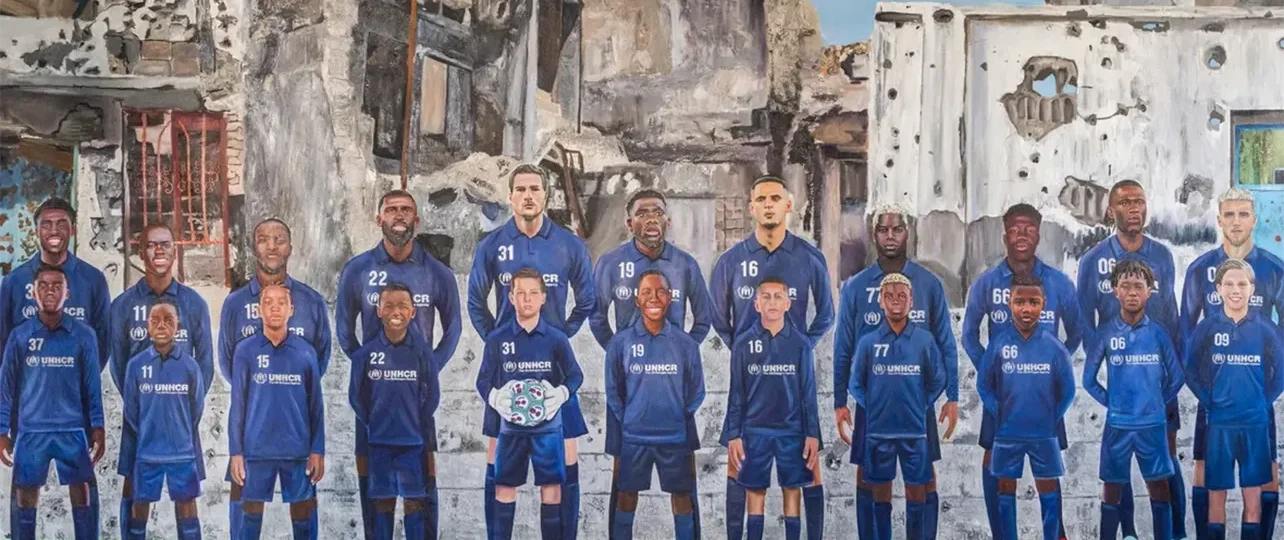

WHEN the 2026 FIFA World Cup spilled into stadiums across Canada, Mexico and the United States, it did more than stage the planet’s biggest football party. In a quieter corner of Manhattan, at the UN Visitors Lobby, the UN Refugee Agency turned the tournament’s glare toward another pitch: one where displacement, resilience and possibility meet.
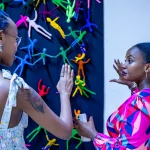
Uprooted to Unstoppable, a three-by-two–metre mural by Vancouver artist and former player Carling Jackson, arrived at the United Nations just as the World Cup opened. It does what strong public art must — it stops you, forces you to look and then insists you look again. Painted with the sweep and colour of sports posters but haunted by the grey silhouettes of war and flight, Jackson’s mural lines up UNHCR’s symbolic “Gamechanging Team”: eleven footballers whose childhoods were shaped by forced displacement. Their adult selves stand in uniform on the pitch; their younger selves stand before them, a visual echo of what they escaped and what they became.
The Gamechanging Team, announced by UNHCR on World Football Day in May, reads like a catalogue of football’s modern migration stories. Alphonso Davies — the team’s captain, UNHCR Goodwill Ambassador and Canada national team leader who was born in a Ghanaian refugee camp after his Liberian parents fled war — occupies centre stage in both the mural and the campaign. Around him are players whose biographies compress continents and conflicts: Germany’s Antonio Rüdiger, the son of parents who fled Sierra Leone; Asmir Begović, Ali Al‑Hamadi, Eduardo Camavinga, Victor Moses, Mohamed Touré, Awer Mabil, Nestory Irankunda, Bernard Kamungo and Ermedin Demirović. Many of them would go on to appear on World Cup rosters, their presence on the global stage amplifying a message that is by now impossible to ignore — elite sport and forced migration are entangled stories of our era.
That entanglement is exactly what Jackson set out to capture. At the exhibition opening, she described the mural as “football’s emotional archive,” a deliberately literal pairing of who these players were and who they became. The children painted before the athletes are not mere backstory; they are claims — on memory, on identity, on better futures won by grit and, crucially, by access to opportunity. In Jackson’s rendering, the pitch becomes a site of refuge as much as a site of triumph. War and displacement form the backdrop, but the foreground is insistently expansive: football as freedom, as community, as a second home.
The UNHCR campaign around the Gamechanging Team is not decorative. It sits amid an escalating global crisis: more than 117 million people were forcibly displaced worldwide at the latest count. UNHCR’s message — illustrated by the mural, a short film commissioned from Upperfast, and explanatory boards at the exhibit — is straightforward and strategic: sport, properly structured, can be a protection tool. Their Sports for Protection programmes operate in camps and cities across more than 15 countries, engaging over 70,000 people with safe sport, coaching, psychosocial support and links to services. For journalists and policymakers, that data point matters. It reframes football from an entertainment behemoth to an instrument for social cohesion, child protection and psychosocial recovery in contexts that aid workers know are desperately short of resources.
There is also a political image-management element to the project. The sight of refugees and their children on billboards, in stadiums and on UN walls humanises a subject often reduced to statistics or securitized rhetoric. The Gamechanging Team initiative leverages star power not simply to inspire but to pressure: these athletes are not just success stories; they are advocates calling for safety and opportunity for displaced children everywhere. Their stories complicate simplistic narratives about migration and integration — showing instead how investment, welcome policies and access to sport and education can turn vulnerability into social contribution.
Still, art and celebrity alone will not fix structural deficits in asylum systems, humanitarian funding or host-community support. The mural is a provocation and an invitation: to spectators inside the UN and to millions following the World Cup, it poses the question of scale. If football — with its global money flows, huge audiences and local clubs — can open doors for some displaced youngsters, what would it take to scale those mechanisms across the millions who remain excluded?
For editors and editors’ readers covering the tournament, the UNHCR exhibit offers a narrative through-line that connects the pomp of the World Cup with the less glamorous work of protection. It is an accessible, human story that carries policy stakes: testimonies of displaced athletes, the locations and reach of sports-for-protection programming, and the raw numbers of those still uprooted.
Practical resources accompanying the exhibition make follow-up reporting straightforward. UNHCR has published images of Carling Jackson’s Gamechanging XI, released a short film about the team, and posted bios and contact points for interviews with the agency and the artist. Those materials allow reporters to move beyond the mural and into reporting on program outcomes, athlete advocacy and the broader humanitarian picture.
In short, while the world’s attention was fixed on goals and group tables, UNHCR’s Uprooted to Unstoppable reframed a different scoreboard: one that measures safety, opportunity and the power of sport to remap lives. The mural will not solve displacement, but it has done what it needed to do in the middle of the World Cup: it made millions of football fans confront the human cost that often shadows the beautiful game — and, crucially, imagine how that game can be part of the solution.
For images, the short film and interview requests, UNHCR provided media contacts in London, New York and Ottawa and posted digital images and the film online at their Gamechanging Team pages and media folder.