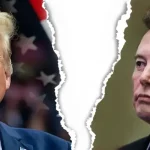
IN America’s unpredictable political landscape, few could have foreseen the power dynamics unfolding between two polarising figures: President-elect Donald Trump and billionaire Elon Musk. Both men, larger-than-life and brimming with confidence, now find themselves in a subtle, tense dance over who truly holds the reins of power in Washington, D.C.
This drama, fueled by ego, influence, and timing, has sparked fierce debate: Is Donald Trump—the “comeback kid” and twice-elected commander-in-chief—still the most powerful man in American politics? Or has the world’s richest man become the true shadow president, steering the nation’s agenda through his unmatched wealth and social media influence?
Musk’s Rise to Political Dominance
Elon Musk, the enigmatic founder of Tesla and SpaceX, has transcended his role as business mogul to become an unelected power broker. Democrats, mixing awe with exasperation, have taken to calling him “President Musk,” a moniker both scathing and telling.
Last week, Musk demonstrated his influence by single-handedly derailing a bipartisan budget bill. Posting at 4 a.m. on X, he called the bill “criminal” and urged Republicans to “kill the bill.” His words ignited a wildfire, with Republican lawmakers quickly falling in line. By day’s end, the bill was dead, plunging the country toward a government shutdown days before Christmas.
The speed and scope of Musk’s impact left many stunned. While Washington had long debated the influence of special interests in politics, here was Musk openly dictating terms. His bold moves led Representative Jim McGovern to quip, “He’s president, and Trump is now vice president.”
Trump: A President in the Shadows?
For Donald Trump, who returns to the White House in January, Musk’s growing dominance presents both opportunity and challenge. While Musk is a key ally, appointed to head the newly formed Department of Government Efficiency (DOGE), his outsized influence risks overshadowing the president himself—a notion Trump is unlikely to tolerate.
Trump’s reaction to the budget crisis proved telling. Though he echoed Musk’s criticisms, calling the bill “ridiculous and extraordinarily expensive,” his statements felt derivative rather than decisive. It was Musk’s voice that Republicans in Congress heeded. Even more striking was Musk’s celebratory post afterward: a patriotic self-portrait with the phrases “VOX POPULI” and “VOX DEI”—clearly positioning himself as the people’s voice.
A Nation Divided
The Musk-Trump dynamic has thrust Washington into uncharted territory. Democrats seek to exploit any rift between the powerhouses, with Senator Bernie Sanders lamenting, “The richest man on Earth doesn’t like our bipartisan deal. Will Republicans kiss the ring?”
Republicans find themselves torn between loyalty to Trump and reverence for Musk’s influence. Representative Dan Bishop embraces this shift, calling it a “fundamental change in the dynamic.” Others quietly wonder whether Musk’s dominance might eventually threaten Trump himself.
Who’s Really in Charge?
As America prepares for Trump’s return to office, one question looms: Who’s really in charge? Is Trump, the seasoned political brawler, still the undisputed leader of his party? Or has Musk, with his billions and boundless ambition, emerged as the de facto commander-in-chief?
The answer remains unclear, but one certainty emerges: The new era of American politics will be shaped by this uneasy alliance—and potential rivalry—of titans. Whether they clash or collaborate, the Trump-Musk dynamic promises to reshape not only the Republican Party but the very nature of power in the United States.
In this battle of egos and agendas, the stakes couldn’t be higher. As Musk might say: “The voice of the people has spoken.” But whose voice will echo loudest in the halls of power remains to be seen.