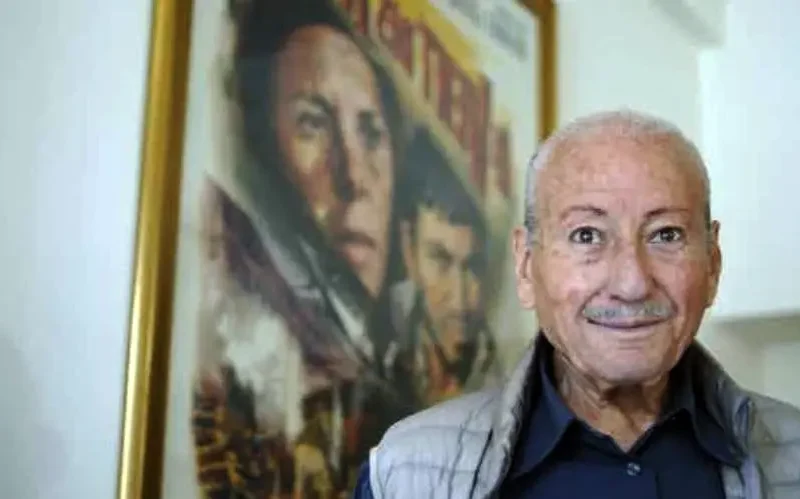
THE lights have dimmed forever on one of Africa’s greatest cinematic voices as Mohamed Lakhdar-Hamina, the legendary Algerian filmmaker who shattered barriers and rewrote the rules of global cinema, died at his home in Algiers at age 91.
In a moment of poetic symmetry that would have suited one of his own films, Lakhdar-Hamina’s death on May 23 coincided with a special Cannes Classics screening of his masterpiece Chronicles of the Years of Fire—the film that made him the first and only African director to claim the festival’s coveted Palme d’Or nearly five decades ago.
From Desert Warrior to Cinema’s Prophet
Born in 1934 in M’Sila under the iron fist of French colonial rule, Lakhdar-Hamina’s path to cinematic immortality began not with cameras but with conviction. The young man who would one day command the world’s attention at Cannes first picked up arms against oppression, deserting the French army in 1958 to join Algeria’s bloody fight for independence.
It was in exile, working with Algeria’s provisional government in Tunisia, that he discovered cinema’s revolutionary power—not just to entertain, but to liberate minds and preserve the memory of a people’s struggle.
“This is a film against injustice, against humiliation,” he once declared, words that became the manifesto for a career that would span six decades and reshape how the world saw African storytelling.
Building a Nation’s Dreams, Frame by Frame
When Algeria won its independence in 1962, Lakhdar-Hamina became one of the founding architects of the nation’s cinema, wielding his camera like a poet’s pen to chronicle the scars and triumphs of decolonisation.
His 1966 debut feature, The Winds of the Aurès, struck like lightning at Cannes, winning the Best First Work Award and establishing him as a force majeure in world cinema. The film’s haunting portrait of a mother searching for her imprisoned son during the independence war became a cornerstone of Algerian cinema—raw, unflinching, and blazingly authentic.

But it was Chronicles of the Years of Fire in 1975 that would etch his name in cinema history forever. This sweeping epic, told through the eyes of a peasant farmer, didn’t just win the Palme d’Or – it obliterated every stereotype about African filmmaking, proving that stories from the continent could command global stages and universal recognition.
The Revolutionary’s Lens
Lakhdar-Hamina’s genius lay in his ability to transform political urgency into cinematic poetry. Drawing from Soviet cinema, Italian Neorealism, and Expressionism, he forged a distinctly African visual language that gave mythic dimensions to his people’s struggles.
His films weren’t just entertainment—they were acts of cultural warfare against colonial amnesia. Works like Sandstorm (1982) and Hassan Terro (1986) continued to probe the complexities of post-independence Algeria, never allowing audiences to look away from uncomfortable truths.
Africa’s Cinematic Prophet
Beyond his own extraordinary filmography, Lakhdar-Hamina became the standard-bearer for the Third World Cinema movement, championing independent, anti-imperialist storytelling across Africa, Asia, and Latin America. He didn’t just make films—he helped build an entire industry, mentoring new generations of filmmakers and proving that African stories deserved global audiences.
His Palme d’Or victory remains a solitary summit—no other African director has scaled those heights since, making his achievement both a triumph and a challenge to future generations.
An Immortal Legacy
As news of his death reverberates through film festivals and screening rooms from Ouagadougou to Cannes, Mohamed Lakhdar-Hamina’s legacy burns brighter than ever. His films remain essential viewing for anyone seeking to understand the intersection of art and resistance, the power of cinema to preserve memory, and the dignity of the oppressed.
In an era when African stories are finally finding their rightful place on global screens, Lakhdar-Hamina stands as the pioneer who first proved it was possible. He didn’t just open doors—he demolished walls.
The boy from M’Sila who traded his rifle for a camera has left us, but his revolutionary vision lives on in every African filmmaker who dares to dream on the world stage. In the end, perhaps that’s the greatest tribute to this godfather of African cinema—that his light continues to illuminate paths for those who follow.
Cinema has lost a giant. Africa has lost a voice. But the revolution he started with each frame he captured will echo through generations yet to come.