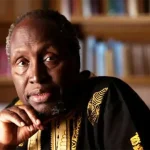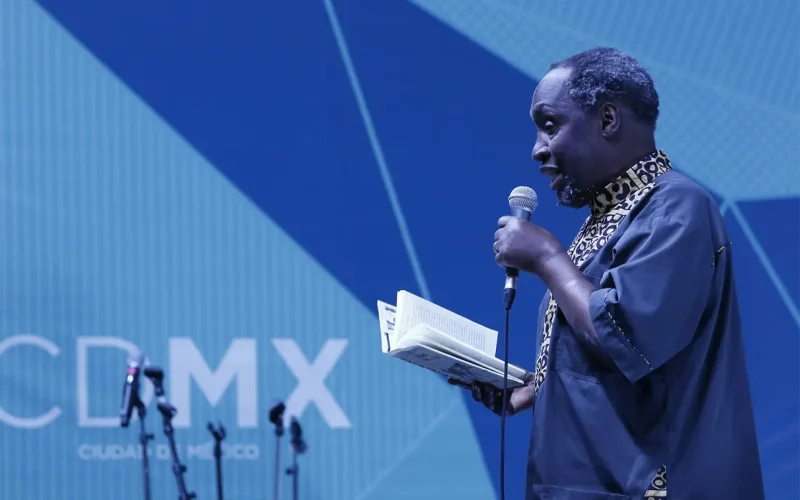
CELEBRATED Kenyan writer and decolonial scholar Ngugi wa Thiong’o passed away on 28 May at the age of 87. Many tributes and obituaries have appeared across the world, but we wanted to know more about Thiong’o, the man and his thought processes. So we asked Charles Cantalupo, a leading scholar of his work, to tell us more.
Who was Ngugi wa Thiong’o – and who was he to you?
When I heard that Ngugi had died, one of my first thoughts was about how far he had come in his life. No African writer has as many major, lasting creative achievements in such a wide range of genres as Ngugi wa Thiong’o. His books include novels, plays, short stories, essays and scholarship, criticism, poetry, memoirs and children’s books.
His fiction, nonfiction and plays from the early 1960s until today are frequently reprinted. Furthermore, Ngugi’s monumental oeuvre is in two languages, English and Gikuyu, and his works have been translated into many other languages.
From a large family in rural Kenya and a son of his father’s third wife, he was saved by his mother’s pushing him to be educated. This included a British high school in Kenya and Makerere University in Uganda.
When the brilliant young writer had his first big breakthrough at a 1962 meeting in Kampala, the Conference of African Writers of English Expression, he called himself “James Ngugi”. This was also the name on the cover of his first three novels. He had achieved fame already as an African writer, but, as is often said, the best was yet to come.
Not until he co-wrote the play I Will Marry When I Want with Ngugi wa Mirii was the name “Ngugi wa Thiong’o” on the cover of his books, including on the first modern novel written in Gikuyu, Devil on the Cross (Caitaani Mutharaba-ini).
I Will Marry When I Want was performed in 1977 in Gikuyu in a local community centre. It was banned, and Ngugi was imprisoned for a year.
And still so much more was to come: exile from Kenya, professorships in the UK and US, book after book, fiction and nonfiction, myriad invited lectures and conferences all over the world, a stunning collection of literary awards (with the notable exception of the Nobel Prize for Literature), honorary degrees, and the most distinguished academic appointments in the US, from the east coast to the west.
Yet besides his mother’s influence and no doubt his own aptitude and determination, if one factor could be said to have fuelled his intellectual and literary evolution – from the red clay of Kenya into the firmament of world literary history – it was the language of his birth: Gikuyu. From the stories his mother told him as a child to his own writing in Gikuyu for a local, pan-African and international readership. He provided every reason why he should choose this path in his books of criticism and theory.
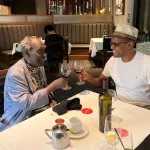
Ngugi was also my friend for over three decades – through his US professorships, to Eritrea, to South Africa, to his finally moving to the US to live with his children. We had an ongoing conversation – in person, during many literary projects, over the phone and on the internet.
Our friendship started in 1993, when I first interviewed him. He was living in exile from Kenya in Orange, New Jersey, where I was born. We both felt at home at the start of our working together. We felt the same way together through the conferences, books, translations, interviews and many more literary projects that followed.
What are his most important works?
Since Ngugi was such a voluminous and highly varied writer, he has many different important works. His earliest and historical novels like A Grain of Wheat and The River Between. His regime-shaking plays.
His critical and controversial novels like Devil on the Cross and Petals of Blood. His more experimental and absolutely modern novels, like Matigari and Wizard of the Crow.
His epoch-making literary criticism, like Decolonising the Mind. His informal and captivating three volumes of memoirs were written later in life. His retelling in poetry of a Gikuyu epic, The Perfect Nine, is his last great book. A reader of Ngugi can have many a heart’s desire.
My book, Ngugi wa Thiong’o: Texts and Contexts, was based on the three-day conference of the same name that I organised in the US. At the time, it was the largest conference ever held on an African writer anywhere in the world.
What I learned back then applies now more than ever. There are no limits to the interest that Ngugi’s work can generate anytime, anywhere, and in any form. I saw it happen in 1994 in Reading, Pennsylvania, and I see it now, 30 years later, in the outpouring of interest and recognition all over the world at Ngugi’s death.
In 1993, he published a book of essays titled Moving the Centre: The Struggle for Cultural Freedoms. Focusing on Ngugi’s work, the conference and the book were “moving the centre” in Ngugi’s words, “to real creative centres among the working people in conditions of gender, racial, and religious equality”.
What are your takeaways from your discussions with him?
First, African languages are the key to African development, including African literature. Ngugi comprehensively explored and advocated this fundamental premise in over 40 years of teaching, lectures, interviews, conversations and throughout his many books of literary criticism and theory. Also, he epitomised it, writing his later novels in Gikuyu, including his magnum opus, Wizard of the Crow.
Moreover, he codified his declaration of African language independence in co-writing The Asmara Declaration, which has been widely translated. It advocates for the importance and recognition of African languages and literatures.
Second, literature and writing are a world and not a country. Every single place and language can be omnicentric: translation can overcome any border, boundary, or geography and make understanding universal. Be it Shakespeare’s English, Dante’s Italian, Ngugi’s Gikuyu, the Bible’s Hebrew and Aramaic, or anything else, big or small.
Third, on a more personal level, when I first met Ngugi, I was a European American literary scholar and a poet with little knowledge of Africa and its literature and languages, much less of Ngugi himself. He was its favourite son. But this didn’t stop him from giving me the idea and making me understand how African languages contained the seeds of an African Renaissance if only they were allowed to grow.
I knew that the historical European Renaissance rooted, grew, flourished and blossomed through its writers in European vernacular languages. English, French, German, Italian, Spanish and more took the place of Latin in expressing the best that was being thought and said in their countries. Yet translation between and among these languages as well as from classical Latin and Greek culture, plus biblical texts and cultures, made them ever more widely shared and understood.
From Ngugi discussing African languages, I took away a sense that African writers, storytellers, people, arts, and cultures could create a similar paradigm and overcome colonialism, colonial languages, neocolonialism and anything else that might prevent greatness.
Charles Cantalupo, Distinguished Professor Emeritus of English, Comparative Literature, and African Studies, Penn State
- This article is republished from The Conversation under a Creative Commons license. Read the original article.