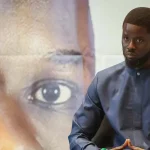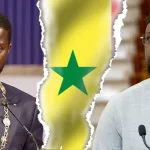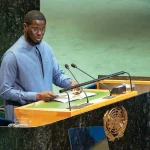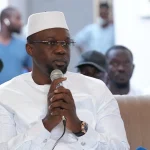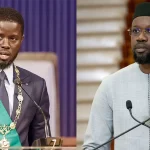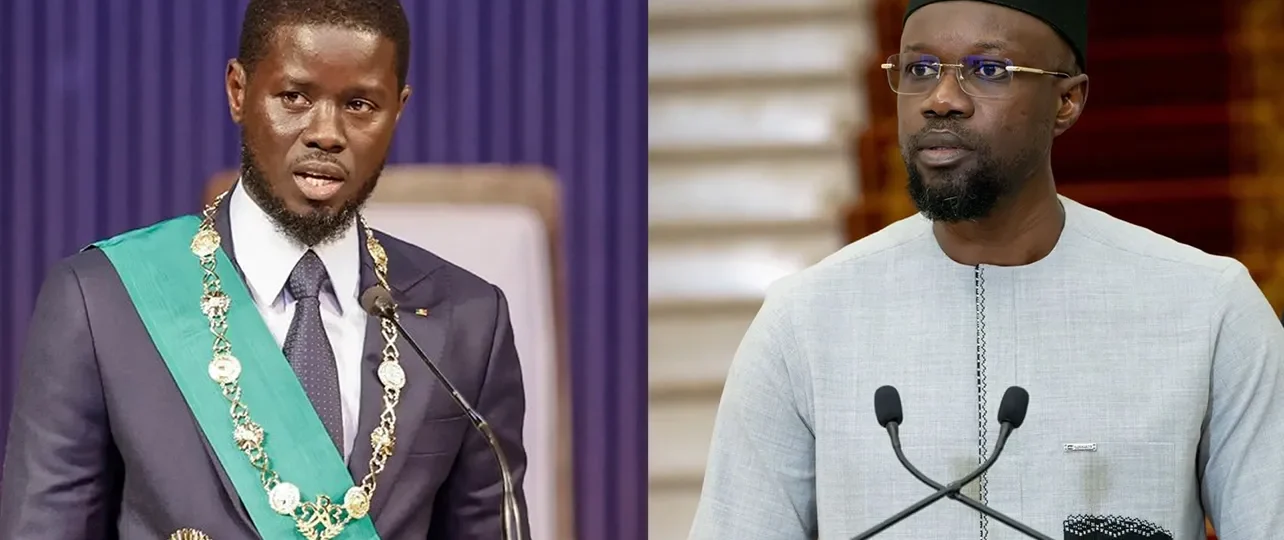

SENEGAL has entered a constitutional crucible of its own making. In the space of days, the West African nation has lurched from promising democratic reformism to a full-blown political war between two men who once personified its hope – a young president and the revolutionary who made him, now facing each other across the barricades of the republic they vowed to transform.
President Bassirou Diomaye Faye has sacked his Prime Minister, Ousmane Sonko. In any other political context, that sentence would be unremarkable – presidents sack prime ministers. In Senegal today, it is seismic. Sonko was not merely Faye’s premier. He was, by almost universal reckoning, Faye’s political godfather: the galvanising force behind the PASTEF opposition movement that swept both men into power on a tide of popular fury against the Macky Sall establishment. The slogan ‘Diomaye is Sonko’ was not a metaphor. It was a constitutional fact of political life.
That brotherhood is now shattered. And Sonko, characteristically, has no intention of going quietly.
| The man Faye just fired could end up running parliament and checking the president from the other side of the board. King vs. former kingmaker. |
The Gambit: Turning Parliament into a Weapon
Sonko’s response to his dismissal has been swift, calculated, and – depending on whom you ask – either constitutionally audacious or constitutionally impossible. PASTEF, his party, still commands a majority in the National Assembly. On Saturday, the Assembly’s Speaker, El Malick Ndiaye, announced his resignation, clearing the runway. The parliament has been convened for Tuesday, 26 May, with two items on the agenda: the reinstatement of Sonko’s parliamentary seat – suspended since 2022 – and the election of a new Speaker.
The arithmetic of the manoeuvre is not subtle. Sonko, as Speaker of the National Assembly, would become, under Senegal’s constitutional architecture, the second most powerful figure in the republic. He would preside over the legislature that checks the executive. The man Faye fired would become, institutionally, his permanent adversary – with the power of the parliament behind him.
In his resignation statement, Ndiaye was measured, almost elegiac. “At the moment I leave this high office,” he wrote, “I remain deeply convinced that the stability of our institutions, respect for republican dialogue, the preservation of civil peace, national cohesion, and the supreme interest of Senegal must remain, in all circumstances, our common compass.” The words are those of a man who knows exactly what he is setting in motion.
‘When a parliament begins to manufacture its own deputies, it becomes a theatrical representation.’
Doudou Ka, former Minister
The Constitutional Thunderclap: Is Sonko Even a Member of Parliament?
The reinstatement plan has detonated a furious legal debate, exposing a constitutional fault line that cuts to the heart of Senegal’s governance architecture.
The most forensic challenge has come from Doudou Ka, a former government minister, whose argument is as surgical as it is damning. Ka’s position: Ousmane Sonko is not a deputy. He has never been a deputy in the 15th legislature. And therefore, he cannot be reinstated into a mandate he never held.
Ka’s reasoning proceeds from Article 54 of the Senegalese Constitution, which states with what he calls brutal clarity that “the functions of a member of the Government are incompatible with the exercise of a parliamentary mandate.” When Sonko led PASTEF’s legislative list in the 2024 elections, he did so while still serving as Prime Minister — without resigning from his government post. His election was proclaimed by the Constitutional Council. But the incompatibility clause, Ka argues, meant that Sonko could never have exercised a parliamentary mandate while simultaneously heading the government. You cannot suspend what never began.
“One does not reintegrate into a set to which one has never belonged,” Ka wrote. “There exists no legal operation, nor law, nor resolution, nor decree that allows rewriting the history of a non-existent mandate retroactively.” He called on the Constitutional Council to act as guardian of the law, and appealed directly to President Faye not to validate what he termed a “parliamentary hold-up.”
‘To suspend is not to extinguish.’
Alioune Badara Diop, legal analyst
The Counter-Argument: What Ka Gets Wrong
The legal rebuttal has been equally forceful. Constitutional analyst Alioune Badara Diop has dismantled Ka’s argument across three axes, accusing the former minister of a reading that is either truncated or tendentious.
First, says Diop, Ka conflates ineligibility with incompatibility. Sonko was regularly elected; the Constitutional Council proclaimed his election; no legal challenge was filed within statutory deadlines. “The incompatibility under Article 54 does not nullify the election,” Diop argues. “It merely requires the elected official not to exercise both functions simultaneously.”
Second, Diop accuses Ka of a deliberate misreading of Article 54 itself. The article’s revised second paragraph states that a deputy appointed to government “shall not sit” — not that they “lose their mandate.” The distinction, Diop insists, is constitutionally decisive: this is “an incompatibility of exercise, not an incompatibility of attribution.” The mandate existed; it was merely suspended.
Third — and most crucially — Diop points to Organic Law No. 2025-11 of August 18, 2025, passed by 138 votes in the National Assembly with a single abstention. Article 124 of that law, he argues, explicitly organises the substitution and automatic reinstatement of a deputy in precisely such circumstances. Far from contradicting the Constitution, it executes an express mandate conferred by Article 59, which delegates to organic law the task of establishing the regime for incompatibilities. “The Roubier doctrine is here unequivocal,” Diop writes: “the new law immediately seizes the future effects of ongoing situations.”
The precedent argument also carries weight. In 2022, several ministers led legislative lists without resigning beforehand, and the situation was resolved through substitution without anyone raising the spectre of constitutional illegitimacy.
Faye in the Eye of the Storm
For President Faye, the crisis presents a paradox of his own construction. He fired Sonko. The constitutional right to do so is uncontested. But the political consequences of that decision are now threatening to consume his presidency. If Sonko takes the Speaker’s chair, Faye will govern against a parliament led by the man he dismissed — a political adversary with institutional power, popular legitimacy, and a grudge.
Ka’s closing appeal is notable: he urged Faye to “carefully reread Article 39” before endorsing the parliamentary manoeuvre. The implication is clear. The president has options. He can decline to recognise the reinstatement. He can refer the matter to the Constitutional Council. Whether he will is the central political question now consuming Dakar.
The Constitutional Council, for its part, has been called upon by multiple voices to exercise its function as guardian of the republic. Whether it acts with the independence the moment demands is another question entirely.
The Larger Stakes: Democratic Promise at Risk
Beneath the legal disputation lies a story of profound political disappointment. Sonko and Faye were not merely politicians. They were symbols — of a generation’s fury at corruption, at the old guard, at the extractive arrangements that had enriched elites while impoverishing the many. The ‘Diomaye is Sonko’ movement was Africa’s most remarkable recent experiment in radical democratic hope.
That experiment now teeters. Two men who shared a vision of transformation are engaged in a battle for institutional supremacy. The constitution that was to be their instrument of reform has become their battlefield.
For Senegal’s youth — who filled the streets for these men, who chanted their names in the face of live ammunition — the rupture is a particular kind of heartbreak. They did not vote for constitutional gridlock. They voted for change.
Whether the institutions hold, whether the Constitutional Council fulfils its mandate, and whether either of these men finds the statesmanship to step back from the precipice will determine not just Senegal’s political future — but the credibility of reformist democracy across a continent watching very closely.