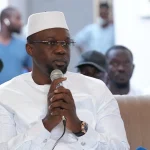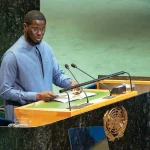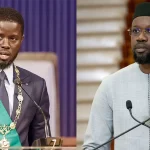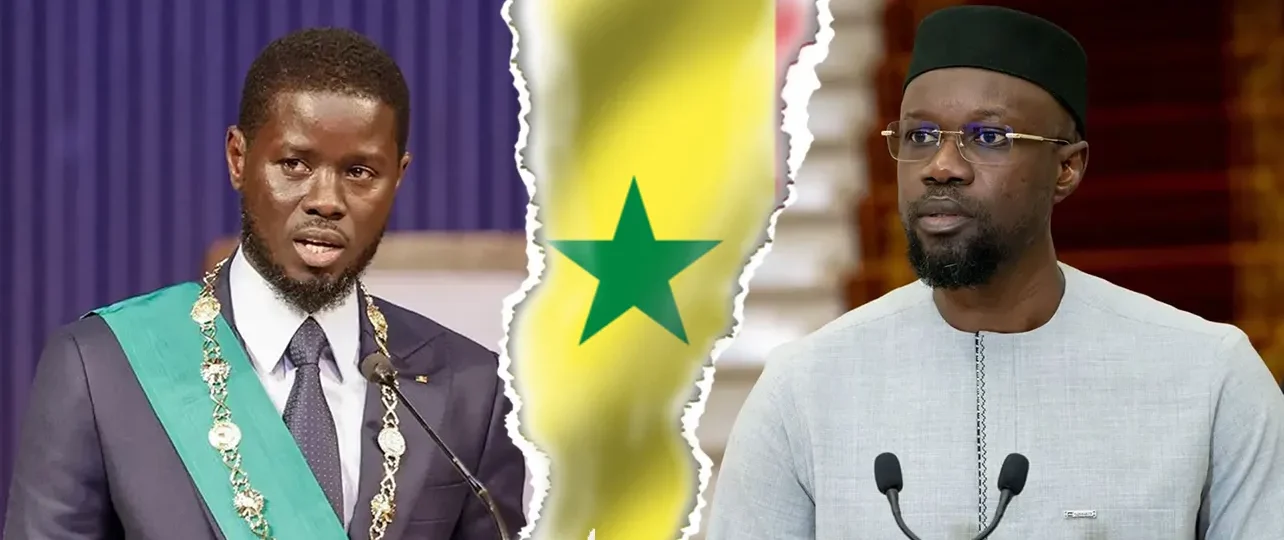

SENEGAL is hurtling toward a constitutional crisis that threatens to shatter the most celebrated democratic awakening in West Africa in a generation. Two years after Bassirou Diomaye Faye and Ousmane Sonko swept into power on a tide of popular hope – their names literally fused into a single rallying cry – their alliance has fractured so completely that the nation now stands on the edge of institutional collapse.
On June 1, 2026, the break became irreversible. Sonko, now Speaker of Parliament after being ousted as Prime Minister, announced on social media that PASTEF — the party he founded in 2014 and which controls a crushing parliamentary supermajority — would neither participate in nor be represented in the new government unveiled by Prime Minister Ahmadou Al Aminou Lo. The announcement came one hour before Lo read out his 30-member cabinet, and it sent a cold shiver through Dakar’s political class and the offices of the International Monetary Fund alike.
Experts are no longer debating whether PASTEF will table a motion of no confidence against the Lo government. They are debating only when — and what the fallout will look like when Senegal’s extraordinary democratic experiment implodes in full public view.
“Pastef will not take part and will not be represented by any ministers.”
Ousmane Sonko, June 1, 2026
The Arithmetic of Crisis
The constitutional mathematics are brutal and unambiguous. PASTEF commands 130 of the 165 seats in Senegal’s National Assembly — a supermajority secured in the November 2024 legislative elections that gave the party an almost unassailable grip on the legislature. Sonko, elected Speaker on May 27, 2026, by 132 of the 133 deputies who voted — in a ballot pointedly boycotted by the opposition — now sits as the second-highest official in the Senegalese state, constitutionally positioned ahead of the President of the Republic in the line of succession.
That positioning is not merely ceremonial. As Speaker, Sonko controls the parliamentary agenda, oversees legislative committees, and possesses the institutional machinery to launch formal inquiries or set in motion a motion of censure against the government at a moment of his choosing. It is a position of extraordinary strategic leverage, and Sonko did not assume it by accident.
The Senegalese Constitution provides that if a motion of no confidence is adopted by an absolute majority of the National Assembly, the Prime Minister must tender the government’s resignation. Faye would then face a stark set of choices: appoint a new Prime Minister acceptable to PASTEF — which would mean accepting Sonko’s terms — dissolve the National Assembly and call fresh elections, or watch the country descend into prolonged executive-legislative deadlock.
None of those options are comfortable. All of them carry profound risks.
| KEY FIGURES AT A GLANCE |
| PASTEF parliamentary seats: 130 of 165 (supermajority) |
| Sonko elected Speaker: 132 of 133 votes, May 27, 2026 |
| Senegal public debt: ~132% of GDP (IMF estimate) |
| IMF lending suspended: US$1.8 billion programme frozen |
| New PM: Ahmadou Al Aminou Lo (independent technocrat, former BCEAO) |
| Cabinet size: 30 ministers, zero senior PASTEF figures |
| Next scheduled elections: November 17, 2026 |
Brothers in Arms, Rivals in Power
The story of Faye and Sonko is, at its core, a story about what happens when a liberation movement achieves power and discovers that governing is nothing like revolution. PASTEF — Patriotes Africains du Sénégal pour le Travail, l’Éthique et la Fraternité — was built by Sonko from the ground up after 2014 as an explicitly pan-Africanist, anti-neocolonial force. It demanded an end to French economic dominance, renegotiation of extractive contracts, abandonment of the CFA franc, and a wholesale purge of the corrupt establishment that had ruled Senegal under former President Macky Sall.
The movement’s path to power was paid for in blood and imprisonment. Sonko was arrested, convicted on a defamation charge that his supporters called politically motivated, and barred from the 2024 presidential election. The resulting youth-led protests across Senegal in 2023 and 2024 were among the most sustained in the nation’s modern history, with more than 23 lives lost. When Sonko’s own candidacy was invalidated, he threw PASTEF’s weight behind Faye — the party’s less prominent secretary-general — securing the presidency with a mandate that carried Sonko’s fingerprints all over it.
The campaign slogan said everything: Diomaye-Sonko / Sonko-Diomaye. The two men were presented as a single political organism. When Faye won on March 24, 2024, he appointed Sonko as Prime Minister just nine days later. The arrangement was designed as a power-sharing compact: Faye would manage the apparatus of state, Sonko would maintain the party’s political legitimacy and popular energy.
For a year, it held. Then the cracks began to show.
“I don’t work for Bassirou Diomaye Faye. I work for Senegal.”
Ousmane Sonko, November 2025
The Rupture: From Friction to Fracture
The first public signs of rupture surfaced as early as July 2025, when Sonko accused Faye of “a failure of leadership” — extraordinary language from a Prime Minister about his own President. By November 2025, Sonko was telling lawmakers plainly that he did not serve the President but served the nation. Faye, in a carefully worded interview, countered by decrying what he called the “excessive personalisation” of PASTEF around Sonko — an unmistakable signal that he intended to wrestle the party’s identity away from its founder.
Beneath the personal rivalry lay a genuine and deepening policy divide. Senegal’s finances were in crisis, with the discovery in 2024 that the previous Sall government had systematically misreported debt data. With public debt rocketing to approximately 132 percent of gross domestic product, the IMF froze its 1.8 billion dollar lending programme and began demanding structural reforms as the price of re-engagement. Faye signalled a pragmatic openness to IMF negotiations and appointed Finance Minister Cheikh Diba — whom he retained in the Lo cabinet, with an expanded portfolio — to lead those talks.
Sonko was having none of it. He had built PASTEF on an explicit rejection of what he called the humiliation of debt restructuring and the subordination of African sovereignty to international financial institutions. His refusal to countenance IMF terms and his criticism of Diba’s proposals to raise fuel subsidies placed him in direct confrontation with the economic trajectory Faye was pursuing. The two men were no longer governing from the same political document.
On May 22, 2026, Faye acted. He dissolved the government and dismissed Sonko as Prime Minister. Three days later, he named Lo as the new PM. Sonko’s response was swift: PASTEF’s parliamentary bloc immediately elected him Speaker, installing him as a rival power centre with constitutional authority and an overwhelming legislative mandate.
A Government Without a Majority
Prime Minister Lo’s government faces a fundamental problem: it has no parliamentary foundation. Lo is a technocrat — a 60-year-old former official of the BCEAO, the West African central bank — with economic credentials but no political base. While the new cabinet includes at least three individuals with PASTEF affiliations, none of its senior figures belong to a party capable of delivering a single dependable vote in the National Assembly.
Sonko, despite congratulating Lo on his appointment with studied politeness, made clear he did not regard the new Prime Minister as holding legitimate authority derived from the party’s programme. PASTEF laid out formal preconditions for any participation in the executive: strict adherence to the 2024 electoral platform, full debt transparency, and robust anti-corruption commitments. These are not conditions Lo can meet without effectively repudiating the governing philosophy Faye has adopted.
Oxford Economics, in a note released on June 1, warned that Sonko “has signalled an intention to exercise strong parliamentary oversight, potentially constraining the executive’s ability to implement reforms aligned with IMF requirements.” That is a bloodless way of describing a scenario in which Senegal’s path to economic stabilisation is blocked by its own parliamentary majority.
The irony is acute. The very men who promised to rescue Senegal from the corruption and mismanagement of the Sall era now risk becoming the architects of its deepest institutional crisis.
“The political crisis could deepen IMF uncertainty at precisely the moment Senegal needs stability.”
Oxford Economics, June 2026
The IMF Time Bomb
For Senegal’s creditors, trading partners, and the millions of citizens whose livelihoods depend on economic recovery, the political deadlock lands at the worst possible moment. The IMF programme, suspended after the revelation of the debt misreporting scandal, represents not merely a financial lifeline but a signal of sovereign credibility to every bond market and development institution with exposure to Senegal.
Faye has been personally handling debt talks, recognising that reaching a new lending agreement is the single most important economic task facing his presidency. Lo’s retention of Diba — now leading a merged Ministry of Economy, Finance, and Planning — suggests continuity of approach in those negotiations. But approach means nothing without the ability to pass the fiscal legislation that an IMF programme would demand, and that legislation must pass through a National Assembly commanded by a man who has publicly dismissed debt restructuring as “a disgrace.”
If PASTEF tables and carries a motion of no confidence before the IMF negotiations can be concluded, the ensuing political vacuum would almost certainly cause those talks to collapse. A country already managing debt at 132 percent of GDP, with borrowing costs elevated and development financing squeezed, can ill afford a prolonged governmental crisis layered on top of its fiscal emergency.
The Youth, the Streets, and the Stakes
Senegal’s political drama has never been merely an elite affair. Sonko’s rise was powered by the energy of a generation — overwhelmingly young, deeply frustrated, and radicalised by years of watching an older political class enrich itself while youth unemployment soared. When Sonko was arrested in 2023, it was young Senegalese who took to the streets at enormous personal risk. When PASTEF was temporarily dissolved by the Sall government, it was youth networks that kept the movement alive.
That loyalty has not dissipated with Sonko’s translation from PM to Speaker. Students rallied behind him following his dismissal, and protests broke out in Dakar within days of the announcement. Sonko’s control of the parliamentary speakership gives those energies a constitutional channel — but it also creates the conditions for street mobilisation if he chooses to escalate. A motion of no confidence that brings down the Lo government would galvanise his base; a rejection of that motion — constitutionally impossible given PASTEF’s numbers, but theoretically possible if enough deputies defect — would be incendiary.
The regional implications compound the domestic stakes. As one of the few stable coastal democracies in a Sahel increasingly dominated by military juntas — Mali, Niger, and Burkina Faso having all abandoned ECOWAS — Senegal has served as an anchor of southern West Africa’s democratic identity. A paralysed Senegalese government risks weakening joint counterterrorism architecture, disrupting intelligence sharing, and providing space for armed groups seeking to extend their reach toward the Atlantic coast.
When, Not If: The Road Ahead
Political analysts speak with unusual unanimity about what comes next. The question they debate is not whether PASTEF will move against the Lo government, but under what circumstances and on what timeline. Several scenarios present themselves.
In the most immediate scenario, PASTEF swiftly tables a motion of no confidence before Lo’s government can establish any governing momentum or conclude any meaningful legislative business. Faye would then be forced either to appoint a Prime Minister acceptable to Sonko — effectively conceding to the parliamentary majority — or to dissolve the National Assembly. Parliamentary elections are already scheduled for November 17, 2026. Faye could choose to bring those elections forward, gambling that PASTEF’s support among the electorate has eroded sufficiently to reduce its legislative dominance.
In a second scenario, Sonko plays a longer game. He uses his control of the parliamentary agenda to obstruct specific legislation — most critically, any fiscal measures required by the IMF — rather than launching the direct constitutional confrontation of a no-confidence vote. This would allow him to weaken Faye incrementally while positioning PASTEF as the defender of sovereignty against IMF conditionality, sharpening his electoral advantage for November.
In either case, the Lo government’s capacity to govern effectively is already severely compromised. A Prime Minister whose majority belongs to the opposition is not governing; he is administering a slow-motion crisis on behalf of a President whose authority is draining away.
As one senior political analyst in Dakar put it bluntly: “This is political suicide — for both of them, and for Senegal.”
A Dream Deferred
The coalition of Faye and Sonko promised Senegalese citizens something rare and precious: the genuine possibility of transformative change, delivered not by soldiers staging coups but by a democratic movement that had earned its mandate through sacrifice and popular will. The young men and women who voted for them in 2024, who marched for them in 2023, who believed in the Diomaye-Sonko project — they deserved better than this.
What has unfolded is the oldest story in politics: two powerful men, intoxicated by proximity to power, discovering that the sharing of it is unbearable. The ideological differences between Faye and Sonko are real, but they are not irreconcilable. What has proven irreconcilable is the desire of each man to be the singular, undisputed centre of authority — the one who defines Senegal’s direction rather than merely serving it.
The coalition has been sacrificed not on the altar of principle, but at the altar of ego. And it is Senegal — its economy, its democratic institutions, its place in the regional architecture of West Africa — that will pay the price.
The world watched with hope as Senegal’s democratic experiment unfolded. It is watching again now, with something closer to dread, as that experiment threatens to consume itself.