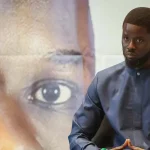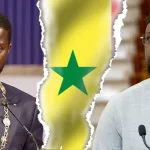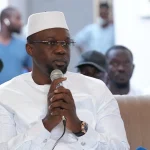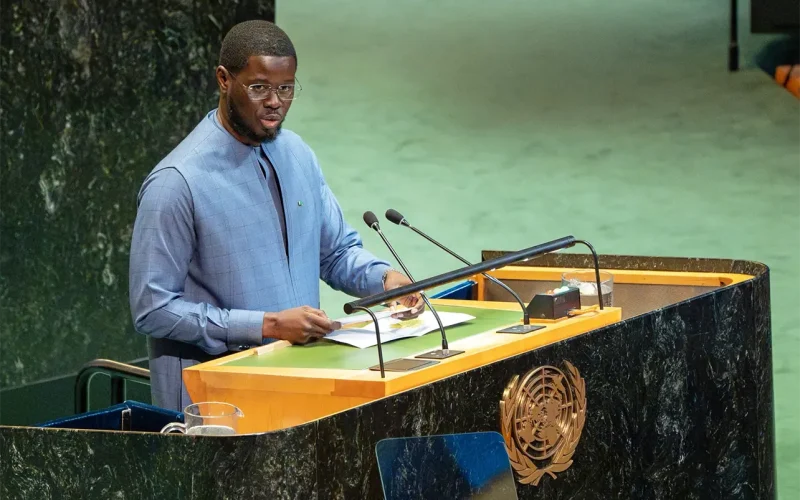
WHEN Bassirou Diomaye Faye walked out of Rebeuss Prison on 24 March 2024, just hours before polls opened on the day that would make him the youngest president in Senegalese history, few could have imagined that within two years he and his liberator, political godfather and now Prime Minister Ousmane Sonko, would be locked in a contest that threatens to crack their shared revolution in two.
On 8 May 2026, President Faye declined to sign into law electoral code amendments passed overwhelmingly by the ruling PASTEF-dominated National Assembly on 28 April – amendments crafted specifically to restore Sonko’s eligibility to contest the 2029 presidential election. The president sent the bill back to parliament for reconsideration, citing what the National Assembly Speaker, El Malick Ndiaye, confirmed was the transmission of two different versions of the adopted text. But in Dakar’s febrile political climate, that bureaucratic explanation is almost universally dismissed. What the city is reading is a declaration of intent.
The battle lines between Africa’s newest presidential pair – men who rose from the same party, the same streets, the same prisons – have been drawn. Three years before the next scheduled presidential vote, Senegal’s two most powerful politicians have started the race.
The Bill That Launched a Thousand Calculations
The legislation at the centre of this conflict targets Articles L29 and L30 of Senegal’s Electoral Code – provisions that have functioned, since the Macky Sall era, as political trap doors capable of disqualifying inconvenient candidates. The PASTEF parliamentary group, operating from a commanding majority of 130 out of 165 National Assembly seats won in November 2024, pushed the bill through under an emergency procedure with 128 votes in favour, 11 against, and two abstentions. The amendments would ‘restructure and clarify’ the grounds for civic disqualification, limit ineligibility to five defined categories tied to the expiry of sentences, and – critically – apply retroactively.
The retroactivity clause is where the politics become personal. In May 2023, Sonko was convicted of defaming a minister whom he had accused of embezzling public funds, receiving a six-month suspended sentence and ordered to pay EUR300,000 in damages. The Supreme Court upheld that conviction in January 2024 – weeks before the presidential election – and rejected a further appeal in July 2025. The effect was devastating: the most galvanising opposition figure in a generation was barred from his own revolution’s most important prize.
In his place, Sonko tapped Faye, then the general secretary of PASTEF, at the time also detained without conviction. Faye won the March 2024 election with 54.28 percent of the vote on his first attempt, without a single day of campaigning outside prison. He assumed the presidency on 2 April 2024 and immediately appointed Sonko prime minister. The arrangement was understood as transitional: Faye would mind the presidency while Sonko prepared his restoration. What nobody fully modelled was what would happen if Faye decided he liked the job.
Faye Finds His Footing – and His Ambition
For much of 2024, Faye governed in the long shadow of Sonko. It was the prime minister who set the pace, held the rallies, commanded the loyalties of PASTEF’s grassroots, and was widely expected to reclaim the top office at the earliest opportunity. But something shifted. Governing, it turns out, is its own form of political capital. And Faye has been accumulating it quietly.
The fractures became visible earlier this year, when a ‘Diomaye-President’ coalition emerged – a political formation pointedly named for the president, not the prime minister, and backed by figures previously aligned with different camps. Sonko’s allies responded by mobilising what they called the APTE coalition, holding a ‘clarification meeting’ in Dakar to define their counter-strategy. Senegal’s ruling party was fracturing in real time, its fault lines tracing the outline of two presidential ambitions.
Faye’s most explicit statement of his authority came in blunt presidential language. Warned that Sonko’s allies would be watching his response to the electoral bill, the president reportedly reminded his government and public that Sonko’s tenure at the head of government is contingent on presidential confidence – and that confidence is not unconditional. ‘If he remains prime minister, it is because he retains my confidence,’ Faye said. ‘When that is no longer the case, there will be a new prime minister.’ It was the language of a head of state who had stopped deferring to the man who made him one.
Faye also fired a legislative flank. On the eve of the National Assembly’s vote on 28 April, the presidency released its own sweeping set of draft reforms: a proposed constitutional overhaul, a comprehensive electoral code rewrite, reforms to political party law, and restructuring of the Constitutional Court – all for public comment ahead of cabinet deliberation. Political analysts immediately recognised the move for what it was: an attempt to reframe the Sonko-driven bill as narrow, self-serving legislation and position Faye’s own process as the legitimate, national-interest alternative.
A Parliament Loyal to Sonko, a Presidency Asserting Its Prerogative
The opposition, watching this fratricidal contest from the benches, has made a considered calculation. The main opposition bloc, Takku Wallu, announced it would renounce any constitutional challenge to the electoral bill – declining to ‘interfere in the internal tensions shaking the ruling party.’ Non-aligned legislators sought to refer the bill to the Constitutional Council but could not assemble the required 17 signatures. The opposition has decided that the best politics is to let the wound bleed.
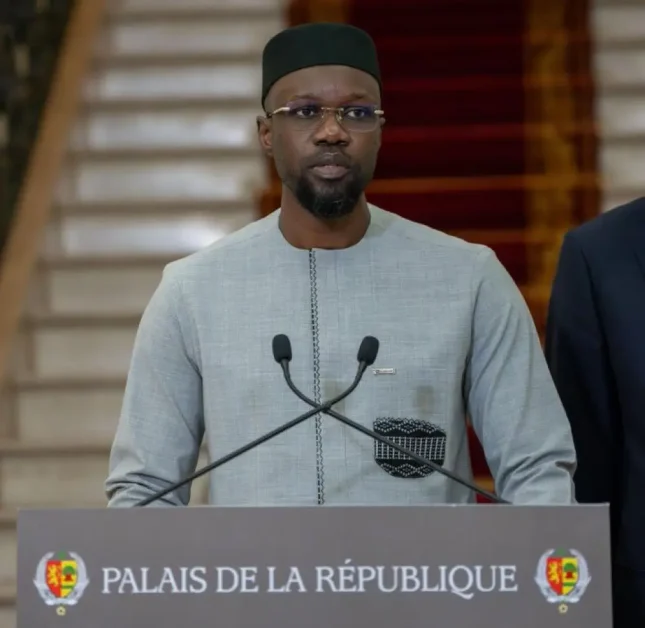
Meanwhile, PASTEF’s Assembly majority – faithful to Sonko rather than to the president who carries their party’s name – is widely expected to reconfirm the bill and return it to Faye for promulgation. The constitutional mechanics are unambiguous: parliament can override a presidential request for reconsideration by re-adopting the original text, at which point the president must either sign it or escalate to the Constitutional Council. Faye’s manoeuvre, legally speaking, may only buy him days. Politically speaking, it has already bought him much more – a public demonstration that he is not a rubber stamp, that he has a constituency of his own, and that his name is on the door of the Palais de la Republique for a reason.
As National Assembly Speaker Ndiaye confirmed the procedural irregularity argument and announced the bureau would meet to determine next steps, one thing was already clear: whatever the bureaucratic explanation offered, the battle had moved out of the legislature and into the open plains of Senegalese political life.
Senegal’s Democracy at the Crossroads
There is a larger story beneath the personalities. The provisions that blocked Sonko from the 2024 election – Articles L29 and L30 – were originally engineered under Macky Sall to exclude opposition figures such as Karim Wade and Khalifa Sall from presidential contests. Having weaponised the electoral code against their own candidates, Sall and his allies bequeathed to their successors a legal framework built for exclusion, not inclusion. It is not unreasonable, in principle, for the new majority to dismantle instruments of democratic manipulation.
But the manner matters as much as the substance. The speed of the parliamentary vote – driven through under emergency procedure, with opposition figures denouncing limited debate – lends the reform the appearance of the very thing it claims to oppose: legislation tailored to one man. Opposition parliamentarian Aissata Tall Sall called it ‘personal’ and ‘dangerous for the Republic because it retroactively erases sentences handed down sovereignly’ by the courts. Civil-society voices, even those broadly sympathetic to PASTEF’s anti-corruption mandate, have expressed discomfort with the pace and specificity of the changes.
Senegal’s 2023-2024 political crisis, which left at least one teenager dead and dozens wounded as protests over Sonko’s legal battles swept the country, was resolved through elections that brought the very men now in conflict to power. For a country that once distinguished itself among West African peers for institutional stability, the emergence of a succession war inside the ruling bloc – three years before it is needed – carries particular resonance. The 2029 presidential race is far enough away that the damage can be contained. It is close enough that both men know every move now is a founding move.
Analysis: The Maker and the Made
The Faye-Sonko dynamic contains a political archetype familiar across African post-independence history: the kingmaker who discovers that the king has stopped listening; the proxy who discovers the throne fits. South Africa’s Thabo Mbeki was once Jacob Zuma’s champion. Zimbabwe’s Emmerson Mnangagwa was once a trusted executor of Robert Mugabe’s will. The specific textures of each story differ, but the underlying logic is consistent: political intimacy at the highest level produces the most personal and consequential rivalries.
Sonko made Faye. He designated him when the law closed his own door. He campaigned for him from a prison cell. He has the deeper roots in PASTEF’s founding ideology, the more combustible popular following, and the longer political memory. But he does not have the presidential seal. Faye holds the instruments of state, the security apparatus, the right to dissolve parliament — a power he exercised once already, in September 2024, after clashes with the legislature. He controls the budget, and with it the capacity to make PASTEF’s parliamentary operation uncomfortable.
For now, neither man has broken from the PASTEF framework. Both continue to govern, at least formally, as part of the same project. But the electoral code confrontation has introduced a logic that tends toward separation. A parliament that defies the president is asserting its loyalty to the prime minister. A president who blocks the prime minister’s restoration bill is asserting his independence from the man who created him. Both dynamics, once started, are difficult to stop.
Senegal is watching. West Africa is watching. The country that held the line on democratic transfer when its neighbours were falling to coups is now testing whether democracy can survive the ambitions of its own reformers.