WHEN unprecedented aid budget cuts were announced by the United States and other major donors earlier this year, concerns were raised about where the reductions in finance and operational capacity would hit hardest and fastest.
The months since have been marked by torturous deprioritisation efforts that have been shrouded in mystery and confusion. In this article, we try to unpack the impact on humanitarian responses in one setting, Mozambique, and work out what it might signal elsewhere.
By Will Worley
The UN-led system has cut the number of people it aims to reach this year by a third: Aid groups say tens of millions who need emergency relief will go without. For the system itself, this deprioritisation also means a shrinking international presence. The most severe form being talked about is “accelerated transition” – away from the existing humanitarian architecture and towards a more development-style approach in the crisis-affected country.
In reality, this means the loss of key humanitarian officials and of the traditional emergency aid coordination mechanism known as the cluster system. With this comes an increased onus on national governments to lead responses – a difficult prospect in countries where the state is a party to a conflict fuelling the crisis, and where local humanitarian leadership has been sidelined amid heavy international footprints.
Jeremy Wellard, head of coordination at the International Council of Voluntary Agencies (ICVA), a network of humanitarian NGOs, says eight countries are currently in accelerated transitions: Cameroon, Colombia, Eritrea, Iraq, Libya, Nigeria, Pakistan, and Zimbabwe. These were revealed in an ICVA briefing earlier this year. There were at least 28 locations with UN-led humanitarian coordination systems before this year’s cuts began.
Of those places, Wellard considers Nigeria, Cameroon, and Colombia to be where the most significant changes are taking place, each for different reasons related to capacity, government access to crisis-affected regions, and donor interest.
Moving from a humanitarian response to development architecture is “not unprecedented”, Wellard told The New Humanitarian. “But doing so rapidly in a number of contexts at the same time is,” and goes against pre-existing advice, he added, while conceding that this situation had been forced by the funding cuts.
Mozambique is not in an accelerated transition but is typical of dozens of other crisis-affected countries where humanitarian operations are still being significantly scaled back in a process dubbed “deprioritisation” in UN jargon. The precise meanings of terms like “accelerated transition” or “deprioritisation” are also unclear, causing confusion and fear among ground-level humanitarians. This is happening amid a broader “humanitarian reset” – the major reform agenda championed by the UN’s emergency relief chief, Tom Fletcher, in response to the sector’s financial crisis.
Poor timing for a massive aid reduction
In Mozambique, multiple crises are worsening all at once.
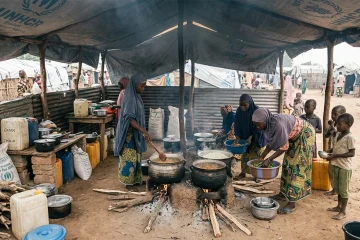
Compounding an economic collapse and an outbreak of the mpox virus are severe environmental and climate impacts from tropical storms and a major drought. But the major concern is the long-running conflict in the northern province of Cabo Delgado, where armed groups, including Islamic State Mozambique, are attacking settlements and causing widespread displacement. Around 57,000 people, more than half of them children, were forced to flee fighting in July, part of the 95,000 people who have been displaced since the start of the year.
Against this backdrop, local aid workers say they were excluded from the discussions around how the reforms would affect their work and thrown into confusion by the flip-flopping policy changes that followed.
“We’re weighing up options,” said Nyararai Magudu, a Mozambican NGO leader.
“No one knows what’s going to happen.”
Among the more visible aspects of deprioritisation have been changes to countries’ humanitarian response plans (HRPs) – the annual reports the UN produces each year that lay out how many people are in need and how many of them will be targeted with assistance. In a process it referred to as “hyperprioritisation”, the UN drastically reduced the scope of these this year because of the lack of resources.
Despite some confusion among aid workers in the country who weren’t at all sure, OCHA confirmed to The New Humanitarian that Mozambique is no longer facing an “accelerated transition”. Its humanitarian response plan, however, has been slashed.
The HRP made prior to the cuts and published in December 2024 correctly predicted that 2025 would be a difficult year in Mozambique: It requested $352 million to help 1.1 million people of the 4.8 million people in need of humanitarian assistance.
Following the aid cuts, a “reprioritised” HRP published in March asked for $126 million to target just 317,000 people across a much more limited geographical area, puzzling humanitarians who could clearly see the escalating crisis in Cabo Delgado.
This year’s humanitarian plan for Mozambique has received only $70.4 million, just 20% of what was originally needed.
An OCHA document warning of the cuts’ impacts said the risks include the prospect of no aid reaching 600,000 people facing severe food insecurity in Cabo Delgado, 245,000 displaced people who will see their living conditions and safety severely decline, and 145,000 schoolchildren at risk of dropping out due to a lack of teachers.
Already, “the cuts are causing a big impact,” said Ulrika Blom, Mozambique country director at the Norwegian Refugee Council, one of the world’s largest international aid agencies. “The presence in the field is rapidly reducing.”
As bad as the shorter-term impacts have been, Blom warned that the situation could get worse, with few resources to do essential planning for 2026. There’s also “no capacity to respond if something [unexpected] happens”, she added.
A letter of local NGO discontent
On 6 June 2025 – when it appeared Mozambique was heading for accelerated transition – a letter from more than 60 (now 119) Mozambican NGOs to senior UN officials expressed “deep concern regarding the potential de-prioritisation of Mozambique as part of the ongoing Humanitarian Reset process led by the [UN] Inter-Agency Standing Committee (IASC).”
“We understand that Mozambique may be among the countries proposed for de-prioritisation, with decisions expected imminently,” the letter added. “If confirmed, this would entail the phasing out of the Humanitarian Coordinator role, dissolution of the cluster coordination system, and termination of the humanitarian appeal process.”
This prospect caused grave concern, with the organisations warning that, “without meaningful consultation, [the decision] will have severe consequences for crisis-affected populations and for the operational capacity of national and local actors. Local NGOs, already disproportionately impacted by recent funding cuts, especially from the US, will be left to shoulder the response without adequate resources or support.”
“The reset must not become an exit strategy in disguise.”
Because of the extent of crises in Mozambique, particularly in Cabo Delgado, “it would be premature to phase out humanitarian operations and development actors are not yet ready to take over,” the letter continued. “Any transition must be orderly, consultative, and dignified – not rushed or dictated externally.”
Magudu, who leads the nascent Mozambique Local Humanitarian Coordination Platform, said he learned about the potential deprioritisation changes from his business partner, who has a longstanding relationship with the UN.
When he spoke to The New Humanitarian on 4 August, Magudu was still “not very clear” on whether Mozambique would be deprioritised, though he noted that senior humanitarians had “changed their tone” following an outcry.
This confusion was reflected by other Mozambican NGOs, who said in the letter that they were “deeply troubled by the limited consultation with local and national NGOs around this critical decision”.
“The absence of inclusive dialogue,” they added, “contradicts the principles of accountability and participation that the [humanitarian] Reset claims to uphold.”
International NGOs working in Mozambique launched their own pushback. “The reset must not become an exit strategy in disguise,” they said in an unsigned advocacy document seen by The New Humanitarian.
The document did not say what they understood the characteristics of deprioritisation to be, other than a nod to how “cluster restructuring or deactivation” should be done. But it was clear on the risks: poor transition readiness, humanitarian harm, coordination collapse, and difficulties with aid access and security.
The document said “urgent operational changes” brought about by funding cuts are absolutely necessary, but they must not sacrifice needs-based targeting, inclusive coordination, or access to conflict-affected and hard-to-reach areas.
A reprieve (of sorts)
The campaigning appears to have paid off, and the UN has now backtracked – at least in Mozambique.
“As part of the lifecycle of operations, Mozambique was reviewed and, for the moment, it’s not being considered for accelerated transition,” an OCHA spokesperson told The New Humanitarian on 6 August.
But the UN’s top humanitarian officials in the country will “continue to review and right-size based on the evolving situation, which will also feed into any further transition discussions”, the spokesperson continued. “The cluster system is still operational,” they added.
While the Humanitarian Coordinator position remains in Mozambique for the time being, the spokesperson pointed out that the role could remain in contexts from which OCHA itself has withdrawn.
It was the prospect of the withdrawal of the humanitarian structures that led local NGOs to form the Mozambique Local Humanitarian Coordination Platform, which is still in its early stages and is so far endorsed by 60 organisations, according to Magudu. “Many of us were just awakened” by the reset, he explained.
“We have to regroup,” he added. “Traditionally, local NGOs have not been given space to shape how the humanitarian response should be. We have been passive players… Sometimes, we are just the mere observers of the whole thing.”
The platform is calling for more inclusion in “internationalised” humanitarian functions, particularly co-chairing some cluster groups and ensuring pool funding is more accessible for local NGOs, “because they know the context, they know the needs of the communities and can deliver services much cheaper than international NGOs,” Magudu said. “The localisation agenda is still piecemeal: There is a lot of talk but little action.”
Mozambique may have avoided an accelerated transition for now, but the humanitarian outlook remains bleak, with displacement and gender-based violence in particular on the rise. As Magudu put it: “The condition is getting dire, and dire, and dire.”
Edited by Andrew Gully and Irwin Loy.
–––––
The New Humanitarian puts quality, independent journalism at the service of the millions of people affected by humanitarian crises around the world. Find out more at www.thenewhumanitarian.org.