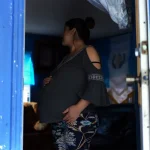
AMINA Ya’u* was six months pregnant when gunmen attacked her village of Rinaye in the Shagari district of Nigeria’s northwestern Sokoto State.
Her husband, Abubakar Tunau, had just finished eating when the armed men forced their way into their home. He was struck with a rifle butt and shot in the chest.
Ya’u collapsed. When she regained consciousness, her mother-in-law was beside her, crying. Her husband was dead.
In the days that followed the September 2025 attack, 35-year-old Ya’u could not eat or sleep. She experienced repeated flashbacks. Four days later, she suffered a miscarriage.
“His murder did not only take his life,” Ya’u said. “It took my means of livelihood, my social protection, and the future I had been dreaming of.”
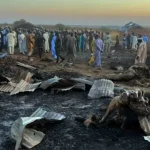
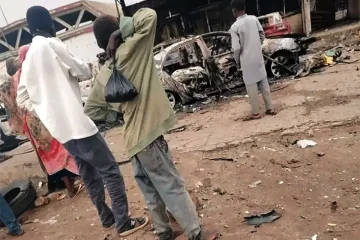
For more than a decade, criminal gangs – known locally as bandits – have preyed on rural communities across northwestern Nigeria. Well-armed, they sweep into villages on motorbikes, seizing anything of value.
The village men they encounter are presumed to belong to self-defence vigilante groups and are killed with little compunction. Women run the risk of sexual assault and kidnapping. The violence has caused mass displacement, destroyed livelihoods, and left thousands dead.
By February 2025, more than 580,000 people – the majority women – had been forced to flee their homes across the three northwestern states of Katsina, Sokoto, and Zamfara due to the insecurity. Some women suffer a double burden when displaced, pushed into begging or survival sex to care for their families.
Bandits can control entire districts, shutting people in with improvised roadblocks, limiting access to markets, and forcing communities to provide free labour in the farms they seize.
Outgunned, the police are of little match and traditional leaders are cowed into silence or collaboration. Despite the deployment of troops, state governments have been unable to impose any level of sustained authority in the worst-affected areas.
Lives upended
In just two districts of Sokoto state – Tangaza and Shagari – a total of at least 450 women have been widowed. Gazali Raka, security adviser to the Tangaza local authority, estimates that no fewer than 300 women have lost their husbands over the past five years. In neighbouring Shagari, community leader Malam Yahaya Shagari puts the figure at about 150 widows.
“These are conservative numbers,” Shagari told the New Humanitarian. “Many cases go undocumented because families flee, or because deaths happen in the bush, during kidnappings or ambushes.”
Sadiya Aliyu, 40, was hiding in a nearby village when her husband was killed in the attack on Rinaye last year that took Ya’u’s husband.
Before the raid, Sadiya raised more than 20 livestock. Today, only two remain – she sold the rest to feed her children. As she spoke, she fell silent repeatedly, seemingly at a loss for words.
“My husband was everything. Now I sell what is left just to survive,” she explained. “Life has never been the same.” On nights when there is no food for the next day, she lies awake, worrying about where their next meal will come from.
“For months, we stopped sleeping in our house. We would hide at night and return in the morning. But they still found him.”
Kuluwa Umaru, 40, became a widow after her husband, Umaru Mahaliya, was killed in Tangaza by the jihadist group Lakurawa. The gunmen – with links to the al-Qaeda affiliated JNIM in the Sahel – were originally invited into Sokoto by villagers to provide protection against bandits, but then turned on those same communities, taxing and intimidating them.
Mahaliya was a trader, hunter, and respected community elder involved in local vigilante efforts – a role that made him a target. “For months, we stopped sleeping in our house,” Umaru recalled. “We would hide at night and return in the morning. But they still found him.”
One afternoon, Mahaliya left home, saying he was going to the farm and promised to buy fuel for Umaru’s grinding machine on his way back. He never returned. His body was later found in the forest.
After his death, Umaru fell into a deep depression, isolating herself and crying. “Only my father understood that something was wrong with me,” she told The New Humanitarian. “He advised me to go for spiritual healing.”
Living with trauma
Despite the scale of the banditry and violence that affects so many citizens, mental health services in much of Sokoto are rudimentary. It is one of Nigeria’s poorest states, with close to 90% of the population living below the poverty line.
Many women suffer from severe mental health disorders after witnessing the murder of their spouses and children, or being kidnapped and repeatedly raped themselves, but go without any specialised care. In a highly conservative society like Sokoto, victim shaming means sexual violence tends to be concealed, and women rape survivors receive even less institutional help.
Danjuma Ishak is a consultant psychiatrist at the Federal Neuropsychiatric Hospital in Kware, one of the few facilities operating in Sokoto. In his experience, there is a gender dimension to the psychological needs of trauma victims, with women experiencing conflict-related trauma differently – and often more severely.
“Psychological trauma affects both men and women, but the impact is often greater on women because they are more vulnerable economically and socially,” he noted.
“Widows are often subjected to excessive mourning rituals, denial of rightful inheritance, social isolation, and coercive remarriage.”
For widows, it is not just the immediate emotional loss of a loved one that can be so destabilising, but also the aftermath – the social and economic exclusion.
Northwest Nigeria is an overwhelmingly Muslim region, and under Islamic traditions, widows are supposed to be treated with dignity and provided with support and protection. But the reality is that the loss of a husband often means the loss overnight of a home, of income, and of social standing.
“Widows are often subjected to excessive mourning rituals, denial of rightful inheritance, social isolation, and coercive remarriage,” note researchers Maryam Umar Ladan and Aminu Alhaji Bala.
While some humanitarian organisations provide food and relief, these interventions are short-term and rarely address the mental health toll of the loss of a breadwinner and partner.
Gender Educators Initiative, a local humanitarian group, supports women and children in insecure communities with feeding programmes and emergency assistance. But project manager Linda Idoko acknowledged a major gap in psychosocial support.
“We have seen that mental health support is almost completely absent, so we are exploring partnerships to integrate psychosocial care into our response,” she explained.
Ishak believes this omission can have long-term consequences.
“Trauma does not end when the shooting stops,” he explained. “Conflict-affected regions need trauma centres, trained psychologists and regular mental health assessments, especially for displaced women.”
*Not her real name.
This story was published in collaboration with Egab. Edited by Lina el Wardani and Obi Anyadike.
The New Humanitarian puts quality, independent journalism at the service of the millions of people affected by humanitarian crises around the world. Find out more at www.thenewhumanitarian.org.