
AFTER holding out in western Gaza City for as long as they could, Rasha Abou Jalal, her husband, and their five children joined hundreds of thousands of Palestinians being forced out of Gaza’s main metropolis by Israel’s intensifying invasion, and fled south on 16 September.
With the Israeli military aiming to take control of Gaza City and displace its residents, perhaps permanently, “staying is no longer just a decision. It has become a battle of identity and existence,” Abou Jalal wrote on 1 September in an entry of the diary she has been keeping for The New Humanitarian.
But by 13 September, as leaflets warning people to urgently evacuate rained down on the neighbourhood where she was staying, other displaced people in the area started to flee. “I no longer have words to convince them to stay,” Abou Jalal wrote. “Perhaps they are right: the right to survive takes precedence over any other consideration.”
Soon, Abou Jalal and her family were the only ones left in the neighbourhood. They hid in the crumbling walls of an abandoned house as quadcopter drones prowled the skies, shooting randomly. “I forbade my children from making any noise or playing outside. Our water and food supplies were dwindling, despite rationing. It was only a matter of time before those drones discovered us,” she wrote.
Read Abou Jalal’s harrowing account of her final days in Gaza City: how Israel’s relentless attack broke the will of people to hold out as the instinct to survive took over, and the beginning of her family’s journey south.
8 September 2025 – Israel’s attacks on highrise buildings
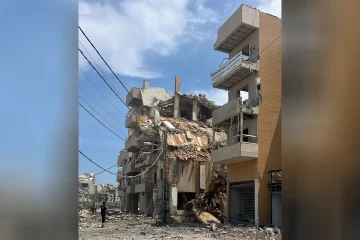
Today, Israel bombed Roya Tower, one of the largest residential towers in Gaza City. The attack did not merely destroy a towering concrete block. It collapsed an entire world that housed people’s dreams and sense of stability.
The Israeli army has launched a systematic campaign to demolish the largest and most well-known residential buildings in the city, which, during the war, have turned into shelters for hundreds, perhaps thousands, of families who lost their homes.
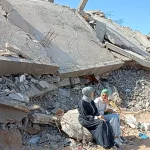
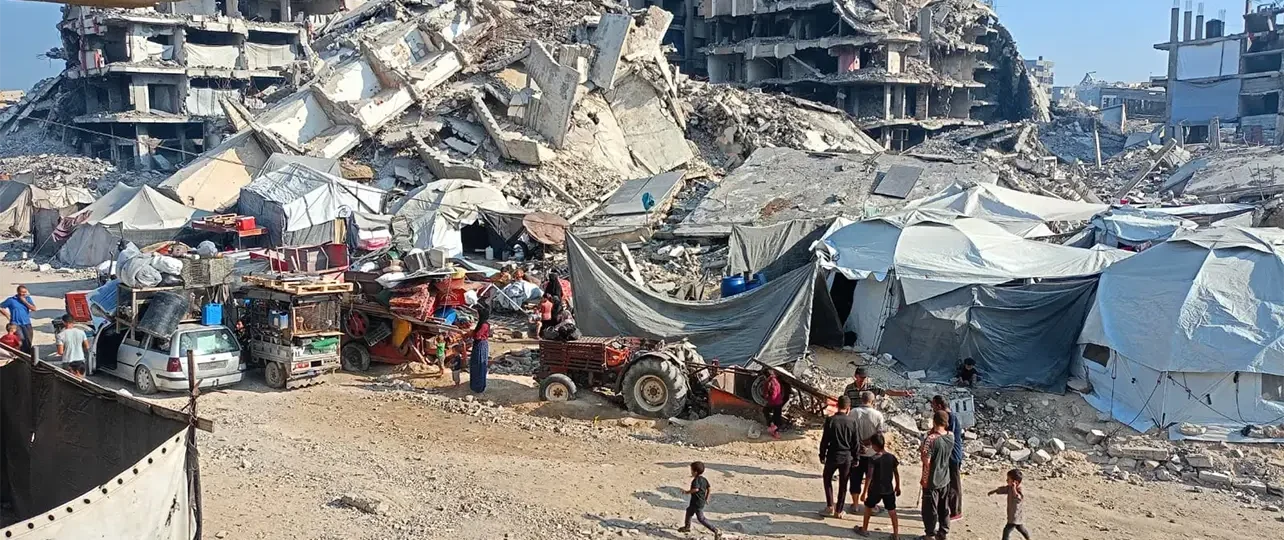
Shortly after it was brought down, I stood beside the rubble of Roya Tower, where the tents of displaced people stretched around it, some torn and some buried under the debris. I met a displaced woman named Fatima Suleiman. She was 39 years old and standing in shock before the void where her tent once stood, erased by the collapse of the tower.
“Where will you go now that your tent has been destroyed?” I asked.
She lifted her head, her eyes filled with sorrow and exhaustion, and replied: “I have no place here anymore… I will have to flee with my children to the south, but we will walk more than 20 kilometres on foot because we have no money to pay even for a ride on a cart.”
She then pointed with a trembling hand to her three children gathered around her: “Look at them, the youngest has not yet turned four. How will he bear walking such a distance? They barely have enough to eat, and their bare feet cannot endure the stones of the road.”
“Haven’t you tried to get another tent?” I asked.
She answered in a hoarse voice: “I’ve been searching since the morning, but all the families here lost their tents too. There are no extra tents, not even a piece of cloth to cover our heads. Tonight we will sleep in the street, under the open sky, amid the dust and rubble.”
“We used to search for a roof to shelter under. Now we lack even a piece of fabric. Israel has left us nothing – no house, no tent. Not even the illusion of safety remains,” she added.
The bombing of Roya Tower and others like it is forcing hundreds of people into yet another journey of displacement – a journey with no known end.
9 September 2025 – The sky looked as though it were on fire
Fear now surrounds us more than ever, especially after Israeli Prime Minister Benjamin Netanyahu issued his warning to the people of Gaza City to completely evacuate. Yet families here continue to defy the orders to flee south, insisting on remaining in their homes, tents, and neighbourhoods.
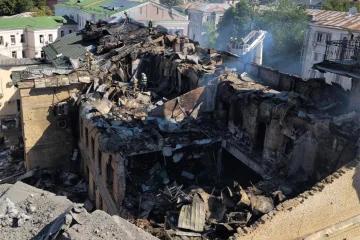
After Netanyahu’s warning, came intense airstrikes. There were dozens more raids on residential buildings sheltering hundreds of displaced families in western Gaza City. One of these strikes targeted the al-Sa’ati family’s four-storey building. Just a few months ago, this family managed to dig a well inside their house to provide water for hundreds of displaced families. Israel has long since cut off Gaza City’s water supply.
The al-Sa’ati family’s well became a source of life and a pillar of resilience for many families. But Israel could not tolerate this, and so it reduced its buildings to rubble. Now, many displaced families in western Gaza City will go thirsty. It’s as if Israel wants to tell us: “If you want water, you must flee south.”
What is happening is a full-fledged war crime, taking place amid a disgraceful global silence.
At the same time, today, Israel bombed the Qatari capital, Doha, allegedly targeting Hamas leadership. The attack spread confusion and unease among people here. My neighbour rushed over to ask me about it, thinking that, as a journalist, I might be able to foresee what will come next.
“No one is able to restrain Israel. It does whatever it pleases,” I told her. My neighbour asked, anxiously: “Will this make our situation even worse than it already is?” I answered: “We are forgotten here, and we have no choice but to endure, no matter how harsh things become.” She seemed not to fully grasp my words, but before leaving, she muttered: “Death is more merciful than this life.”
By nine o’clock in the evening, I was preparing the bedding for my children inside the tent when a commotion broke out outside. People were gathering and looking up at the sky. Israeli flares were lighting up the night sky directly above our heads. The sky looked as though it were on fire. It was terrifying. Israel wants to force us to flee by every possible means: relentless airstrikes, targeting water supplies, and now depriving us of rest at night.
My children came out of the tent, their eyes wide with astonishment. My daughter asked me innocently: “Mom, what is this?” I could not tell her the truth, so I lied: “They are fireworks launched by people in the nearby neighbourhood to celebrate a wedding.” She quietly returned with me to the tent, but I was certain she did not believe me.
10 September 2025 – We have been set back 100 years
Today, I was weighed down by household chores, which I have no choice but to perform in the most primitive ways. Life here has lost all of its modern conveniences. Netanyahu has fulfilled his promise, made on the first day of the war, to set Gaza back by 50 years. Except I believe we have been set back by 100 years.
Everything here is extremely difficult to do. Even the simplest tasks require tremendous effort and suffering. My neighbour comes to me every morning, sighing, and says with a voice mixed with anger and sadness: “How can the world remain silent about this war that is being waged so openly against civilians without moving a finger?”
This question no longer stirs me as it once did. I have grown accustomed to silence and abandonment. All I want is for the day to pass without hearing that the Israeli army is getting closer to us.
It is now four in the afternoon. The residents of a six-storey residential building near us received a warning from the Israeli army to leave immediately. They were given only 20 minutes to evacuate. Such a short time was not enough to do anything. I saw families lost in indecision: Should they take food or water? Clothes or bedding? In the end, women and children fled empty-handed, carrying nothing at all.
But the tragedy did not end there. Dozens of displaced families living in a nearby camp left their tents, fearing the strike would reach them. And when they returned after the bombardment, they found nothing. Their tents had been turned into ash.
This scene repeats itself every day in Gaza. People here live in a renewed hell with no end.
It is now 10 o’clock at night. My children were asleep when suddenly the sky lit up again with Israeli flares. People rushed out of their tents, staring at the sky as the night turned into day. The last time we saw night illuminated to this extent was on 6 October 2023 – the day before the war. Since then, Israel has completely cut off electricity from Gaza, and we are still living in total darkness. Yes, we live without electricity. We live in the depths of hell.
But the worst part came when one of the flares fell on a tent sheltering a widow with her four children, sending it up in flames. People rushed to extinguish it. They managed to save the family, but some of the children suffered burns. I watched the scene with deep anxiety mixed with despair, then went back to my tent, knowing that another long day awaited me tomorrow.
This is what we face in Gaza. Death comes in many forms: by bombing, by hunger, by disease, or by fire.
11 September 2025 – “We would rather die here than live in tents of humiliation and hunger”
I woke up as the rays of the sun slipped through the small window of our tent onto my face. For a moment, I felt they were calling me to life, but the sound of airplanes quickly dragged me back to reality.
Today, Israel continued bombing residential towers in Gaza City that were housing hundreds of families who refused to evacuate to the south. It is clear that the goal is to force people to flee. Each tower destroyed does not only affect its residents, but the entire surrounding area: dozens of displaced families lose their fragile shelters nearby and are left once again in the open.
Today, another residential building near me collapsed after consecutive strikes. From a distance, I watched as men and women rushed into the streets in a hysterical state, carrying their children in their arms and running at full speed, while the planes still circled above. There were children crying, women screaming, and men running in every direction. Only a few minutes were enough to turn the building into a mountain of rubble and add dozens more families to the list of displaced people who have no shelter.
I heard a woman screaming as she clutched her little daughter’s hand: “We will not go south. We would rather die here than live in tents of humiliation and hunger.”
Despite everything, many families still refuse to evacuate. They say fleeing does not save them from death; it only postpones it. Death by bombing here, or death by hunger there.
In the evening, the camp around me was buzzing with talk about the demolished towers. Some men sat debating whether there was any point in staying, while women busied themselves trying to calm the children who were still terrified from the sounds of explosions.
As for me, I returned to my tent. I sat writing these lines while my children tried to fall asleep. Outside, the planes never left the sky, and their sound announced that the night would be no calmer than the day.
13 September 2025 – I wept because I love my city, Gaza
There is no longer any hope in my heart. Despair has taken over after a sleepless night because of the intense Israeli bombardment that systematically targeted residential buildings. I can no longer find words to describe the severity of the strikes and the reverberation of the explosions in my chest.
The people who had been holding out in the western part of Gaza City, those who refused to move south, have come to the conviction that staying here is no longer useful. They had pinned great hopes on a ceasefire agreement being reached soon, but the Israeli airstrike in Qatar, which is playing the role of mediator in these negotiations, extinguished the last of those hopes.
I woke this morning to commotion again around me: people were leaving. The scene was like a dagger in my heart. I saw a man uprooting his tent while he fumbled with his family’s clothes and bedding and heaped them onto a handcart. Moments later, paper leaflets fell from the sky – leaflets dropped by the Israeli army – bearing in large red letters “URGENT WARNING” and in smaller print “You are in a dangerous combat zone. For your safety, evacuate immediately to the south.”
Those leaflets provoked utter chaos among the people. Most of those living in the tents tore them down and began to depart southward.
I no longer have words to convince them to stay. Perhaps they are right: the right to survive takes precedence over any other consideration. Despair overwhelmed me to the point that I began to think about moving south, but the transportation fare is beyond our means. The cost of transport from Gaza City to the south used to be around $120 dollars. Now, it has risen to $900. My mind was paralysed.
I spoke with my husband, who prefers to move south. I told him frankly, “You are right. Evacuation is our inevitable last option.” I went into my tent and wept a great deal. I wept because I love my city, Gaza, where I was born and raised, and today I am being forced to leave it. I wept because I feel defeated by this war, and because there no longer seems to be any inner hope for anything positive.
15 September 2025 – The steadfastness and will to stay broke
For the past two days, my mind has been able to think of nothing but escape. Israel has sharply escalated its military operation to push the population southward. More residential buildings are being destroyed in airstrikes, and quadcopter drones are everywhere, firing at anything that moves.
Here, the steadfastness and will to stay broke, and all families started searching for a way to escape and survive death.
As for me, I considered the possibility that this escalation might be temporary and that calm would return again. I tried to endure longer, refusing the idea of displacement to the south. I could not accept the thought of leaving my city, Gaza.
My family and I fled to a house that its residents had just abandoned, seeking shelter inside. Several fragments from nearby airstrikes had pierced my tent. We lived in this house on the 14th and 15th, hiding from the quadcopter drones.
I forbade my children from making any noise or playing outside. Our water and food supplies were dwindling, despite rationing. It was only a matter of time before those drones discovered us. There was no one left in the residential neighbourhood where we were except us. We realised this would not succeed for long in protecting us.
16 September 2025 – The road of torment
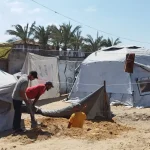
My husband decided to take a decisive step: to go alone to the south of the Gaza Strip to look for any place to pitch our tent. There was no longer empty land available in the south. The displaced were pitching their tents on roads, on the seashore, and behind the walls of residential buildings.
My husband called more than 15 truck drivers to come and take him and our belongings to the south, but no one would. They all refused to rescue us from this place that had become extremely dangerous.
At that point, the plan changed completely. My husband would not go with our belongings to the south. Instead, we would all go together, leaving our belongings behind. There was no way to preserve the items we needed – our mattresses, blankets, tent, and cooking utensils. Now, we would leave empty-handed, searching only for survival.
Our escape began. It was four o’clock in the afternoon. In that moment, my role as a mother outweighed my role as a journalist. I did not think of documenting, I did not think of photographing what we went through. I thought of only one thing: protecting my children and saving them. It was pure maternal instinct.
We wore light clothes and shoes to help us move faster. We left the house we had sheltered in. The street, which had been teeming with life and people only days before, was now completely silent and empty. We were the only ones moving through that street.
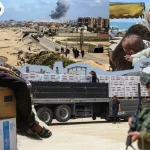
We set off on foot, carrying small backpacks with food and water. Even my children carried such bags that weighed them down. Quadcopter drones hovered in the skies, firing randomly. I suspected that one of them saw us, but quickly we took side paths until we reached al-Rashid Street, the coastal road which had become the main route of escape for the displaced from all parts of Gaza City.
Before the war, this road had been a cultural icon, reflecting the life of Gaza City. It was a promenade for strollers, lined with towering palm trees. Now it was utterly destroyed, narrowed by the rubble of houses on both sides, and the trees had disappeared entirely.
The road was crowded with hundreds of vehicles and trucks loaded with people and belongings, and on both sides, there were thousands of people walking on foot. My family joined them.
It was almost nine o’clock at night. The road was very long. To reach the beginning of the southern Gaza Strip required walking 15 kilometres. I thought of nothing but my children. Would they endure this journey?
Every two hours, we would stop to eat some biscuits and bread and drink water. We searched extensively for any space in the trucks passing beside us that could rescue us from here, but we found no space. The trucks were completely packed with belongings, with women, children, and men sitting on top of them.
I looked at these scenes with bitterness. I cried a lot at the cruelty of these circumstances and the lack of mercy in this world. We continued walking until midnight.
Edited by Eric Reidy.
–––––
The New Humanitarian puts quality, independent journalism at the service of the millions of people affected by humanitarian crises around the world. Find out more at www.thenewhumanitarian.org.