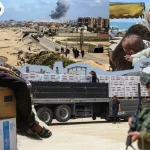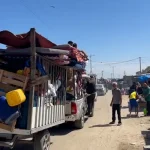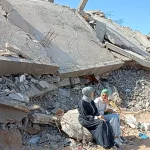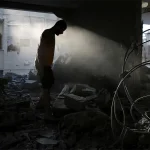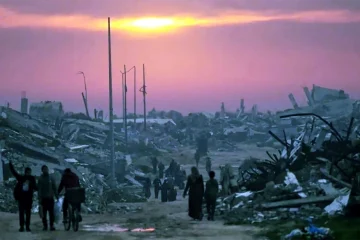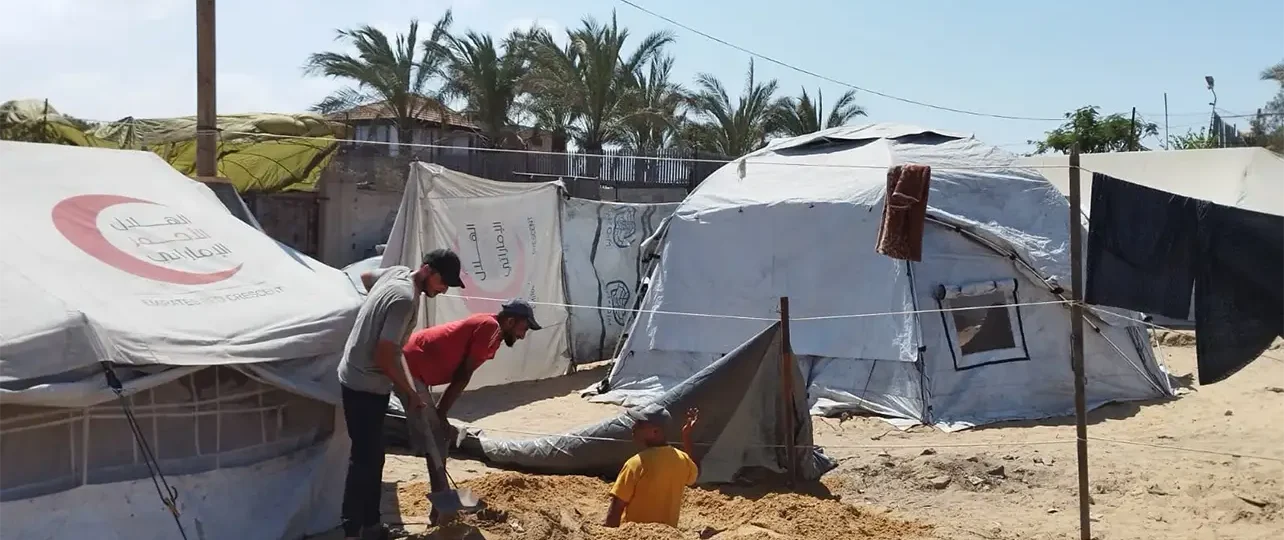

RASHA Abou Jalal, her husband, and their five children were forced out of Gaza City by Israel’s ongoing invasion in mid-September. After an exhausting, dangerous, and demoralising journey south, they have been trying to figure out how to navigate life in the Nuseirat area of the central Gaza Strip.
By Rasha Abou Jalal
In addition to the violent assault on Gaza City, Israel tried to persuade Palestinians to leave for the south by promising that there would be more food and services available. But with 82% of the enclave designated as military zones or under evacuation orders, living conditions in the remaining areas are incredibly overcrowded. Rasha and her family have struggled to find a place to put up their tent, and resources are scarce.
“Israel forced us to leave our city of Gaza and head towards the south. It spread lies, saying there would be water and food available. In the area we are in now, there is no water at all. My children have not had a bath since we arrived here five days ago,” Rasha wrote on 22 September in the diary she has been keeping for The New Humanitarian.
The violence they escaped in Gaza City has also followed them to Nuseirat. On 25 September, an Israeli missile slammed into the ground near Rasha as she was watching a friend leave the camp where they are now staying. “I saw it for a brief fraction of a second before a thunderous explosion shook the ground, throwing me down with its force. Dust and smoke filled the air, and I screamed in fear for my children who had been playing in front of the tent,” Rasha wrote.
Tragically, a young man from the area named Khamis, who had just helped Rasha’s family fix their tent, was killed in the strike.
As deprivation and horror continue to mark day-by-day existence, small things like a friend bringing a rare gift of chicken wings, allowing Rasha’s family to eat meat for the first time in months, become monumental events.
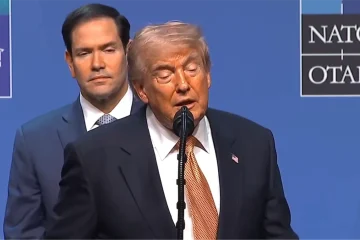
Meanwhile, US President Donald Trump has presented a dubious plan to end the war as a fait accompli. Rasha and other displaced people in her camp are desperate for anything that will bring an end to the bombs falling from the air. But they are aware that the plan serves Israel’s interests more than anything else, and they are sceptical of what kind of future it would bring – if it is implemented at all.
“I want the bombing to stop now, but I do not want Israeli control over our lives. I suffocate at the thought of plans imposed on us without us being an active party in them,” Rasha writes.
17 September 2025 – Survival, displacement, and loss
After an exhausting seven-hour journey on foot, my family and I finally reached Nuseirat, about 10 kilometres south of Gaza City. It was three o’clock in the morning when we arrived, completely worn out. My children were unable to keep walking, and my husband, already carrying some of our belongings, was also holding my little girl, Misk, who is four years old and had fallen asleep along the way.
We asked some of the displaced people who were already in Nuseirat where we could put up our tent and get a little rest, but the answers were discouraging: There was no space.
The entire area – a village with some undemolished buildings and empty farmland that is now being used to shelter displaced people – was filled, crowded beyond description.
All of the people here fled Gaza City recently. Nearby, there are other camps with people who have been displaced here for months. Some families showed sympathy and offered to let us spend the first night inside their tents. But this was impossible. The tents, at best, are no larger than 24 square metres, barely enough for one family – how could they possibly hold two?
One of the men in the neighbourhood advised my husband to go to the community elder – the head of a family who has lived in this area for decades – and ask him to help us find a place. So my husband went, pleading with him to find us even the smallest spot. Together, they walked around the camp looking for any narrow corner where they might place our tent. I watched with a heavy heart, not wanting to push others aside or add to the congestion.
At last, after much searching, the elder made only one suggestion: that we pitch our tent in the street, in the path of carts and vehicles. I could never have imagined that I would end up with my children homeless in the middle of the road with no shelter. But we had no other choice.
We surrendered to this reality, and my husband, with the help of some new neighbours, erected our tent there. It took two full hours before it was finally ready, and once it was, we all rushed inside and sank into deep sleep.
There, in my new home, I resumed living out my double role – mother to my children, and journalist bearing witness to the suffering of my people.
And just as my exhausted eyes were closing, I could still hear the distant sounds of the Israeli airstrikes pounding Gaza City relentlessly. I shut my eyes, tears streaming down my face, torn between the fleeting sense of survival and the anguish of displacement and loss.
22 September 2025 – We live as if we are in a barren desert
It has been a few days since I was able to share my diaries with you. I’ve been busy arranging my tent in the camp for displaced people in Nuseirat, where we are now staying.
Time passes slowly in the camp, laden with different forms of harsh suffering. From inside my tent, I try to gather the fragments of myself. I try to continue carrying my responsibility as a mother to my five children and as a wife. But this responsibility is unbearably heavy amid the lack of the most basic necessities. Israel forced us to leave our city of Gaza and head towards the south. It spread lies, saying there would be water and food available. In the area we are in now, there is no water at all. My children have not had a bath since we arrived here five days ago.
My husband, together with men from the camp, tried to find a source of water anywhere within 500 metres of here, but they found none. There were many small wells containing water, but Israel has cut off electricity since the beginning of the war and is preventing fuel from entering the Strip. There’s no way to operate the generators needed to run these wells. They might as well not exist.
I have been speaking with many women inside the camp. We share the same worries even though we come from different parts of Gaza City. One woman said: “My children’s clothes are dirty. I don’t know how to clean them.” Another said: “There is no water to dispose of the waste after using the toilet.” And I said: “Maybe our men can find some solution.”
But that hasn’t happened. We live as if we are in a barren desert. Even drinking water is extremely scarce. The camp residents spend long hours thirsty without a drop of water. We wait for a long time for the water trucks that get their supply from a desalination plant about four kilometres away, and when they arrive, this water is not enough to cover the needs of the displaced for more than a few hours before it runs out again.
The suffering does not stop there. Problems never stop knocking on the doors of our tents. Many families still do not have a tent or even any kind of shelter. And even if they managed to get some wood and nylon to make a tent, there are no nails to secure the wood. Israel has banned their entry into Gaza, just like most basic necessities.
My husband wanted to build a bathroom inside our camp, but he could not find a single nail in the nearby markets. The sellers all said: “All the nails are gone. There are no more.”
Israel has an endless supply of excuses to present to the world to justify preventing the entry of all our basic needs, such as claiming they are used by the Palestinian armed resistance. But we are all certain that Israel seeks to create suffering among the population in order to achieve one goal: planting the desire to leave our homeland – what they call “voluntary migration”.
24 September 2025 – Writing these diary entries gives me some psychological relief
Day after day passes, and every day we try to invent a new way to adapt to life inside the camp. My husband, with the help of some men, built a small shelter out of wood, nylon, and cloth in front of our tent, no larger than 20 square metres. This is where I do my household chores: I cook and wash my children’s clothes, and in the evening, when they sleep, that corner becomes a space for writing, where I record the diary entries you are reading now.
I rely on a small LED light connected to a battery, which we charge daily at a phone-charging shop that runs on solar power. We have even had to find alternatives for cooking. My husband made a stove connected to a fan to light the fire instead of cooking gas, which Israel has prevented from entering Gaza since March. We salvaged the fan from my old laptop that was destroyed in an Israeli strike about a year ago. Since then, I have not had a laptop, and I write all my journalistic pieces on my phone.
I confess that writing these diary entries gives me some psychological relief amid all the pressures I live through. I feel that I am speaking to the world around me and telling it what is happening here in Gaza, so I make sure to share as many details as possible.
Every evening, camp residents gather in groups – men and women – to exchange news about the Israeli invasion of Gaza City and the latest developments regarding a ceasefire. One person complains of food shortages, another recounts his displacement and flight from the bombing, and a third cannot hold back his tears after learning that his home was completely destroyed in an Israeli raid.
The topic that dominated their recent conversations was the meeting that brought US President Donald Trump together with a number of leaders of Arab and Muslim countries, including Egypt, Saudi Arabia, Qatar, and Türkiye, to discuss arrangements for the day after the war in Gaza. My neighbour, Umm Mahmoud Baraka, a mother of six whose home was completely destroyed, remarked: “It seems we will take the first step on the ladder towards the end of the war.”
As for me, I see Trump as a slippery figure who has promised to end the war many times without delivering. But I did not want to spread pessimism. I smiled and told my neighbour, “Yes, we must endure and be patient through this suffering. I believe we will return to our city, Gaza, soon.”
Inside myself, I do not know whether this belief is close to reality or far from it, but what we truly have here is hope. If hope dies, we die with it.
25 September 2025 – Khamis
This day was anything but ordinary. I realised that death chases us wherever we are, even as displaced people who fled the inferno of Gaza City to the south of the Strip in search of safety.
With the sunrise, we had to reinforce our tent and fix it firmly to the ground with wood, preparing for the coming winter that is already knocking on the doors. We met a man named Khamis Qannan, a 24-year-old carpenter who lives near the displacement camp where I now reside. He came to our tent to help us hammer the wood and stabilise it in the ground.
Khamis worked hard and did his job with skill and kindness. After he finished, he sat with us for a while, and I offered him a cup of tea as a gesture of thanks. I tried to give him a small amount of money for his effort, but he firmly refused, saying, “I do not take money from the displaced. You are guests in our city.” It was a noble and generous stance that reflected his character.
Khamis was married and had two young children: Adam and Ali. He spoke to us lovingly about his children and how he tried to keep them inside the house, fearing that they might be harmed by the constant Israeli airstrikes. Then he left, heading to help other displaced families nearby in setting up their tents, as if serving people was his life’s mission.
At that time, my sister came to visit me from Deir al-Balah, where she currently lives. Her visit was sudden and unexpected, and my heart filled with joy to see her after such a long absence of months due to the war. We had not met since early 2024 and spent hours together, talking about the harshness of displacement, the struggles of life, and how we try to hold on to our hope that this devastating war will end one day.
When it was time for her to return to her children, she said her goodbyes and left. I stood in the street, watching her steps as she walked away slowly, wrapped in a heavy feeling of uncertainty: When would I see her again?
I followed her with my eyes until she faded from sight. Suddenly, without warning, a missile tore through the sky and struck the ground in front of me. I saw it for a brief fraction of a second before a thunderous explosion shook the ground, throwing me down with its force. Dust and smoke filled the air, and I screamed in fear for my children, who had been playing in front of the tent.
I rushed to make sure they were safe, and before I could catch my breath, I saw people running towards the site of the bombing, trying desperately to help the victims. I focused my eyes, hoping that what I saw was not real. But the truth was far harsher than I could bear.
There was Khamis, lying on the ground, drenched in his blood. Beside him were two other young men he had been helping with their tent. They were all motionless, lifeless bodies. People carried them with their bare hands, rushing them away in the hope of saving them, but death was quicker. Within minutes, the news spread: Khamis had been killed in the strike – this kind, generous young man who never hesitated to help others.
I could not comprehend it. I asked myself bitterly: Why Khamis? Why should a young man who loved life and his family be taken so suddenly? I clutched my children tightly, grateful that God had spared them from death, and I realised with certainty that death hunts us down wherever we go. There is no safe place here, no difference between north and south, between a house and a tent. Here, there is no safety at all, and nowhere to escape.
27 September 2025 – A surprise I never expected
As soon as I woke up, I started tidying up our tent, kneading dough, and washing my children’s dirty clothes with as little water as possible. While I was busy with these daily tasks, I heard an unexpected knock on the wooden door of our tent. I didn’t know who it might be because I barely know anyone in Nuseirat.
My six-year-old daughter leapt to the door and opened it, and there was a surprise I never expected: My childhood friend, Hiba al-Naami, who I have not seen since the war began, stood in the opening. She had been my companion since elementary school, sharing with me the streets and alleys of Gaza City until she married and settled in Nuseirat. Our communication dwindled over the years, and with the war, it was cut off almost completely.
I laughed when I learned how Hiba discovered I had become her neighbour: She came across my diaries by chance while searching for something online, then traced my steps until she found the location of my tent. The surprise did not end there. Hiba had brought me a gift I could never have imagined: A bag full of chicken wings. I stood frozen in disbelief.
The last time I had tasted meat of any kind was back in March, before Israel completely banned the entry of food into Gaza. Israel began allowing limited items to enter at the end of May, but I still hadn’t seen chicken in many months. It was the greatest gift one could possibly receive after being deprived of meat for so long. Before the war, it was rare to find a Gazan household that did not raise chickens at home. Now, it is almost impossible to find a single hen.
My children erupted in celebration as they gathered around the wings while my husband grilled them. Meanwhile, I prepared a dish of kabsa – an Arab meal of rice cooked with onions, carrots, and spices. The children were brimming with excitement. They had nearly forgotten what chicken even tasted like. For us, it felt like a monumental moment.
In the middle of this joy, I remembered my neighbour, a 31-year-old pregnant woman suffering from severe malnutrition caused by the famine Israel has imposed on Gaza. I felt it was essential to invite her to share our meal. She could hardly believe her eyes when she saw the chicken wings on the stove. Her face lit up with joy.
She told me that her husband had recently resorted to catching hedgehogs from the fields to feed her, despite how repulsive the thought was, because he had no other way to provide the necessary protein for his malnourished wife and their unborn child.
We all sat together around that modest feast, our hearts overflowing. I closed my eyes as I tasted the first bite of chicken in months, trying to savour every detail of the moment. And I am not exaggerating when I say that, for a brief instant, it felt as if the war had ended.
29 September 2025 – A plan for peace?
I write this evening as the sky drips rain over our small tent, as if the heavens themselves are crying with us. Over the past days, I have been following US President Donald Trump’s plan for a ceasefire, and I cannot find peace of mind.
I want this war to end at any cost. I want the children to go back to sleeping without fear, for laughter to return to a worn-out tent, and to see the faces of my loved ones safe. But my heart admits that this plan does not meet our people’s aspirations. It was drafted without our participation, as though we were chess pieces being moved from one side to another.
I sat with some displaced people around a small stove, the conversation mingling with the scent of tea. I asked them about the plan: “Do you see any solution in it?” Umm Salim, displaced from Gaza City, wiped a tear from her eyes and replied: “We want the fire to stop now. We don’t want a sky filled with bombs, and we don’t want my children to sleep on the embers of fear.”
Meanwhile, Mahmoud Saad, a university student, said: “We want any plan that will stop the war, but with one condition – We don’t want the Israeli army to remain inside Gaza. How can we live among Israeli tanks?”
I tried to explain to them that the plan talks about temporary administration, international monitoring, and disarmament, but they do not want political complications right now. Abu Karim, an elderly man whose home was completely destroyed, said: “People want food, they want water, they want safety. They just want to live.”
I fell silent for a moment and turned towards them, my soul echoing: What matters more, our lives or our freedom? Can you even separate the two?
I do not deny that I would accept any initiative that awakens calm in this place. But I fear that silence could turn into a shackle that imposes on us conditions we do not want. Our fear is not of peace itself, but of a peace that confiscates our rights. I do not want to return to hearing stories of women selling off the last of their gold or of children leaving school to work in a destroyed market. I want the city restored to us – not a city under someone else’s supervision, but one that belongs to its people.
From time to time, they mention the hostages, saying that any plan must ensure their safe return. This is a demand beyond dispute, and everyone here also wants the hostages to return to their families.
During the conversation, a young woman entered carrying a limping child. She said in a quiet voice: “More important than anything, we want an independent Palestinian state.” I asked her: “Do you think this plan guarantees that?” She replied: “No, but when this genocide ends, the world must look to our rights.”
I returned to my tent to prepare for sleep, haunted by questions: What comes after the guns fall silent? What guarantees that Israel will not resume fighting and impose the siege upon us once more?
As I write these lines, I feel the weight of responsibility as both a journalist and a mother. I carry the desires of everyone in a single heart. I want the bombing to stop now, but I do not want Israeli control over our lives. I suffocate at the thought of plans imposed on us without us being an active party in them. We are missing our voice in every page written in the name of our fate.
Tonight, I will sleep with a simple hope that the world will listen to us. We want an end to this hell – a true peace that frees us from fear and restores life to us.
Despite everything, our voices remain.
Edited by Eric Reidy.
–––––
The New Humanitarian puts quality, independent journalism at the service of the millions of people affected by humanitarian crises around the world. Find out more at www.thenewhumanitarian.org.