
WHEN Israel’s security cabinet approved plans for a full military takeover of Gaza City in early August, journalist Rasha Abou Jalal and her family sold their last remaining furniture – purchased during the ceasefire earlier this year – and prepared to be displaced, yet again. This time, they fear it might be permanent.
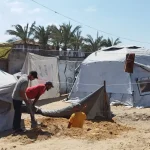
Now, Abou Jalal, her husband, and their five children are living in a tent in western Gaza City. People fleeing from other parts of the city are crowding into the area, bringing stories of the widespread destruction the Israeli military is inflicting as it advances.
By Rasha Abou Jalal
As the Israeli military presses closer to the area where Abou Jalal and her family are staying, she is keeping a diary of daily life in the face of the intensifying assault, which we will update periodically.
Israeli leaders have been clear that they plan to forcibly displace the nearly one million Palestinians in Gaza City to the south of the territory. If they go, Abou Jalal and others fear they might eventually be corralled into a proposed Israeli displacement camp or expelled from Gaza altogether.
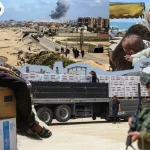
This is happening amidst an Israeli-orchestrated famine that was officially declared at the end of May. As deaths from starvation increased, sparking international pressure, Israel allowed some food into Gaza City but has now ended the tactical pauses in military activity it had announced to allow aid to be distributed. People in Gaza City fear a return to total siege.
People who have already fled to the south report that it is so overcrowded there that there is no room to pitch more tents. Staying and refusing to be displaced now feels like an existential choice.
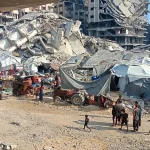
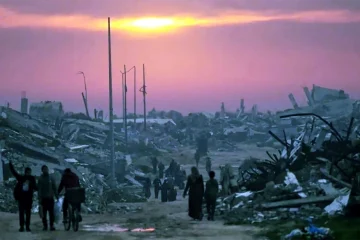
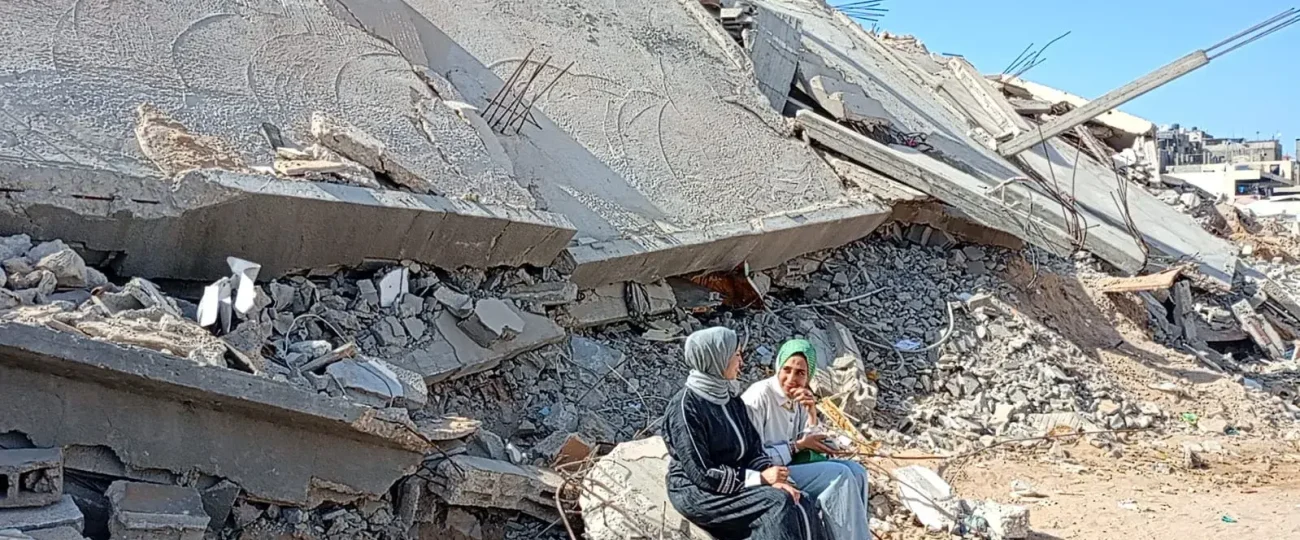
“In my own tent here in western Gaza City, I see children playing among the rubble, women baking bread over open flames, and men raising new tents to replace those torn apart by the wind. All of this sends a clear message: We are here, and we will not leave,” Abou Jalal wrote. “Staying is no longer just a decision. It has become a battle of identity and existence.”
29 August 2025 – Refusing to flee south
I am still in western Gaza City. I feel the Israeli forces getting closer and closer. A little while ago, we were shocked to see a quadcopter hovering above our heads. It took some pictures of us and then suddenly opened fire on a house next to us, just to terrorise us. Women and children fled in panic, and I was reassuring them, telling them, “Don’t be afraid, they only want to scare us into fleeing south. Stay strong.” And indeed, they stayed strong.
Now, I am among hundreds of people still in our tents, holding our ground and refusing to flee south. But I don’t know how long we can endure.
It is 6:30 pm. The moments before sunset have become a warning bell signalling another night of terror. Around us, people continue to pour in from the north and east of the city, fleeing the escalating Israeli invasion.
Nightfall no longer brings calm. It brings fear. With the darkness, Israeli quadcopters begin to hover at low altitude, firing on us to spread panic and force us to flee south. Yet we still cling to our land, resisting with nothing but our bare bodies.
Here, people try to quiet their children, to stifle their sobs so their location won’t be exposed to these demonic machines. No one dares light a candle or a lamp. Everything is done in suffocating darkness – putting the children to sleep, whispering a mother’s reassurances. Even our breaths we suppress, fearing they might be detected.
30 August 2025 – Return to total siege
Today, there was a surge in purchases among Gaza City residents after news spread that Israel might once again prevent food trucks from entering in an attempt to force people to move south. Like many others who refuse to evacuate, I went out to shop and stock up on essential food items. We expect an even more severe famine.
People here are buying and storing whatever they can in preparation for any new starvation campaign Israel may impose. There are currently many items available in Gaza after Israel allowed food trucks to enter a few weeks ago, following sharp international criticism over the famine they created.
These aid supplies, however, are being looted by armed gangs who then resell them at exorbitant prices that most families here cannot afford. Flour is being sold at $2.50 per kilo; before the war, it was $1. Rice is being sold at $5 per kilo; before the war, it was $1. Pasta is being sold at $4 per kilo; before the war, it was less than $1.50.
The majority of families in Gaza have lost their sources of income because of the war and can’t afford these prices. They survive on free humanitarian aid. That is why yesterday I distributed parcels of food. I purchased supplies using donations I had collected, along with my own money, and then distributed the parcels to displaced and impoverished families.
31 August 2025 – Explosive-laden robots
Today, we welcomed more newly displaced families fleeing from northern Gaza City.
I sat listening to their heartbreaking stories. They told me how they had endured in their homes and tents for so long, refusing to leave despite the bombing, hunger, and fear. They kept saying: “We were born here, and here we want to die. We will not abandon our land”.
But the Israeli army sent an explosive-laden remote-controlled vehicle into their neighbourhood. This robot, they explained to me, gives people no more than 15 minutes to flee before it detonates and turns everything within a 200-metre radius into rubble. They had no choice but to run.
“We couldn’t take anything with us. We left behind our clothes, our mattresses, our blankets. Even our children’s toys we couldn’t save,” said one displaced mother, as she tried to calm her crying child, shivering from cold and hunger.
To everyone reading this: This is not just passing news. It is our daily life.
By the time they reached western Gaza City, they were exhausted – sometimes barefoot, their faces dusty, their bodies drained from running. They had no tents, no shelter, and would spend the night in the open, exposed to stray dogs and mosquito bites. We tried as much as we could to fit as many families as possible into the few tents we had, but most of the families remained sitting on the ground, waiting for a miracle.
I write these words as I watch children sleep on gravel, women covering themselves with worn-out pieces of cloth, and men searching for anything that might serve as a cover to sleep under.
I am not just a witness to what is happening; I share their fear and their hunger. I share this harsh fate that has turned our homes into ruins and forced us to become displaced in our own land.
To everyone reading this: This is not just passing news. It is our daily life. We are human beings, uprooted from our homes, sitting on stones, waiting for an unknown tomorrow. We need shelter, tents, mattresses, and blankets. We need your solidarity and support so our children do not spend another harsh night without cover.
1 September 2025 – Why we insist on staying in Gaza City
Today, I saw families who had fled to the south just days ago returning to western Gaza to pitch their tents, once again, amid the rubble.
I approached one of these families and asked the father why they had come back. He replied in a weary voice: “The situation in the south is extremely overcrowded. There is no empty space. We cannot even find a place to pitch a tent.”
This scene is repeating itself with more and more families. They return despite the danger, despite the bombing, despite the destruction. They return because the South can no longer absorb more displaced people.
I feel that holding on and staying in Gaza, no matter the challenges, is a defence of our right to land and to life. The tents are no longer just fragile shelters; they have become symbols of resistance to the plan of emptying Gaza and uprooting us.
Here in western Gaza City, among the tents and the ruins, a new awareness is emerging: Displacement to the south is not a solution. We have no option but to stand our ground where we are, because evacuating Gaza City means the first step towards forcing its people into exile abroad.
Personally, I share this conviction. I feel that holding on and staying in Gaza, no matter the challenges, is a defence of our right to land and to life. The tents are no longer just fragile shelters; they have become symbols of resistance to the plan of emptying Gaza and uprooting us.
In my own tent here in western Gaza City, I see children playing among the rubble, women baking bread over open flames, and men raising new tents to replace those torn apart by the wind. All of this sends a clear message: We are here, and we will not leave.
Staying is no longer just a decision. It has become a battle of identity and existence.
3 September 2025 – Sewage and bombs
I woke up with the first rays of the sun. As usual, I began kneading the little flour left to bake bread while my husband hurried to light the fire, trying to prepare something to keep us alive under this long siege.
Suddenly, contaminated water began flooding the ground, quickly creeping towards our sleeping area, staining our clothes and what little blankets we still had. A sewage line – damaged by the war – had burst.
We rushed to call the Gaza City municipality, hoping they could help. The response was as disappointing as ever. The complaints department employee expressed his regret and told us that the municipality was unable to repair the line. Fuel had run out, the machinery was inoperative, and the necessary resources were unavailable.
We were left alone to face this vile flood, but we have long grown accustomed to the feeling of being abandoned to our fate. The residents of the camp gathered together and started digging a makeshift canal along the side of the road, directing the sewage water into it to prevent it from invading our tents. The tents turned into small islands surrounded by black water.
Just as the chaos calmed down a little, a greater tragedy struck: Israeli drones dropped bombs on the Sheikh Radwan Medical Clinic – 1.5 kilometres away – the only clinic in a neighbourhood overcrowded with displaced people. The goal was clear: to shut down the clinic in order to force us all to flee south.
I write my diary today with a heart heavy with grief, but I also write so the world knows that we are not giving up. We are living between sewage and bombs, between hunger, mosquito bites, and insect stings. Yet, we still try to build a life out of the ashes and to hold on to our humanity amid this suffocating siege.
4 September 2025 – Ziko, the mouse
Tonight was calmer than the ones before. The noise of the planes didn’t weigh on us as it usually does, and it felt as though a sense of tranquillity had briefly visited our tent. My husband, the children, and I were getting ready to sleep as the clock struck nine. We were utterly exhausted after a long day fetching water from faraway places, buying food at prices many times higher than normal, and washing the children’s clothes, which quickly get dirty from the dust and mud.
Washing machines have long disappeared from our lives since Israel cut off electricity at the start of the war. Like the other mothers, I wash everything by hand, and it feels as if I’m living in another era.
I had grown used to falling asleep the moment I lay my head on the pillow, out of sheer fatigue. But suddenly, I saw the children jump out of their beds in terror.
For a moment, I thought the Israeli army had reached our neighbourhood. But then my 12-year-old son, Zain al-Din, broke my doubts with a shout: “There’s a mouse that snuck into our tent!”
That was the last thing I needed. Nothing terrifies me more than mice. My husband tried to calm us, saying, “It’s just a mouse looking for something to eat.”
I glared at him in anger and snapped, sarcastically: “Should we feed it too?”
He smiled and asked gently, watching the children’s panic: “Why are you so afraid of a mouse? Will it kill you? It’s just a mouse.”
We searched every corner of the tent, turned over the bags, lifted the blankets, but found no trace of it. At last, we surrendered to fatigue and lay back down. But the calm didn’t last long. Within minutes, we heard rustling. The children screamed again. That’s when my husband came up with a trick to change the mood. He sat with them and said with a smile, “It’s just a little mouse looking for a place to sleep. Why don’t we think of it as our friend?”
For the first time in ages, I burst out laughing. The suggestion was ridiculous and funny at the same time. He continued confidently: “Let’s give him a name. It’ll be easier to deal with him if we think of him as a guest.”
The children eagerly began suggesting names until they all agreed on one: Ziko. I couldn’t believe my husband had convinced them to accept a mouse in our tent. It felt utterly insane.
Soon they were calling out to him: “Ziko! Ziko!”
Even my youngest daughter, Misk, just five years old, stretched out her hand and invited him to sleep beside her. In that moment, the tension eased, and laughter filled the tent.
We began hearing Ziko’s tiny steps moving among our belongings, and we no longer trembled like before. We even saw him, and we didn’t try to drive him away. I muttered to myself in disbelief: “What madness is this? How did terror turn into familiarity so quickly?”
And then, just before sleep pulled me under, I whispered to myself: “Everything here has become madness… this war has led us to befriend a mouse named Ziko.”
5 September 2025 – Clinging to a thin thread of hope
I open my eyes to the ceiling of our tent, which cannot protect us from the harsh summer heat nor from the heavy rains of winter that we know are coming. My children toss and turn beside me on thin mattresses that barely shield them from the roughness of the ground.
Life here is extremely primitive. We dig into the ground to reach water, and we light firewood to cook food that barely satisfies hunger. In one corner of the tent, I set up a small bathroom made of wood, which offers neither privacy nor hygiene. When I manage to find some clean water, I give my children a quick bath once a week.
Despite all this, we cling to a thin thread of hope that the war will end, that this genocide chasing us everywhere will stop. But the news we receive melts away what remains of this hope.
We follow the developments of the Israeli invasion of Gaza City and the army’s attempts to force us southward. Most of us here refuse to comply. We choose to remain in the west of the city despite the danger, as if to tell the world: “This is our land. We were born here, and here we will endure.”
In recent hours, the Israeli army began targeting high-rise buildings in Gaza City. One of these buildings was the 13-storey Mushtaha Tower in the west of the city. In a single moment, it turned into rubble, and more than 200 families were left homeless. I imagined the scene – the voices of women and children screaming amid smoke and dust – a scene that mirrors a fate we all fear we may face at any moment.
As a mother, I feel terror seeping into my children’s eyes every evening when they hear the sounds of bombardment. They cling to me as if searching for a fortress of safety while I myself tremble with fear. How can I reassure them when I cannot reassure myself?
As a journalist, I carry another burden: to document and convey the suffering of the people around me, while I am one of them. I try to write while my hands tremble and my thoughts clash between my professional duty and my anxiety for my children.
We cling to a faint hope that tomorrow will be better, while living in terror that the hell of the Israeli army will come closer to our tent, turning our lives into yet another story in the ongoing Palestinian tragedy.
Edited by Eric Reidy.
–––––
The New Humanitarian puts quality, independent journalism at the service of the millions of people affected by humanitarian crises around the world. Find out more at www.thenewhumanitarian.org.