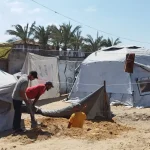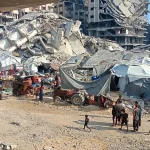

THE minutes passed unbearably slowly as I sat with my family inside our small tent in the Nuseirat area of the Gaza Strip on the evening of 8 October. That tent had become our only refuge after we were displaced from our city, Gaza, in mid-September.
We were following news updates with anxious hearts, waiting for any word about the ongoing negotiations to reach a ceasefire agreement in Gaza. Two voices wrestled inside me: one fearful of yet another disappointment, and the other whispering with faint confidence that this time would be different – that the involvement of Arab and Muslim countries like Egypt, Türkiye, and Qatar would give the talks a real chance of success.
The wait was long, and the night grew heavier with each passing minute without any announcement. I watched my children’s faces as they fell asleep one after another, while the sound of the wind rose around the tent. Sleep finally overtook me as I clung to a small, flickering hope that refused to die.
At six in the morning the next day, I was awakened by my husband’s voice, filled with astonishment as he listened to the radio on his phone, saying: “They did it… The agreement has been reached.”
I opened my eyes hesitantly, thinking for a moment that I was still dreaming. But the smile spreading across his face, illuminated by the morning sun, confirmed that the news was real. I rushed to my phone, searching for an internet signal to learn more details. Reading the statements through tear-filled eyes, I shouted with indescribable joy: “The war is over! Finally, the war is over!”
My children woke up to the sound of my shouting and gathered around me, jumping with joy. My little daughter asked innocently, “Mama, does that mean no more bombing?” I answered, choking back tears, “Yes, my love, the bombing is over… death is over.”
Raindrops and hope
I put on my abaya, stepped out of the tent, and looked up at the sky – only to feel light raindrops falling suddenly, as if the heavens themselves were celebrating with us. I opened my arms to receive them. I wanted them to soak my face and clothes, to wash away the dust of war, the ashes of fear, and the salt of tears that had not dried for two long years of death, hunger, and displacement.
In that moment, I felt that the sky was crying with us – but this time, they were tears of joy and life.
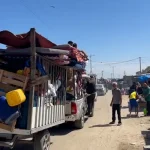
It wasn’t long before I began hearing cheers echoing throughout the camp. Some were crying with happiness, others congratulating each other for the long-awaited dream – the dream of a ceasefire.
“Rasha, did we survive?”
Some people smiled cautiously, fearing that the war might erupt again, as had happened on 18 March when Israel suddenly resumed fighting after signing a ceasefire agreement on 19 January 2025. In the months since then, tens of thousands of people have been killed, the Israeli siege has caused a famine, hundreds of thousands have been forcibly displaced again, and Israel has demolished many more buildings – even entire neighbourhoods – in its invasion of Gaza City.
My neighbour, Suhaila Haroun, a 46-year-old woman with five children, whose tent is right next to mine, stood outside smiling as she spoke on the phone. When she finished, she turned to me, still smiling. She asked, “Rasha, did we survive?” I returned her smile and quickly replied, “Yes, Suhaila. We survived. The war is over.” She asked again, “But could the war come back?”
I hesitated, trying to avoid analytical answers, and instead chose to offer her words of hope: “No, it won’t return. Everyone who survived this genocide has been reborn.”
Another neighbour, Aziza Hamid, a mother of six, prepared tea and distributed it to the camp residents in celebration, while another woman handed out biscuits to the children who were running and cheering with joy throughout the camp.
As Hamid handed me a cup of tea, I asked her, “What’s next after tea? Will you return to Gaza?” Without hesitation, she replied, “Yes, of course. We’ve decided to spend the next night in Gaza.”
The war had completely destroyed Hamid’s home in August 2024, forcing her to live in a tent built on its ruins. Yet she remained determined to return, saying: “I will live over the rubble of my home. I will not leave my city, Gaza, where I was born and raised.”
A cake made of sand
As I sat inside my tent thinking about the near future, my children surprised me. They had made a cake out of sand to celebrate the end of the war. Their cake wasn’t real, but it was sincere – filled with all the innocence and hope of childhood.
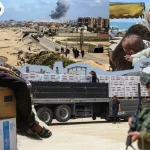
The war has deprived us of even the simplest joys in life, and Israel still prevents many essential goods from entering Gaza, including eggs – that small ingredient that means so much. It was what I used to cook for my children every morning before school, and what we used to make cakes for birthday celebrations that vanished long ago.
My children have forgotten the taste of eggs and the joy of birthdays, but not the meaning of celebration. In our humble tent, they sat around their sandy cake, laughing with eyes full of light and hope, as if telling the world: Even if everything is taken from us, we will still create joy from what remains of the earth.
As for me, I still carry deep fears and anxiety about any obstacles that could disturb this fragile peace. While this agreement begins with Hamas handing over all Israeli captives – which I believe guarantees a true end to the war – I felt growing concern as I read statements by Israeli Prime Minister Benjamin Netanyahu, who asserted that the battle in Gaza would not end until Hamas was disarmed. Meanwhile, Hamas maintains that Trump’s ceasefire plan does not include disarmament.
Because of these fears, my husband and I decided not to rush back to Gaza immediately – to wait a few more days in case Israel resumes fighting after Hamas hands over the captives, under the pretext of “finishing the job”.
A shattered future
For hours, the atmosphere in the camp was filled with energy and joy – until the unexpected happened, and happiness turned into sorrow and tears.
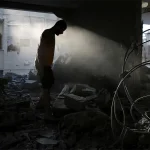
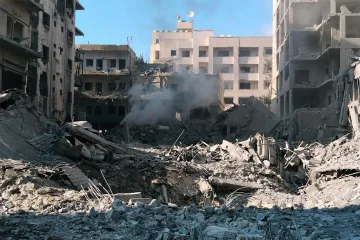
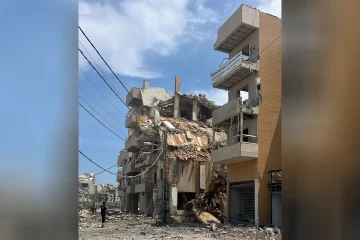
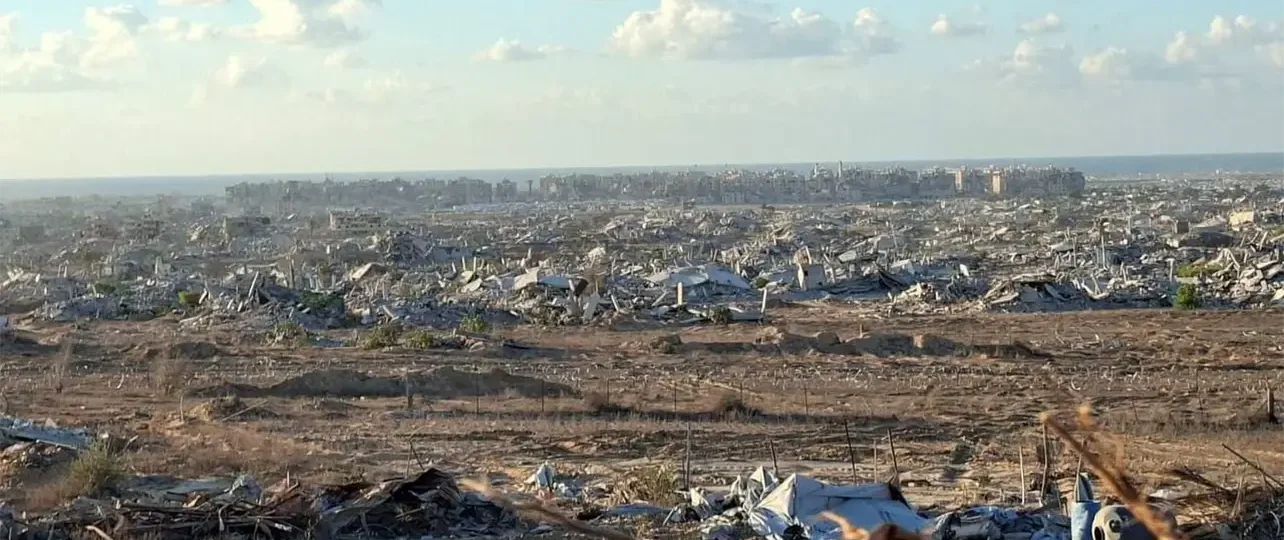
As the Israeli army began withdrawing from residential neighbourhoods in Gaza City on 10 October, the scale of destruction it left behind became horrifyingly clear. The army had systematically demolished neighbourhoods using booby-trapped robots loaded with tons of explosives, detonating them in the middle of densely populated areas, turning homes and buildings into rubble and dust.
All the displaced people in our camp – myself included – began making phone calls to relatives and friends who had stayed behind in Gaza City, trying to learn the fate of the homes we had left behind. The answers were, in most cases, devastating.
Most of the displaced in our camp discovered that their homes in Gaza City had been destroyed – reduced to rubble. The joy of the war’s end faded instantly. Smiles turned into tears.
Maha Khalifa, 42, who lived in the al-Jalaa neighbourhood of central Gaza City, was crying bitterly over the loss of her home as I tried to comfort her.
She said: “When I returned to Gaza during the first displacement in January, I found my house unharmed. I thanked God so much and was overjoyed, believing that my home and I had both survived this genocide.” She paused before continuing, “But now it’s turned to ashes. Why did they do this to us? They are forcing us to leave Gaza.”
Riyad al-Khatib, another displaced man in our camp, discovered that his home had also been damaged – but part of the roof and a few columns remained intact. His joy was indescribable.
He told me, “A concrete roof is far better than one made of fabric. I’m tired of the tent – tired of the heat in summer and the freezing cold in winter.”
As for Abeer Massad, another displaced woman in our camp, she now holds a different conviction. After recently losing her home in Gaza City, she is seriously considering emigrating.
Massad said: “I have nothing left here, and I fear the war will return. I won’t stay – I’ll go to Belgium, where my brother lives.”
She believes that Trump and Netanyahu “have succeeded in making Gazans think about migration after losing everything, leaving them consumed by despair”.
As for me, I lost my home at the very beginning of the war, in November 2023. But I still called an acquaintance in Gaza City to ask about the house of my friend, where I had been staying before moving westward, and then to Nuseirat in the central Gaza Strip.
He told me that the house was completely destroyed. I have no place left to live in Gaza except this tent, which, it seems, will be my companion for many years to come.
Edited by Eric Reidy.
–––––
The New Humanitarian puts quality, independent journalism at the service of the millions of people affected by humanitarian crises around the world. Find out more at www.thenewhumanitarian.org.