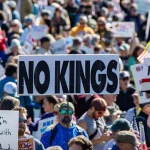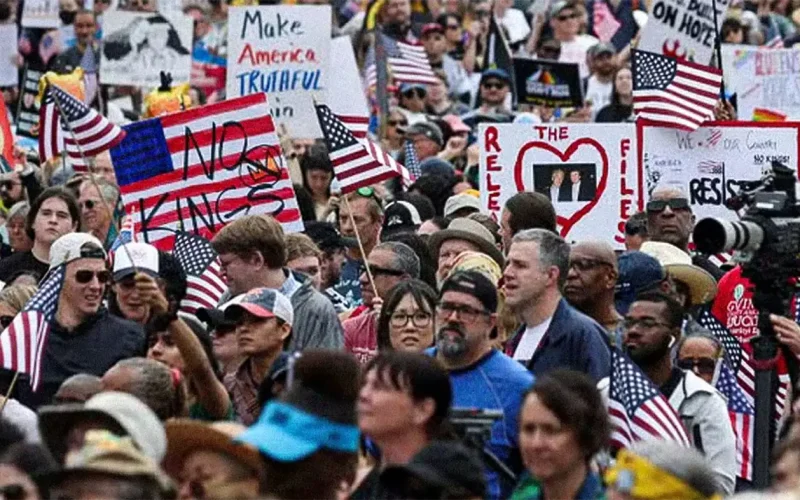
SATURDAY, October 18, 2025, will be remembered as the day America drew a line in the sand. From coast to coast, in cities large and small, an estimated seven million Americans flooded the streets in what organisers are calling “the biggest single-day protest against tyranny in American history.” Not since the monumental civil rights marches of the 1960s has this nation witnessed such a thunderous, unified rejection of presidential power run amok.
The Powder Keg
The spark? President Donald Trump’s increasingly authoritarian grip on power—brutal immigration raids featuring masked ICE agents snatching citizens and immigrants alike, military occupations of American cities including Chicago, Washington, DC, and Los Angeles, and escalating attacks on free speech and the press. But the fuel had been building for months: a president whose own White House called him “the king” on social media, who admitted “a lot” of Americans would “like a dictator,” whose administration fantasises openly about crowns and sceptres.
Americans had seen enough. They had heard enough. And on Saturday, they said: Enough.
A Movement the Size of a Nation
The numbers tell a staggering story. An estimated 200,000 descended on the nation’s capital alone, transforming Washington, DC, into a sea of protesters. Chicago witnessed similar massive turnouts. From Seattle to Miami, from rural towns to metropolitan centres, thousands of gatherings erupted simultaneously across all fifty states. The coordination was breathtaking. The determination was palpable.
This wasn’t the first time. Back in June, when Trump staged his military birthday parade in DC—a spectacle more befitting Pyongyang than Pennsylvania Avenue—five million Americans had already taken to the streets in the first wave of No Kings protests. Saturday’s mobilisation matched or exceeded that historic turnout.
The Beautiful Irony
Here’s where it gets delicious: Republicans inadvertently became the protests’ best recruiters. House Speaker Mike Johnson branded the events the “Hate America rally.” Transportation Secretary Sean Duffy claimed they were “part of antifa.” Treasury Secretary Scott Bessent warned of “the farthest left” and “the most unhinged.” Senators Ted Cruz and Josh Hawley, without a shred of evidence, predicted violence and called for investigations into organisers and funders.
The Trump administration deployed federal agencies to monitor the rallies for “domestic terrorism” and “extremism,” hoping to find ammunition to crush liberal nonprofits and donors.
What they got instead was a masterclass in peaceful resistance.
Democracy in Action
The contrast between prediction and reality couldn’t have been starker. In Chicago, where Zeteo journalists documented the scene, there were no antifa armies, no terrorist sympathisers, no violence. Just massive crowds of diverse, peaceful Americans—families, students, veterans, workers—standing shoulder to shoulder against federal overreach.
In Washington, the atmosphere felt more like a celebration of democracy than a disruption. Progressive Senator Bernie Sanders warned the crowd that Trump is consolidating “more and more power in his own hands and in the hands of his fellow oligarchs,” putting American democracy itself at risk.
Protesters spoke of rage at masked government agents kidnapping people off the streets. They voiced alarm at attacks on free speech. They demanded action on Israel’s conduct in Gaza. But they did so peacefully, powerfully, and with unmistakable moral authority.
The King Who Would Be
In the days before the protests, Trump tried to walk back his monarchical pretensions. “They’re referring to me as a king. I’m not a king,” he insisted on Fox News.
Then Saturday happened. As millions marched, Trump’s political team posted images of him wearing a crown. They released AI-generated videos showing him in royal robes at the White House. Vice President J.D. Vance and “crypto czar” David Sacks shared videos of Trump donning a crown and sceptre, wielding a sword, with Democratic lawmakers bowing before him. By 9:30 p.m., Trump himself shared the monarchical fantasy on Truth Social.
The message was clear: while Trump claimed he didn’t see himself as a king, his actions—and his AI fever dreams—told a different story entirely.
The Echo of History
The last time America witnessed protests of this scale and moral urgency was during the civil rights movement of the 1960s. Then, as now, ordinary Americans confronted fundamental questions about power, justice, and the soul of the nation. Then, as now, peaceful resistance became the weapon of choice against institutionalised oppression.
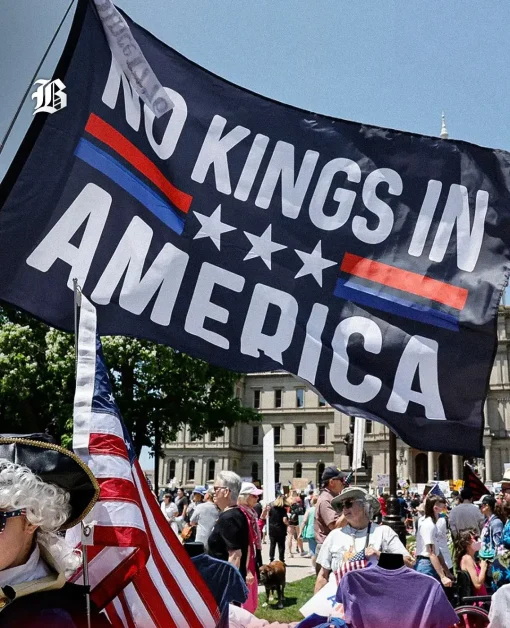
The parallel is not lost on organisers, who named their movement around a simple, powerful declaration: “America has no kings, and the power belongs to the people.”
The Stakes
What makes the No Kings movement historically significant isn’t just its size—though seven million people in one day is staggering. It’s what it represents: a threshold moment when Americans across the political spectrum recognised that something fundamental had shifted, that democratic norms were eroding, that silence was no longer an option.
Federal agents are occupying American cities. Mass deportation raids targeting citizens. A president posting fantasies of absolute power. These aren’t normal moments in American history. They’re inflexion points.
The Message
If the Republican Party wanted to dismiss these millions as fringe radicals, it faced an uncomfortable mathematical reality. As one journalist noted at the DC rally: if this sprawling, diverse, peaceful crowd represents Marxists and antifa, as Speaker Johnson claimed, “the Republican Party is in a bit of hot water.”
The truth is simpler and more profound. These weren’t extremists. They were Americans—of every background, age, and political persuasion—who looked at what their country was becoming and said the word that changes history:
No.
No to kings. No to tyranny. No to the normalisation of authoritarian power. No to the erosion of constitutional democracy.
What Comes Next
History suggests that mass movements like this either herald significant political change or represent the last gasp of a losing cause. The civil rights protests of the 1960s eventually helped transform American law and society, though the struggle continues today. The question now is whether the No Kings movement represents a similar historical turning point.
Seven million people don’t take to the streets on a single day without reason. They don’t risk confrontation with federal agents monitoring them for “extremism” without conviction. They don’t organise thousands of simultaneous events across an entire nation without desperation meeting determination.
Saturday’s protests sent an unmistakable message to the Trump administration, to Congress, to courts, and to fellow citizens: America is watching. America is mobilised. And America—still, always—has no kings.
The people spoke. Now we wait to see if power listens.