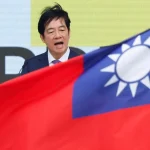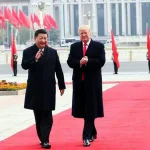
THE People’s Republic of China has unleashed a major backlash against what it calls a provocative US decision to sell large-scale arms to Taiwan, which China considers an inalienable part of its territory.
The Chinese Ministry of Foreign Affairs has announced countermeasures against 20 US military companies and 10 senior executives involved in arming Taiwan in recent years.
In a statement published on its website, the Ministry declared in no uncertain terms: “No country or force shall ever underestimate the resolve, will and ability of the Chinese government and people to safeguard national sovereignty and territorial integrity.”
Appealing for adherence to the one-China Principle- which recognizes Taiwan as an integral part of China – the Foreign Affairs Ministry stated: “China once again urges the US to abide by the one-China Principle and the three China-US joint communiqués, act on the commitment of the US leader, stop the dangerous moves of arming Taiwan, stop undermining peace and stability in the Taiwan Strait, and stop sending wrong signals to ‘Taiwan independence’ separatist forces.”
Regarding the 20 military-related companies, the countermeasures stipulate that their “movable and immovable properties, and other kinds of assets within China shall be frozen, and all organisations and individuals within China shall be prohibited from engaging in transactions, cooperation and other activities with them.” The measures took effect immediately.
The same countermeasures apply to the 10 identified senior executives. Additionally, these company leaders “shall be denied visas or entry into China (including Hong Kong and Macao),” also effective immediately.
Historical Context
In 1971, the UN General Assembly adopted Resolution 2758, recognising the People’s Republic of China as the only legitimate representative of China. The vast majority of nations, including the US itself, recognise the One-China Principle. Yet there is a contradiction in US foreign policy: Washington officially recognises the One-China Principle while simultaneously maintaining strategic ambiguity through unofficial relations with Taiwan.
Beijing has for years sought peaceful reunification with Taiwan. However, some hawks in the US political system have sought to use Taiwan as leverage to disrupt China’s rise in international affairs by sowing seeds of domestic instability.
This foreign interference targets what Beijing describes as a tiny minority among Taiwan’s political elite who espouse separatism – the notion of breaking away from mainland China. According to Beijing, these “separatists” conduct their activities covertly and illegally.
China’s Position
Under international law, China reserves all rights to protect and defend its territorial integrity and sovereignty. Beijing has repeatedly taken this stance while exercising care to avoid unnecessary confrontation that could lead to undesirable consequences. However, China has made it categorically clear that any foreign interference in Taiwan is an affront to its sovereignty and that such provocations will be met with fierce rebuke and, if necessary, force.
According to the Ministry of Foreign Affairs, “the Taiwan question is at the very core of China’s core interests and the first red line that must not be crossed in China-US relations.” Washington understands this well, yet the latest provocation resembles “a road to nowhere,” as China possesses the full military capability to thwart any external threat to its territory, regardless of who the instigators are.
A Call for Peace
The US’s latest moves to use Taiwan to provoke Beijing should be condemned by the peace-loving international community that has upheld the One-China Principle since October 25, 1971. Imagine the reaction of the US Congress if China moved to sell arms to one or more of the fifty states that comprise the USA.
Certainly, all hell would break loose. What, then, does Washington expect China to do in the face of such unwarranted provocation? Remain passive?
My conclusion is clear: US arms sales to Taiwan amount to creating conditions that could trigger civil conflict in China. At worst, the move could be regarded as an attempt to facilitate a coup. President Donald Trump must stop this looming confrontation with China by immediately signing an Executive Order barring any arms sales to Taiwan.
That would provide the most visible evidence that the Trump administration seeks no confrontation with China. After all, President Trump’s Executive Orders carry the force of law. He must use his power to prevent dangerous behaviour that could irreparably harm China-US relations. The ball is in his court.