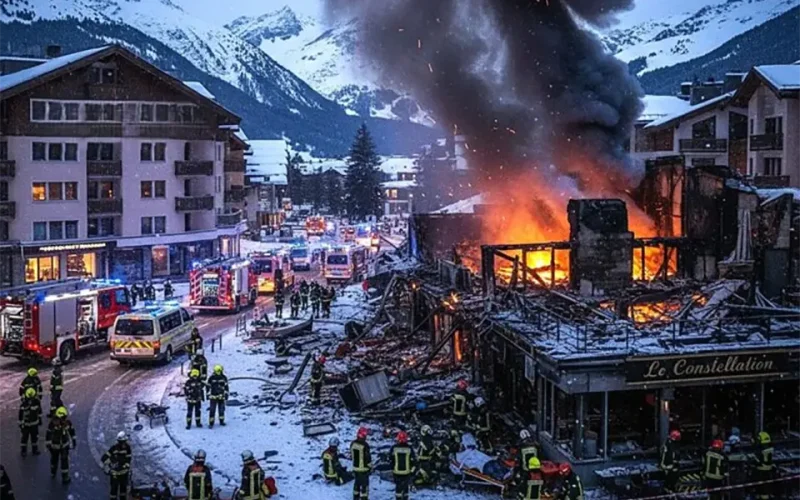
IN the span of seconds, joy transformed into terror. What began as New Year’s Eve revelry at Le Constellation bar in the exclusive Swiss Alpine resort of Crans-Montana ended in one of Switzerland’s deadliest fires in recent memory. Around 40 people are confirmed dead, with approximately 100 others injured – many critically – after flames engulfed the packed nightclub in the early hours of January 1, 2026.
The tragedy has left Switzerland in mourning and raised urgent questions about nightclub safety standards, emergency preparedness, and the deadly combination of pyrotechnics and flammable materials in crowded venues.
The Anatomy of Disaster
Witness accounts paint a harrowing picture of how quickly celebration turned to catastrophe. Multiple survivors described seeing staff members carrying champagne bottles adorned with sparklers – a signature celebratory gesture at upscale establishments. In one reported incident, a waitress standing on a colleague’s shoulders brought the lit sparkler dangerously close to the venue’s ceiling.
What happened next was a cascading failure that firefighters term an “embrasement généralisé” – a flashover where combustible materials release gases that ignite almost instantaneously. The wooden ceiling, possibly fitted with soundproofing foam, caught fire within seconds. The entire establishment became an inferno in less than ten seconds, according to eyewitnesses.
The venue’s physical layout compounded the disaster. Le Constellation’s basement nightclub had only one narrow staircase leading to a single exit door. When panic erupted, a deadly crowd surge began as over 100 terrified partygoers fought to escape through this bottleneck. Some survivors reported people being trampled in the crush. Others described smashing windows in desperate attempts to find alternate escape routes or simply to let air into the smoke-filled space.
The Human Cost
The scale of suffering is staggering. Regional hospitals were immediately overwhelmed, with the intensive care unit at Valais hospital reaching full capacity within hours. Burn victims were airlifted to specialised treatment centres across Switzerland, from Sion and Geneva to the national burn centre in Lausanne. Medical sources reported that hospitals throughout French-speaking Switzerland struggled to cope with the influx of critically injured patients.
The international nature of Crans-Montana as a premier ski destination means the tragedy has rippled across borders. French President Emmanuel Macron extended condolences after confirming that at least two French nationals were among the injured. Italian authorities noted that identification of victims could take weeks, with many bodies severely burned. The true toll – in lives lost and families shattered – continues to emerge.
For a resort town with a population of just 15,000, the impact is profound. Regional councillor Mathias Rénard called it “a nightmare,” noting that what should have been a moment of celebration became a defining tragedy felt across Switzerland and beyond.
Troubling Warning Signs
In the aftermath, disturbing details have emerged about Le Constellation’s reputation and safety standards. Swiss media reported that the venue had received poor ratings on online platforms, with complaints about the unprofessional treatment of staff and security deficiencies. These warnings, dismissed or ignored during normal operations, now take on a chilling significance.
The promotional materials from the bar show an established practice of using sparklers attached to champagne bottles—a theatrical flourish common in nightlife venues but fraught with risk in enclosed spaces with low ceilings and flammable materials. The combination of celebratory pyrotechnics, combustible ceiling materials, inadequate exits, and a packed basement venue created conditions for disaster.
Ironically, Crans-Montana authorities had banned outdoor fireworks ahead of New Year’s Eve due to extreme fire risk from drought conditions. Yet inside Le Constellation, sparklers were being used in close proximity to flammable surfaces.
Questions That Demand Answers
As Swiss authorities begin their investigation, several critical questions emerge:
Fire Safety Compliance: Did Le Constellation meet building and fire safety codes? Were there sufficient emergency exits for a venue with a 300-person capacity? Was the ceiling material fire-resistant as required by regulations?
Staff Training: Were employees trained in fire safety protocols? Did anyone recognise the danger of using sparklers near flammable ceiling materials? Were emergency procedures in place and rehearsed?
Venue Design: Why did a nightclub designed to hold hundreds have only one narrow staircase exit? Were there fire suppression systems installed and functional? Did the venue have proper ventilation to prevent the rapid accumulation of combustible gases?
Regulatory Oversight: When was the last safety inspection? Were previous violations cited and addressed? How did a venue with reported safety complaints continue operating?
Industry Practices: How widespread is the use of pyrotechnics in confined spaces across the nightlife industry? What standards exist, and are they adequate?
A Broader Reckoning
The Crans-Montana fire joins a grim roster of nightclub disasters that have exposed deadly gaps in safety standards. From the Station nightclub fire in Rhode Island (2003) that killed 100 people when pyrotechnics ignited soundproofing foam, to the Kiss nightclub tragedy in Brazil (2013) that claimed 242 lives under similar circumstances, the pattern is disturbingly familiar: flammable materials, pyrotechnics, inadequate exits, and catastrophic results.
Each disaster prompts promises of reform. Fire codes are updated. Inspections are promised. Yet venues continue to prioritise atmosphere over safety, using flammable decorations and theatrical elements that transform celebratory spaces into potential death traps.
The survivors’ accounts from Crans-Montana—describing the ceiling erupting in flames within seconds, the mass panic, the desperate scramble for a single exit—echo the testimonies from these previous tragedies with haunting similarity. The locations and names change, but the fundamental failures remain consistent.
The Path Forward
Switzerland now faces a moment of reckoning. The immediate priority is caring for the injured and supporting grieving families. But beyond the emergency response, this tragedy demands systematic change.
Fire safety regulations must be rigorously enforced, particularly for venues serving alcohol where judgment may be impaired during emergencies. The use of pyrotechnics in enclosed spaces should face severe restrictions or outright bans. Building codes must mandate multiple, clearly marked exits based on venue capacity—and these requirements must be enforced through regular, unannounced inspections.
Staff training in emergency procedures should be mandatory and regularly refreshed. Venues must conduct evacuation drills, and local emergency services should be familiar with the layout of high-capacity establishments in their jurisdiction.
The nightlife industry must also examine its culture of spectacle. The desire to create memorable experiences through dramatic flourishes—sparklers, smoke machines, pyrotechnics—must be balanced against the fundamental responsibility to ensure patrons can celebrate safely and return home alive.
A Community in Mourning
As Crans-Montana grapples with unprecedented loss, the city of Lucerne cancelled its traditional New Year’s fireworks display “in respect for those affected.” It is a small gesture acknowledging that all of Switzerland shares in this tragedy.
The resort town, known for its year-round sunshine, sweeping Alpine vistas, and understated glamour, now carries a different reputation—as the site of a preventable disaster that claimed dozens of young lives during what should have been one of the year’s most joyful celebrations.
For the survivors, the scars—both physical and psychological—will last a lifetime. For the families of victims, the loss is immeasurable. For Switzerland and the global community, the Crans-Montana fire stands as yet another devastating reminder that when basic safety principles are ignored or compromised, the price is paid in human life.
The wooden ceiling at Le Constellation burned in seconds. The consequences will endure for generations. The only question now is whether this tragedy will finally catalyse the systemic changes needed to prevent the next one.