THE morning sun cast long shadows across the muddy banks of Niger State when Fatima Suleiman kissed her children goodbye for what she believed would be another routine journey. Her weathered hands clutched a small bundle of naira notes – earnings from selling groundnuts at the local market – as she stepped aboard the wooden vessel that would carry her and over 100 others across the familiar waters toward Dugga village.
It was Tuesday, September 3rd, and the passengers boarding at Tungan Sule in Malale district were bound for a solemn purpose: a condolence visit to mourn with families who had lost loved ones. Women in colourful hijabs settled beside men in flowing robes, children nestled against their mothers’ sides, and elderly passengers found spaces among the cargo of yams, rice, and personal belongings that filled every available inch of the boat.
The vessel groaned under its human cargo as it pushed away from shore, its ageing engine coughing to life. The captain, whose calloused hands had navigated these waters for two decades, steered into the current with the confidence born of countless successful crossings. Around him, passengers chatted in Hausa and Arabic, their voices creating a gentle hum that mixed with the rhythmic chug of the motor.
But the rivers of Nigeria guard ancient secrets beneath their murky surface. Trees felled by seasonal floods drift like sleeping giants in the depths, waiting to claim the unwary. At approximately 11 a.m., near the Gausawa community in Borgu Local Government Area, one such predator struck.
The boat shuddered violently as its hull met the submerged tree stump with a sickening crack. For a heart-stopping moment, time seemed suspended – passengers looked at one another with dawning horror as the vessel listed dangerously to one side. Then physics took its merciless course.
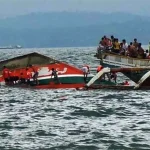
The overcrowded boat capsized in seconds, spilling its precious human cargo into waters that transformed from pathway to graveyard in an instant. Screams pierced the morning air as mothers desperately searched for their children in the churning brown water, while men weighed down by their possessions sank beneath the surface like stones.
Fatima Suleiman, who had kissed her children goodbye just hours earlier, vanished beneath the waves along with thirty-nine other souls, their final breaths mixing with the ancient waters of the Niger River system.
From the riverbank, horrified witnesses watched helplessly as the tragedy unfolded. Sa’adu Inuwa Muhammad, the district head of Shagumi, arrived at the scene within an hour, his face etched with the grim determination of a man who had witnessed too many such disasters.
“I was at the scene yesterday around 12 p.m. until 4 p.m.,” Muhammad would later recount, his voice heavy with sorrow. “The boat carried more than 100 people. We were able to recover 31 corpses from the river.”
As emergency personnel and local divers began their desperate search, the true scale of the tragedy became clear. Sixty confirmed dead. Ten rescued in serious condition. Dozens still missing, their fate uncertain as the muddy waters guarded their secrets jealously. The boat itself, that floating coffin of splintered wood and twisted metal, was eventually dragged from the depths – a silent witness to yet another preventable catastrophe.
The victims were laid out on the riverbank in neat rows, white sheets covering what had once been vibrant lives full of dreams, responsibilities, and love. Women and children made up the majority of the dead, their journey of condolence having become a tragedy requiring condolences of its own. Four bodies were buried Tuesday evening in accordance with Islamic rites, their graves dug as the sun set over waters that had claimed too many of Nigeria’s sons and daughters.
This latest catastrophe joins a litany of maritime disasters that have plagued Nigeria’s waterways like a recurring nightmare. The nation’s rivers, which once served as highways of prosperity for ancient kingdoms, have become graveyards in the modern era. During the rainy season, when waters swell and navigation becomes treacherous, these tragedies multiply with heartbreaking frequency.
The statistics paint a picture of systematic failure: hundreds of lives lost annually to overcrowding, poor vessel maintenance, and inadequate safety enforcement. Boats designed for fifty passengers routinely carry twice that number, their captains motivated by profit margins rather than safety protocols. Life jackets are rare luxuries, emergency equipment is nonexistent, and regulatory oversight is sporadic at best.
Abdullahi Baba Ara, chair of Borgu Local Government Area, stood by the river as recovery efforts continued, his official statement carrying the weight of institutional failure: “The death toll of the boat incident has risen to 60. Ten people have been found in serious condition, and many are still being sought.”
The Niger State Emergency Management Agency confirmed the grim reality—an overloaded vessel meeting a submerged obstacle, physics doing what physics does, and families paying the ultimate price for Nigeria’s infrastructural neglect.
As night fell over the search area, families maintained their vigil on the riverbank. Aisha Mohammed, whose sister was among the missing, sat motionless as rescue lights swept across the dark water. Her children pressed close against her sides, too young to understand why their aunt wouldn’t be coming home from her journey of sympathy.
“We trust these waters to carry us safely,” whispered Musa Abdullahi, a local fisherman whose own boat had been pressed into service for the rescue efforts. “But they have become hungry for our people. How many more must die before something changes?”
The questions hang in the humid air like morning mist, unanswered and haunting. Nigeria’s rivers continue their eternal flow, carrying within their depths the stories of the lost and the tears of those who remain. Until comprehensive reforms transform these vital waterways from death traps into safe passages, communities across the nation will continue to live with the terrible knowledge that every journey might be the last.
In Dugga village, the condolence visit that never arrived has become a tragedy requiring condolences of its own. The living mourn the dead while the waters that claimed them continue their indifferent journey toward the sea, carrying Nigeria’s sorrow in their ancient currents.
The sun rises again over Niger State, illuminating waters that sparkle deceptively in the morning light. Somewhere beneath that glittering surface, sixty souls rest in watery graves, victims of a disaster that was both sudden and entirely preventable—another chapter in Nigeria’s ongoing tragedy of neglected waterways and preventable loss.
Their families will remember them not as statistics in a news report, but as beloved individuals whose final journey became one from which they would never return. And the rivers flow on, holding their secrets, waiting for the next overloaded boat, the next submerged obstacle, the next preventable tragedy in Nigeria’s troubled waters.