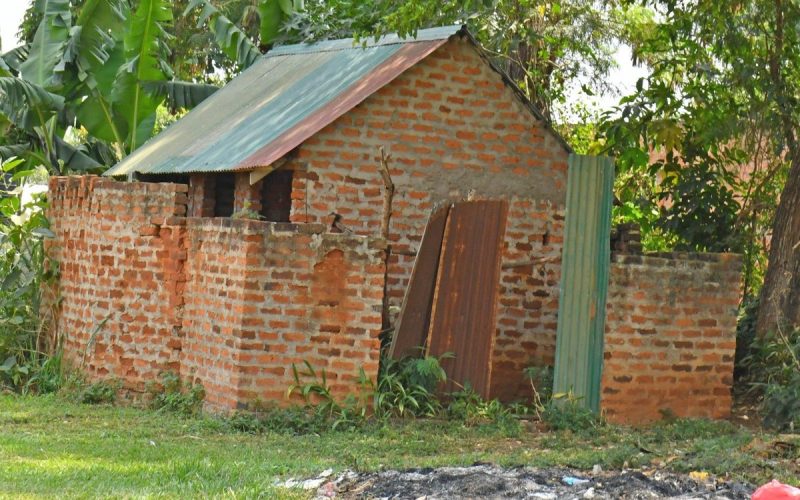
EVERY so often, a nation produces a piece of public infrastructure so audacious in its emptiness that it transcends mere scandal and becomes performance art. Bulambuli District has now given Uganda – and honestly, the whole continent – its masterpiece: a toilet block at Muyembe Health Centre IV that cost the public purse a reported 73 million shillings, and features every component of a functioning latrine except, gloriously, the latrine part.
No pit. No hole. No descent into the earth of any kind. Just a slab, a wall, a roof, and a drainage groove – an air-conditioned waiting room for a bodily function that, structurally speaking, has nowhere to go. Officials who inspected the site under Minister Balaam Barugahara’s aptly named “Expose the Corrupt” campaign found, in effect, a concrete monument to the idea of sanitation rather than the practice of it. Call it conceptual plumbing.
This publication has covered its share of iron sheets that vanished into ministerial goat sheds and ghost soldiers who somehow kept drawing salaries decades after failing to exist. But there is something almost admirable about the ambition on display in Bulambuli. Most corruption at least has the decency to build something – a road with no tar underneath, a school with no roof. Here, officials appear to have skipped the middleman entirely and monetised absence itself. Give the architect of this scheme a UN prize for minimalism; the toilet is, after all, the ultimate exercise in negative space.
“They alleged that he used sh73 million to build a toilet without even a pit. It’s just a structure.”
Minister Balaam Barugahara, standing in front of the structure in question
The former District Health Officer, for his part, insists the real bill was a far more modest 7 million shillings, spent on an emergency washable slab so patients wouldn’t have to share facilities with the general public. A charitable reading is possible: perhaps the missing 66 million shillings simply evaporated somewhere between the Bill of Quantities and the actual bill – Uganda’s public procurement sector being, as any seasoned observer knows, a triangle of unusually porous accounting where numbers enter as millions and exit as rounding errors. The original documents, we are told, were left at the office. The copies were at home. The pit was nowhere at all.
There is a pattern worth naming plainly, without the theatre. This is not an isolated pratfall; it sits inside a well-documented architecture of impunity, in which supplementary budgets balloon, health workers go unpaid, and inspectorates recover only a sliver of the trillions of shillings that vanish from the public account each year. Bulambuli’s toilet is not the disease. It is simply the symptom that happened to be photogenic enough – and absurd enough – to travel.
Credit, grudgingly, to Local Government Minister Balaam Barugahara for turning up in person, camera crew in tow, to stand in front of a toilet with no pit and demand answers on the spot. Political theatre it may be, but Ugandans have watched enough silent corruption over the decades to know that a minister publicly embarrassed on camera beats a minister quietly protected by one. The former DHO has since been ordered arrested and made to fetch his “missing” documents from home – presumably not in the same vehicle used to ferry ministers’ goats.
The uncomfortable truth beneath the punchlines is this: in a country where more than a third of rural households still have no latrine at all, and where families dig their own pits foot by foot at ruinous personal cost, a health facility serving the sick and the pregnant was left instead with 73 million shillings’ worth of nothing. Somewhere in Bulambuli, a patient in genuine need still has to walk to “the general toilet.” The money meant to spare her that walk appears to have taken a walk of its own.
Africa does not lack engineers capable of digging a hole. It lacks, all too often, the political will to stop those entrusted with public funds from digging holes exclusively in the budget. Until that changes, Bulambuli’s toilet stands — magnificently, uselessly — as a monument not to sanitation, but to the peculiar Ugandan gift for spending millions to achieve precisely nothing, and then demanding applause for the effort.
The African Mirror will continue to follow the case, the missing documents, and — should it ever materialise — the pit.