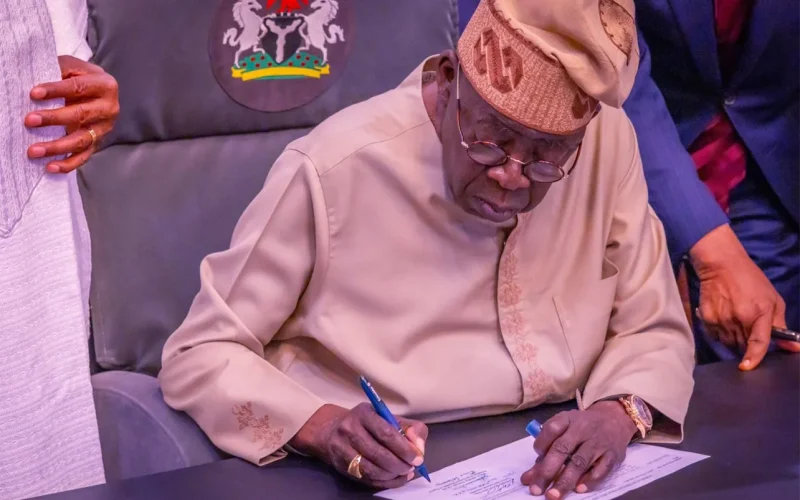
PRESIDENT Bola Ahmed Tinubu has signed an executive order requiring that all government oil and gas entitlements be paid directly into the Federation Account, eliminating a set of deductions he described as structural distortions that have long weakened revenue flows to Nigeria’s federal, state, and local governments.
The order, designated Presidential Executive Order 9 of 2026, was signed on February 13 and has since been gazetted. Its full title is the Presidential Executive Order to Safeguard Federation Oil and Gas Revenues and Provide Regulatory Clarity, 2026.
Under the new directive, all Royalty Oil, Tax Oil, Profit Oil, Profit Gas, and other government entitlements arising from Production Sharing Contracts and related agreements must flow directly into the Federation Account rather than through existing retention mechanisms. The order also abolishes the additional 30 per cent management fee and a separate 30 per cent Frontier Exploration deduction that had previously been applied before funds reached the account.
Tinubu announced the measure in a statement on Wednesday, framing it as a corrective action against what he called “excessive deductions, overlapping funds, and structural distortions” in the sector. “When revenues meant for federal, state, and local governments are trapped in layers of charges and retention mechanisms, development suffers,” he said.
The Nigerian National Petroleum Company Limited will henceforth operate strictly as a commercial enterprise under the terms of existing law, the President said, signalling an end to what his administration characterised as duplicative deductions and fragmented oversight.
Tinubu also announced that his administration would conduct a comprehensive review of the Petroleum Industry Act to identify and address fiscal anomalies, which he said were undermining national revenue. An Implementation Committee has been approved to oversee coordinated enforcement of the executive order.
The Federation Account is the constitutionally established pool from which oil revenues are shared among the three tiers of the Nigerian government. Any reduction in deductions taken before funds reach the account would, in principle, increase the size of allocations available to federal ministries, states, and local government councils — a politically significant outcome given the fiscal pressures many state governments have faced since the removal of the petrol subsidy in 2023.
The presidency did not immediately disclose the projected naira value of revenues expected to be recovered under the new framework, nor did it specify a timeline for the PIA review.