THE global humanitarian system is buckling under the weight of a war it did not start and cannot stop. Over two days of UN briefings in Geneva, a cascade of agency officials laid bare the full anatomy of collapse: toxic black rain falling on Tehran after strikes on oil depots; nearly 700,000 people displaced across Lebanon; Afghan children screened for malnutrition at twice the rate of a week ago; and Sudan’s food pipeline rerouted 9,000 kilometres around the Cape of Good Hope because the Strait of Hormuz and the Bab el-Mandeb strait are no longer safe to traverse.
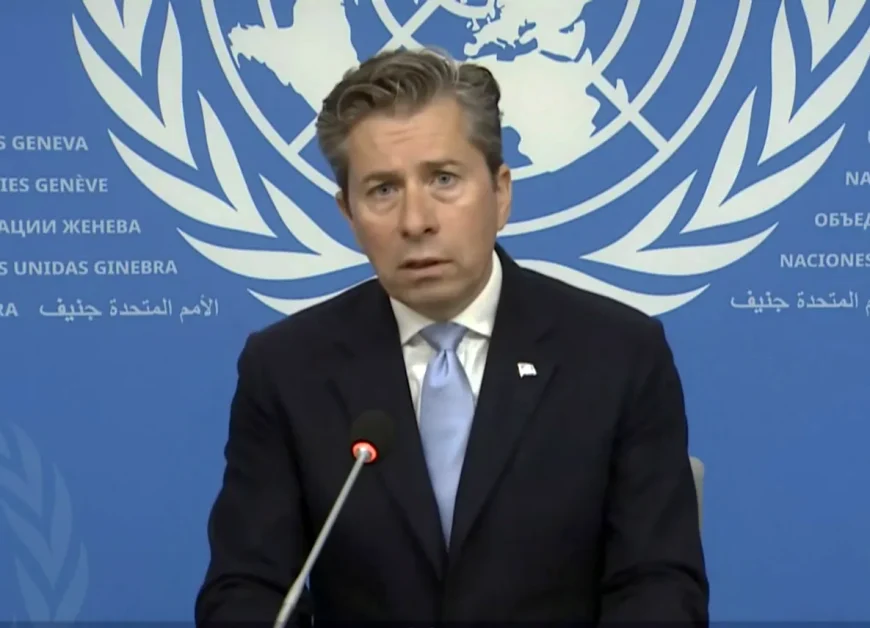
On Wednesday, UN Emergency Relief Coordinator Tom Fletcher distilled the central obscenity: the war consuming the Middle East costs one billion dollars a day, while his office remains over $14 billion short of what it needs to keep 87 million people alive.
“Even just $1 billion would allow us to save millions of lives. So, the choice is there.”
THE ARITHMETIC OF ABANDONMENT
The $23 billion global humanitarian appeal Fletcher’s office unveiled in December remains two-thirds unfunded. Without urgent disbursement, he warned, ‘millions of people will die.’ The appeal is not aspirational; it is the irreducible minimum — a ‘hyper-prioritised plan’ already stripped of every non-essential line item to focus only on those facing the most acute needs.
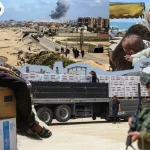
In January alone, more than seven million people received lifesaving assistance across 17 operations — in places where no commercial supply chain reaches, and no government acts. Sudan alone saw nearly two million people reached, despite active conflict and collapsing logistics infrastructure. Fletcher asked donors to imagine that result sustained every month for a year. Currently, sustaining it is not possible.
The funding shortfall is not new. But it is worsening at precisely the moment when need is ‘soaring,’ in Fletcher’s word, and the political will of traditional donor governments is visibly contracting. Washington’s ongoing reassessment of foreign assistance commitments, combined with European fiscal pressures, has gutted the assumptions on which the humanitarian financing model was built.
TOXIC RAIN AND THE LOGIC OF ESCALATION
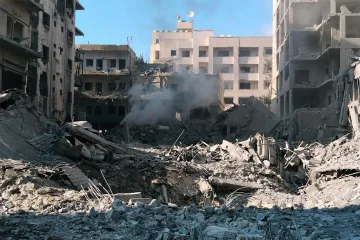
Before Fletcher spoke, UN Human Rights office spokesperson Ravina Shamdasani raised the first alarm of the day: Israeli and US strikes on oil depots in Tehran have released a plume of toxic pollutants that is now falling as ‘black rain’ and ‘acidic rain’ across the Iranian capital. The World Health Organisation confirmed the danger is real. Hospitals have been alerted. Authorities have ordered people indoors.
The WHO is monitoring a ‘massive release’ of toxic hydrocarbons, sulphur oxides and nitrogen compounds — compounds with documented long-term effects on respiratory health and water quality. Iranian strikes on oil infrastructure in Bahrain and Saudi Arabia have compounded the crisis, raising what WHO spokesperson Christian Lindmeier described as concerns of ‘wider regional pollution exposure.’ The UN’s human rights office questioned whether proportionality obligations under international humanitarian law were met, noting the targeted sites do not appear to be of military exclusive usage.’
The environmental contamination is not incidental damage. It is a preview of what total war against civilian infrastructure produces — and it will outlast any ceasefire.
LEBANON: 700,000 UPROOTED, A GRANDMOTHER DISPLACED TWICE
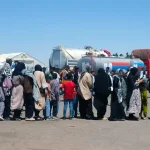
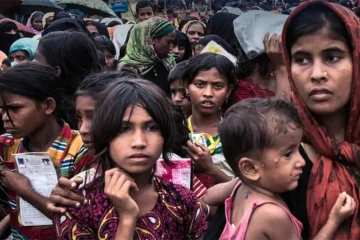
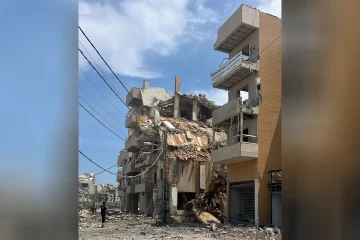
In Lebanon, more than 100,000 people fled in the 24 hours preceding Tuesday’s briefing alone, pushing the total number displaced by the current conflict to nearly 700,000. UNHCR Representative Karolina Lindholm Billing said the pace of displacement already exceeds the ferocity of the 2024 war with Israel.
‘We see cars lined along the street with people sleeping in them,’ she told reporters. ‘Most fled in a rush with almost nothing.’ At a Beirut shelter she visited on Monday, she met a woman in her nineties who had lost 11 members of her family in 2024. That woman is now sheltering in the same school — converted to emergency accommodation in 2024, converted again in 2026. Her story is one of hundreds of thousands.
THE STRAIT OF HORMUZ AND AFRICA’S COLLATERAL WOUND
Fletcher flagged what was already visible in the supply chain data: the war has effectively closed two of the world’s most critical maritime chokepoints. Jean-Martin Bauer, director of the World Food Programme’s Food and Nutrition Analysis Service, made the operational consequences concrete. The Strait of Hormuz and the Bab el-Mandeb strait off the Horn of Africa are now subject to restrictions and elevated risk, forcing shipping lines to divert. War risk insurance for containers in affected zones has risen by $2,000 to $4,000 per unit.
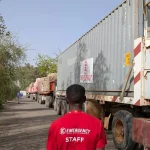
The human cost of that detour is most visible in Sudan, where WFP’s largest global operation depends on food purchased in India, shipped via Oman and Saudi Arabia into Port Sudan. That route is now compromised. Shipments must instead transit through Tangiers — adding 9,000 kilometres and approximately 25 days to delivery times. Bauer put it plainly: it is like crossing the United States coast to coast and then turning back. For a malnourished child waiting on a therapeutic food supplement, those 25 days are not a logistical inconvenience. They are a sentence.
AFGHANISTAN: THE RETURN NO ONE WANTED
The war is also reshaping population flows beyond the immediate region. Some 110,000 Afghans have returned from Iran since the start of 2026, with approximately 1,700 crossing back each day since hostilities began. Insecurity and economic collapse in Iran are pushing them out; what awaits them in Afghanistan offers little relief.
At the Islam Qala border crossing in Herat province, UNICEF’s Afghanistan representative, Tajudeen Oyewale, reported that the number of children screened and treated for malnutrition has doubled in a single week. Supply chain disruptions caused by the war are already delaying the nutritional supplements that children need. ‘A malnourished child will get the nutritional supplement required not immediately, but with some level of delay and at a higher cost,’ Oyewale said. That delay, in a child with acute malnutrition, can be the difference between recovery and death.
“The world has decided it is far more interested in spending enormous amounts developing increasingly deadly weapons than on saving lives.”
DRONES, DOLLARS AND THE GEOMETRY OF MORAL FAILURE
Fletcher’s most pointed indictment was not about funding gaps or logistics. It was about choices. The proliferation of drone warfare across the Middle East conflict — where unmanned systems have reshaped the tempo and reach of hostilities — he framed as evidence of a civilizational priority: states are investing heavily in increasingly lethal tools while defunding the machinery of human survival.
This is not rhetorical excess. It is an accurate description of where sovereign capital flows. Defence budgets across NATO and the Gulf have risen sharply in 2025 and 2026. The UN’s core humanitarian mechanisms are simultaneously being told to do more with less. The contrast does not require editorialising; it requires only arithmetic.
A PIVOT TOWARD PRIVATE CAPITAL
Facing the reality that government pledges are both insufficient and slow to move, Fletcher announced a broader public appeal targeting foundations, corporations, and individual donors. To date, that initiative has raised $60 million — a meaningful figure, and a wholly inadequate one relative to the need. But the strategic pivot matters: it signals that the UN is no longer treating donor-government financing as a reliable foundation.
‘We cannot rely on governments alone,’ Fletcher said plainly. The humanitarian system, which was architected around state contributions, is beginning to acknowledge that the political economy underpinning it has shifted. Whether private philanthropy can fill a $14 billion hole is a question that answers itself. But the direction of travel tells us something important about where global multilateralism is heading.
WHAT CLOSING THE GAP REQUIRES
Fletcher’s ask is specific: not pledges for later, but disbursements now, in the first half of 2026. Humanitarian programming is time-sensitive. Food pipelines, medical supply chains, shelter procurement — these require advance financing and procurement cycles that cannot absorb mid-year cash arrivals without disruption. His plea to donor states with available funds to ‘get those funds moving fast’ is an acknowledgement that the gap between commitment and delivery is, itself, a form of abandonment.
The Democratic Republic of the Congo, Haiti, and Sudan were each named specifically as operations where the funding shortfall is most immediately life-threatening. All three are African contexts — a reminder that the consequences of the Middle East war’s drain on global humanitarian attention and resources fall disproportionately on the continent already most exposed to cascading crises.