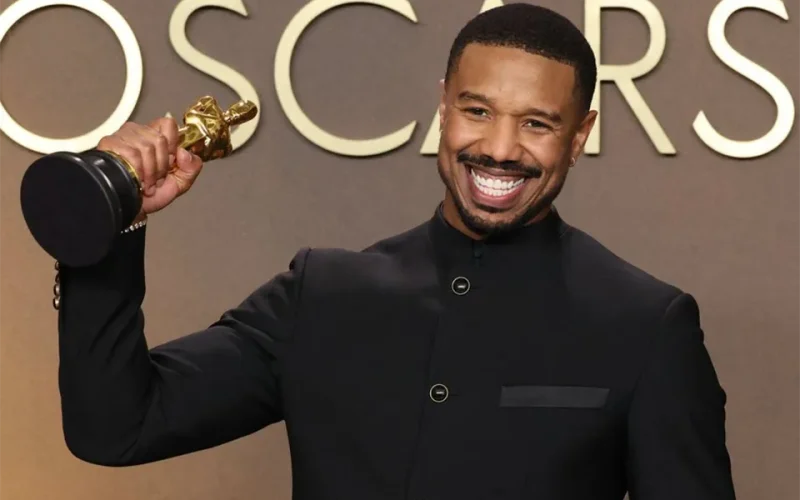
THE Dolby Theatre in Los Angeles fell momentarily still on the night of 15 March 2026 when Michael B. Jordan stepped to the podium to receive the Academy Award for Best Actor. He had won for his dual performance in Ryan Coogler’s Sinners – portraying twin brothers Smoke and Stack, children of the Black South navigating violence, vampires, and history in the 1932 Mississippi Delta. But what the world’s cameras caught next had less to do with Hollywood and everything to do with Africa.
“God is good,” Jordan said, visibly overwhelmed. Then, scanning the audience: “Momma, what’s up? Pops — where you at? My dad came in from Ghana to be here.”
That single sentence – spare, unscripted, and immediately viral – compressed decades of diaspora experience into six words. It was the acknowledgement of a Ghanaian father watching his American-born son claim the most coveted prize in world cinema. For the continent, it was a moment of reflection, reclamation, and outright pride.
“My dad came in from Ghana to be here.”
Michael B. Jordan, accepting the Oscar for Best Actor, 98th Academy Awards, 15 March 2026
THE SIXTH BLACK MAN
Jordan’s win makes him only the sixth Black actor in Hollywood history to claim the Best Actor prize. He joins a lineage that begins with Sidney Poitier – the Bahamian-American pathbreaker who won in 1964 for Lilies of the Field – and runs through Denzel Washington (Training Day, 2002), Jamie Foxx (Ray, 2005), Forest Whitaker (The Last King of Scotland, 2007), and Will Smith (King Richard, 2022). In his speech, Jordan named each of them, calling them “giants” and “ancestors”. He also invoked Halle Berry, who in 2002 became the first and, until now, only Black woman to win Best Actress.
“I stand here because of the people that came before me,” Jordan told the assembled industry. “To be amongst those giants, those greats, amongst my ancestors, amongst my guides — thank you.”
At 39, Jordan had never previously been nominated for an Academy Award. His career arc – from child actor on The Wire, through Fruitvale Station and Creed to Black Panther and now Sinners – represents perhaps the most narratively satisfying first-time Oscar win in a generation. The win was not a consolation; it was a verdict.
GHANA: THE ROOT BEHIND THE MAN
Michael Bakari Jordan – the middle name Bakari meaning “noble promise” in Swahili – was born on 9 February 1987 in Santa Ana, California, and raised in Newark, New Jersey. His father, Michael A. Jordan – known as Tony – grew up in South Central Los Angeles, the son of a single mother. He served in the United States Marine Corps before building a career in aviation logistics, eventually working as a supervisor at John F. Kennedy International Airport in New York. It was Tony who set up the catering business that allowed the family to stabilise while their son’s career took root.
What is now known is that Tony Jordan has made his home in Ghana, part of a growing movement of African Americans repatriating to West Africa – a journey accelerated by Ghana’s “Year of Return” in 2019 and its “Beyond the Return” programme, which invited members of the global African diaspora to formally reconnect with the continent. His son’s Oscar night speech was, in this sense, not merely a personal biography. It was a vivid, prime-time illustration of the generational re-rooting that Ghana and the broader continent have been actively cultivating.
Jordan has previously described his father as a formative intellectual influence. “Whenever I would go by the dining room, he’d always be reading. My dad was very adamant about educating himself and giving us a sense of identity and to understand where we come from,” the actor has said in prior interviews. That emphasis on ancestral awareness – knowing where one comes from — saturates Sinners, a film whose central artistic argument is that the Black American cultural body cannot be understood outside of its African origins.
“Whenever I would go by the dining room, he’d always be reading. My dad was very adamant about giving us a sense of identity and to understand where we come from.”
Michael B. Jordan, on his father’s influence
SINNERS AND THE WEST AFRICAN GRIOT
Sinners is not incidentally African. It is structurally, spiritually, and artistically so. Ryan Coogler – who won the Oscar for Best Original Screenplay for the film, his first Academy Award – conceived Sinners as a meditation on the roots of Black American music, and those roots run directly to West Africa.
The film’s centrepiece is a bravura long-take sequence inside a Mississippi juke joint in which a young blues musician’s performance conjures a vision of music across all time: West African griots beating the talking drum, funk, hip-hop, gospel, and Afrofuturism collide on a single stage. The griot – the hereditary keeper of oral history, music, and ancestral knowledge in West and Central African traditions — is explicitly invoked as the ur-source of all that follows in the African diaspora’s cultural life.
Coogler has spoken extensively about the film’s African genealogy. “You’re talking to somebody who went back to the continent of Africa to connect with his ancestors – with the two Black Panther films – but I skipped over the American South,” he told IndieWire. “I found that there’s a legitimate argument to be made that the Delta Blues is America’s most important contribution to global popular culture.” The film also features a Hoodoo priestess – played by Nigerian-British actress Wunmi Mosaku – whose spiritual authority is presented as a direct inheritance of Yoruba religious tradition.
Coogler grew up in Oakland, California, with maternal grandparents from Mississippi. His wife and producing partner, Zinzi Coogler, has Mississippi Delta Chinese ancestry. The research that underpinned Sinners was, by Coogler’s account, exhaustive and emotionally transformative – a filmmaker returning to sources he had previously approached only at the remove of fiction.
NIGERIA’S OWN: WUNMI MOSAKU AND THE HOODOO PRIESTESS
Among the night’s nominees with direct African roots, Wunmi Mosaku deserves particular attention. Born in Nigeria and raised in Manchester, the 39-year-old actress was nominated for Best Supporting Actress for her portrayal of Annie, a Hoodoo priestess, in Sinners. Though she did not win – that award went to Amy Madigan for Weapons – her nomination and the cultural resonance of the role mark a significant moment for Nigerian representation at the Academy Awards.
To prepare for Annie, Mosaku immersed herself in Yoruba spiritual practice and ancestral tradition, the very religious complex that travelled through the Middle Passage from West Africa to the Americas and gave rise to Hoodoo, Vodou, and Candomblé. Her performance was widely described by critics as the emotional and spiritual anchor of the film.
At this year’s BAFTA Awards, where she won Best Supporting Actress, Mosaku offered a rare moment of public vulnerability, saying she had found in the role “parts of myself I thought I had lost or tried to dim as an immigrant trying to fit in.” That statement — from a Nigerian woman who travelled to Britain as a child — carries more weight than most Oscar speeches manage.
“I found parts of myself I thought I had lost or tried to dim as an immigrant trying to fit in.”
Wunmi Mosaku, BAFTA acceptance speech, on playing Annie in Sinners
A RECORD NIGHT FOR BLACK CINEMA
Sinners entered the 98th Academy Awards having already made history: it became the most nominated film ever at the Oscars, with 16 nominations, breaking a record previously shared by All About Eve (1951), Titanic (1997), and La La Land (2016). The film ultimately took home four awards: Best Actor for Jordan, Best Original Screenplay for Coogler, Best Cinematography for Autumn Durald Arkapaw — the first woman of colour to win that category in the award’s nearly century-long history — and Best Original Score for Ludwig Göransson.
Arkapaw, who is of Filipino and Creole descent, asked every woman in the Dolby Theatre to stand when she accepted her award. “A lot of little girls that look like me will sleep really well tonight because they’ll want to become cinematographers,” she said in the press room. “Just being onstage, getting this award for a movie like that, will change so many girls’ lives.”
The evening’s best picture prize went to Paul Thomas Anderson’s One Battle After Another, which led the night with six awards, including Best Picture, Best Director for Anderson, and Best Supporting Actor for Sean Penn. But in terms of cultural significance and continental resonance, it was Sinners — and the African roots it wore openly — that defined the 98th Academy Awards.
Also notable from an African perspective: Tunisian filmmaker Kaouther Ben Hania was nominated in the Best International Feature Film category for The Voice of Hind, Rajab. Her film, rooted in the Palestinian human rights crisis, did not win, but her nomination extended the record of African filmmakers reaching Hollywood’s highest stage.
THE COOGLER-JORDAN AXIS AND BLACK HOLLYWOOD’S MOMENT
Sunday night was also a vindication of the creative partnership between Jordan and Ryan Coogler, who has now directed Jordan in five films: Fruitvale Station (2013), Creed (2015), Black Panther (2018), Black Panther: Wakanda Forever (2022), and Sinners (2025). Jordan acknowledged the debt directly on stage.
“You gave me the opportunity and space for me to be seen,” Jordan told Coogler from the podium. “I’m so honoured to call you a collaborator and a friend.” Coogler, who won his own statuette for Best Original Screenplay hours later, described the film as the most personal of his career — a reckoning with ancestral history that he had, by his own admission, previously avoided.
That Jordan and Coogler — two Black men from the American working class, both with direct ties to African cultural inheritance — now stand as multiple Oscar laureates in the same night, for the same film, is not a footnote. It is a statement about whose stories Hollywood is now being forced to honour.
WHAT GHANA HAS WON
Ghana’s government and citizens were among the first to respond to Jordan’s speech on social media, with the hashtag #GhanaProud trending within minutes. The moment arrives as Ghana continues to position itself as a spiritual home for the global African diaspora. President-elect John Dramani Mahama’s government has indicated it will continue and expand the Year of Return framework.
For the continent more broadly, the 98th Academy Awards represented something qualitative and new. An American actor whose father lives in Ghana, a director whose work consciously reconnects African-American culture to its West African source, and a Nigerian actress whose performance of ancestral Yoruba spirituality moved the world — all on the same stage, in the same film, on the same night.
The middle name Bakari, meaning noble promise, turned out to be prophetic.