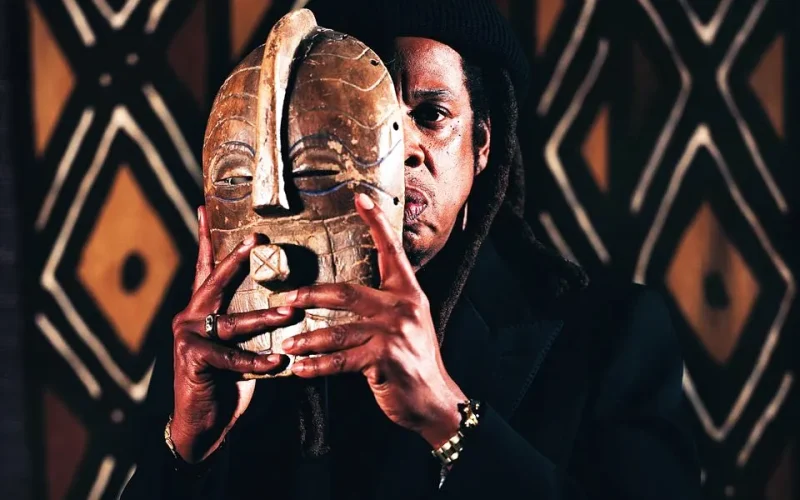
NOBODY asked Jay-Z to do this. That is the most important thing to understand about the cover of GQ’s April 2026 issue. Nobody sent Shawn Corey Carter a memo. No delegation from Kinshasa flew to New York. No African Union subcommittee on cultural diplomacy tabled a motion. The man simply sat down — or stood up, or however one poses with a Kifwebe mask — and, with characteristic nonchalance, delivered what may be the most consequential act of African cultural promotion since Miriam Makeba sang at the United Nations in 1963.
He did it, as Congolese musician Alesh noted with barely concealed delight, “without making too much noise.” Classic Jay-Z. The man who once rapped about selling crack cocaine in Marcy Projects now poses before Kuba cloth on the world’s most prestigious men’s magazine, cradling a Songye Kifwebe mask from the Kasaï-Oriental and Lomami river basin — and the Democratic Republic of Congo has not stopped vibrating since.
The Kifwebe does not merely represent power. It is power — geometric, ancient, uncompromising. Jay-Z didn’t borrow a prop. He borrowed a cosmos.
THE FACE THAT NEEDS NO INTRODUCTION
Let us be precise about what is on that cover, because precision matters when we are talking about objects of this magnitude.
The Kifwebe mask — the name means, simply, ‘The Face’ — is not décor. It is not the kind of thing you pick up at an airport curio shop between duty-free whisky and over-priced neck pillows. The Kifwebe belongs simultaneously to the mask itself, to the Bwadi bwa Kifwebe secret society that holds custodianship over it, and to the sacred dance performed in its presence. It is a trifecta of meaning. In one carved, geometric, ochre-and-white object, you have art, governance, and spiritual choreography folded together like a particularly sophisticated origami.
The Songye people who created it live in the Lomami River region, straddling what today are the provinces of Kasaï-Oriental and Lomami. Though they share ancestral roots with the Luba — another of Central Africa’s towering civilisations — the Songye broke away centuries ago to forge a visual identity as distinctive as a thumbprint: rigorous, geometric, sometimes terrifying, always authoritative. The masks are characterised by their bold striations, their jutting central ridge, and their refusal to be anything other than exactly what they are. There is no ambiguity in a Kifwebe. It stares at you, and you understand, instinctively, that you are not the most important thing in the room.
Jay-Z, a man not accustomed to being the second most important thing anywhere, appears to have grasped this immediately. The result is a photograph that, in the language of fashion shoots, does not say “here is a celebrity with a prop.” It says: “Here is a man who has read the room — the room being the entire Congo Basin.”
The Kuba Kingdom was producing woven masterpieces when Europe was still arguing about whether the Earth went around the Sun.
ENTER THE KUBA — BECAUSE ONE CIVILISATION WAS APPARENTLY NOT ENOUGH
But wait. The cover does not stop at the Kifwebe. Behind Jay-Z, filling the frame with its extraordinary geometric vocabulary, is Kuba cloth — the Shoowa fabric, produced by the women of the Kuba Kingdom, located to the west of Songye territory in what is today Kasaï-Central.
Kuba cloth is to Central African textile what the Sistine Chapel ceiling is to Renaissance painting: a pinnacle. The Shoowa variety is created exclusively by women, using cut-pile raffia techniques that require months of patient, exacting labour. The patterns — interlocking diamonds, chevrons, spirals, oblongs — are not drawn from templates. They live in the hands and the memory of the weavers, transmitted across generations in a form of living intellectual property that has no certificate of ownership because it needs none. The Kuba Kingdom was producing these masterpieces when Europe was still arguing about whether the Earth went around the Sun.
What Jay-Z’s GQ cover has therefore achieved, whether by design or by the inspired hand of Young Paris — the Congolese-born artist and designer born Milandou Badila, signed to Roc Nation, who orchestrated this entire visual dialogue — is what can only be described as a cultural super-collision. Two of the most prestigious artistic traditions of the DRC, occupying the same frame, mediated by one of the most famous black men on the planet, on one of the world’s most-read magazine covers. The Songye and the Kuba do not typically share space. They have done so now. On glossy paper. In newsstands from New York to Nairobi.
YOUNG PARIS: THE MAN BEHIND THE MASK
Credit, loudly and unstintingly, must go to Young Paris. It was he who conceptualised the visual, he who understood that the Kifwebe is not merely decorative but a “sculpture of power,” traditionally deployed to maintain social order and hold malevolent forces at bay. It was he who ensured that when one of music’s most powerful figures stood for his portrait, he stood in the company of objects that had been holding their own power for centuries before Reasonable Doubt was even a rumour.
That Young Paris did this through Roc Nation — Jay-Z’s own empire — makes the whole affair feel less like a magazine shoot and more like a homecoming that never formally happened but was always, somehow, inevitable.
Nobody asked. Nobody lobbied. Nobody needed to. The masks spoke for themselves. They always have.
WHAT THE DRC GETS THAT IT DIDN’T BUDGET FOR
The DRC’s Embassy in Washington, D.C. — which shared the cover with visible, justified pride — has not spent a single dollar on this campaign. No tourism board commissioned it. No Ministry of Culture signed off on a brief. No public relations agency billed for it. And yet the reach of that single image, circulating across Instagram, X, WhatsApp groups from Goma to Gemena, has done more for the international visibility of Songye and Kuba artistic heritage than a decade of museum catalogues and academic symposia.
This is what culture does when it is left to breathe. It travels. It attaches itself to power and prestige and rides those coattails to rooms it was never formally invited into. The Kifwebe mask has stared down spirits and antisocial forces for centuries among the Songye. It turns out it was also quite good at staring down the global cultural marketplace from the cover of GQ.
For the citizens of the DRC — a country that has, in recent years, contributed rather more of its domestic drama to international headlines than its cultural magnificence — this image arrives as something close to a balm. A reminder that before the headlines, before the geopolitics, before all of it, there was this: civilisations of extraordinary sophistication, making objects of arresting beauty, in the heart of the continent. That those objects are now on a global magazine cover is not a surprise to anyone who has spent time in a Kasaï museum or a Kuba weaving house. It is long overdue.
ONE FINAL OBSERVATION
Jay-Z’s GQ cover story is headlined, with characteristic economy, “2026 Is All Offence.” He is not wrong. But from the Congo Basin’s perspective, this particular act of cultural assertion is something subtler and more lasting than offence. It is presence. It is the quiet, geometrically precise, centuries-deep insistence of the Kifwebe — The Face — that it has always been here, that it will continue to be here, and that it does not require anyone’s permission to be magnificent.
The question, now that the world has seen it, is what the world intends to do about it.
We suspect the mask already knows the answer.