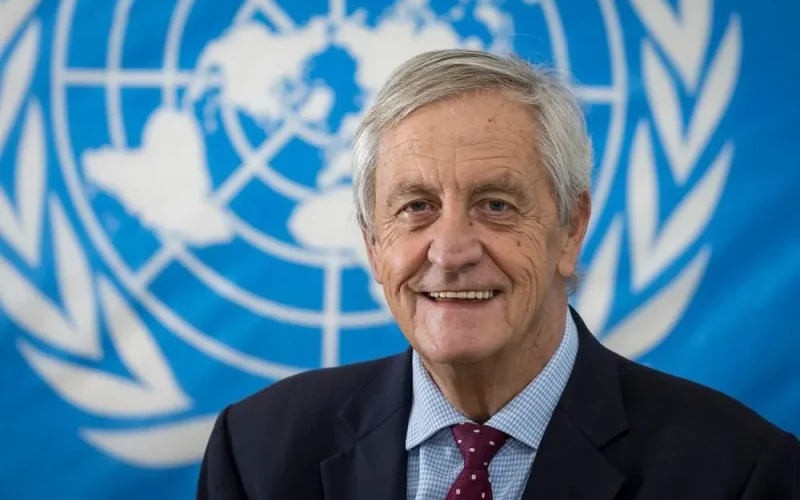
NICHOLAS Roland Leybourne Haysom – universally known as Fink – passed away in New York after a long illness, leaving behind a formidable legacy that stretches from the trenches of South Africa’s anti-apartheid struggle to the fragile peace processes of the African continent and beyond. Born on 21 April 1952, he lived a life of astonishing moral purposefulness, wielding the law as an instrument of liberation, dignity and peace across more than four decades of public service.
South Africa has lost one of its finest sons – a man who did not merely observe the injustices of his time but stood directly in the line of fire to contest them, legally, politically and morally. South Africans from the legal fraternity, the broader liberation movement, his comrades and colleagues at the United Nations, and all those who valued law in the service of humanity, have extended our sincerest condolences to his family, friends and all who were privileged to know him.
The Making of a Freedom Fighter
Fink Haysom was educated at Michaelhouse in the KwaZulu-Natal Midlands, a school that produced its share of establishment figures. Yet Haysom would spend his life as an insurgent against that establishment. He pursued law at both the University of Natal and the University of Cape Town, where he served as president of the Students’ Representative Council – an early signal of the role he would play in organising resistance.
In 1976, at a moment of acute national crisis – the year of the Soweto Uprising – Haysom stepped into the presidency of the National Union of South African Students (NUSAS), inheriting an organisation in disarray following the arrest of many of its leaders by the apartheid security apparatus. It was a baptism of fire that would define his character. He did not flinch. He led. He was jailed four times by the regime, spending periods in solitary confinement, yet he emerged each time with his convictions undiminished.
In 1979, together with fellow Wits academics Halton Cheadle and Clive Thompson, Haysom co-founded what would become one of South Africa’s most consequential human rights law firms: Cheadle Thompson & Haysom Attorneys. Born from the University of the Witwatersrand’s tradition of socially engaged scholarship, the firm became a fortress for the oppressed, litigating landmark human rights cases through the dark years of the 1980s and early 1990s in the High Court of South Africa.
Simultaneously, Haysom served as associate professor of law and deputy director at the Centre for Applied Legal Studies (CALS) at Wits, an institution that became one of the most important intellectual engines of anti-apartheid legal scholarship. It was here that he produced some of his most significant academic and advocacy work, including his 1983 report Ruling with the Whip: A Report on the Violation of Human Rights in the Ciskei and his landmark 1986 study Mabangalala: The Rise of Right-Wing Vigilantes in South Africa — a meticulous investigation into state-sponsored violence that laid bare the machinery of terror operating behind the facade of apartheid legality. He also co-authored The Last Years of Apartheid: Civil Liberties in South Africa (1992), published with the Ford Foundation.
In those years, Haysom was a constant presence at the courts, in the townships, and on the platforms where the future of South Africa was being argued. His legal work was activism made tangible: representing communities threatened with forced removal, challenging the detention without trial of activists, and exposing the use of vigilantism as an instrument of counter-insurgency. His name became synonymous, in South Africa’s legal circles and beyond, with courage in the face of state power.
Counsel to Madiba: At the Heart of the Transition
When South Africa crossed the threshold from apartheid to constitutional democracy in 1994, Fink Haysom was there – not as an observer, but as one of its architects. Appointed Chief Legal and Constitutional Adviser in the Office of President Nelson Mandela, he served the entirety of Madiba’s presidency from 1994 to 1999, guiding the new democratic state through some of its most delicate legal and constitutional questions.
This was a moment requiring not only technical legal mastery but extraordinary political wisdom. The Constitutional Court was being established. The Truth and Reconciliation Commission was navigating the boundary between accountability and amnesty. A new bill of rights – one of the most progressive in the world – was being tested against the realities of a society still fractured by race, class and historical dispossession. Haysom was at the centre of all of it, trusted implicitly by Mandela himself.
He later co-authored South African Constitutional Law: The Bill of Rights (2002) with Halton Cheadle and Dennis Davis, a foundational text in South African jurisprudence that bears testament to his enduring contribution to the legal architecture of the post-apartheid state.
Peacemaker Without Borders: The UN Years
After leaving Madiba’s office in 1999, Haysom turned his formidable skills toward the African continent’s unresolved wounds. From 1999 to 2002, he served as chair of the constitutional committee at the Burundi peace talks, under the facilitation of former President Mandela himself – a remarkable continuation of a partnership forged in the liberation struggle. The Arusha Peace and Reconciliation Agreement for Burundi, to which these talks contributed, represented one of Africa’s most complex negotiated settlements.
From 2002 to 2005, Haysom served as principal adviser to the mediator in the Sudanese Peace Process – the negotiations that would ultimately produce the Comprehensive Peace Agreement of 2005, paving the way for South Sudan’s eventual independence. This work inaugurated what would become a defining chapter of his life: the pursuit of peace in the most fractured corners of the continent.
He then entered the United Nations system formally, serving as Head of the Office of Constitutional Support for the UN Assistance Mission in Iraq (UNAMI) from 2005 to 2007, before becoming Director for Political, Peacekeeping and Humanitarian Affairs in the Executive Office of the UN Secretary-General from 2007 to 2012 – a role that placed him at the strategic nerve centre of global peace and security.
In 2012, Secretary-General Ban Ki-moon appointed Haysom as Deputy Special Representative for Afghanistan, and in 2014, he was elevated to Special Representative and Head of the UN Assistance Mission in Afghanistan (UNAMA). He led the UN’s work in one of the world’s most dangerous environments, committed to constitutional governance even as the country’s democratic experiment faced an existential threat.
In March 2016, he was appointed Special Envoy for Sudan and South Sudan. In 2018, Secretary-General António Guterres appointed him Special Representative and Head of the UN Mission in Somalia (UNSOM). After only four months, he was controversially expelled by the Somali government following his principled questioning of the legal basis of the arrest of a political figure — a moment that crystallised the price Haysom was willing to pay for speaking inconvenient truths to power. The UN Security Council itself expressed regret at Somalia’s decision.
He served subsequently as Secretary-General’s Special Adviser on Sudan (2019–2020) and on Southern Africa (2020–2021), before his final UN appointment in January 2021: Special Representative and Head of the United Nations Mission in South Sudan (UNMISS) — bringing his life’s work full circle to the continent he had spent three decades fighting to liberate and stabilise. In 2025, he stepped down from UNMISS after a tenure in which he worked tirelessly to advance the Revitalised Peace Agreement in one of Africa’s most complex post-conflict environments.
Scholar, Author, Intellectual
Throughout his career, Haysom’s activism was always grounded in rigorous scholarship. His writings — on civil liberties, constitutional law, farm labour, forced removals, vigilantism and peacebuilding — form a body of work that shaped both legal practice and academic discourse in South Africa and internationally. The University of Cape Town conferred upon him an honorary Doctor of Laws in 2012, recognising not just his achievements but his intellectual contributions to the discipline he loved. New York Law School followed with a further honorary doctorate in 2019.
He served as an adviser on the Board of International IDEA and was widely regarded as one of the foremost global authorities on constitutional transitions and peace processes. His counsel was sought by governments, UN bodies and civil society organisations across four continents.
A Legacy That Outlives a Lifetime
Fink Haysom was a man who believed, with unshakeable conviction, that law must be a servant of justice — not of power. In an era when that distinction was most urgently contested in South Africa, he chose his side without equivocation. When that battle was won, he carried the same convictions to Burundi, Sudan, Iraq, Afghanistan, Somalia and South Sudan, places where the work of peace remained brutally incomplete.
He was, above all, a comrade in the deepest sense of the word — someone who understood that freedom is indivisible and that the struggle for human dignity does not end at national borders or with the signing of a constitution. South Africa produced him, the Struggle shaped him, and the world beyond benefited immeasurably from both.