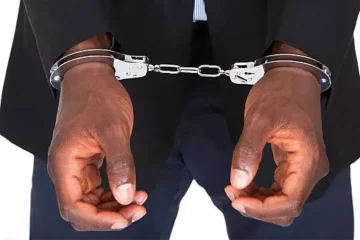
HE has no name in the international dispatches. He is described only as a 24-year-old labourer – a young man of working hands and ordinary circumstance – who has now become the face of a new era of state-sanctioned persecution in Senegal A court in the Dakar suburb of Pikine-Guédiawaye has sentenced him to six years in prison and fined him 2 million CFA francs (approximately $3,300 USD) for what the court recorded as “acts against nature and public indecency.”
He was arrested earlier that same month. He did not have long to live freely before the law found him.
His conviction carries the grim distinction of being the first secured under Senegal’s newly enacted legislation that doubles the maximum penalty for consensual same-sex relations from five years to ten. That
law was signed by President Bassirou Diomaye Faye on 31 March 2026 — a mere ten days before the young man’s arrest. The ink on the law was barely dry before his life was changed irrevocably.
The legislation President Faye signed into law is notable not merely for the severity of its penalties but for the sweeping breadth of its reach. Beyond criminalising same-sex relations, the new law introduces
criminal sanctions for anyone found guilty of promoting or financing same-sex relationships. This is not incidental – it is intentional, and it signals an attempt to smother not just identity but association, solidarity, and advocacy.
The National Assembly passed the measure by an overwhelming majority, giving it the democratic veneer of popular mandate. That democratic majority does not, however, bestow it with moral legitimacy. Laws born of prejudice, regardless of the votes that consecrate them, remain instruments of oppression.
The timing of the first conviction is instructive. It did not take months for the state machinery to move. Within days of the law’s signing, a young man was in custody; within days of that, he was sentenced. The speed is not coincidental – it is a message.
“The speed of the first conviction is not coincidental. It is a message – from the state to its citizens, and to the world.”
A CLIMATE OF FEAR, NOT LAW
UN Human Rights Chief Volker Türk did not equivocate in his assessment of the legislation. He called it “deeply worrying” and said that it flies in the face of sacrosanct human rights principles. His is not a lone voice of Western liberal discomfort – it is the considered position of international human rights law, which Senegal, as a signatory to multiple human rights instruments, has formally committed to uphold.
Human Rights Watch researcher Larissa Kojoué offered the sharpest diagnosis of what the law has produced on the streets of Dakar: a climate of “constant fear.” She told the Associated Press that arrests have become more aggressive because, as she put it, there is now backing from the state apparatus. This is the decisive shift — not merely that prejudice exists, as it long has, but that the state has now formalised it, weaponised it, and deployed it.
Local Senegalese media have documented dozens of arrests related to the country’s anti-LGBTQ+ laws since February alone — a surge that predates even the new legislation, suggesting the law formalises an
enforcement culture already in motion.
THE COURTS IN ACTION: TWO CASES, ONE DAY
The unnamed 24-year-old was not alone in the courts on Friday. On the same day his sentence was handed down in Pikine-Guédiawaye, two other men stood before the court of summary jurisdiction in the same
jurisdiction: Amadou Ba, a young man denounced to authorities by his own brother, and his partner, Gora Diakhaté.
They had been held in pretrial detention since 20 January 2026 – nearly three months before their sentencing. In court, both admitted the charges. Their stated reason: desire. Amadou Ba sought a measure of legal mercy by invoking Article 50 of the Penal Code concerning mental incapacity. Gora Diakhaté, unrepresented by counsel, simply promised never to engage in such acts again. Neither plea moved the court substantially. The prosecutor requested the maximum – five years imprisonment and a fine of one million CFA francs each. The judge followed the prosecution’s line, convicting both.
The detail of Ba being denounced by his own brother deserves its own weight. It speaks to the social dimension of this persecution — to the fracturing of families, the weaponisation of kinship, and the chilling prospect that intimacy itself has become a liability within one’s own household.
SENEGAL IN A CONTINENT TURNING INWARD
Senegal is not acting in isolation. It is the latest in a line of African states to intensify legal penalties against LGBTQ+ people.
Uganda’s Anti-Homosexuality Act, Ghana’s Human Sexual Rights and Family Values Act, and now Senegal’s doubled maximum sentence form a pattern of legislative momentum that advocates fear may be contagious.
What makes the Senegalese case particularly striking is the political context. President Faye came to power on a reform platform, presenting himself as a break from the entrenched political class of the former
President Macky Sall. Yet on this issue, he has reached not for reform but for reinforcement, lending his presidential pen to a law that the UN Human Rights Chief has publicly condemned.
This matters for how Africa’s progressive democrats and Pan-Africanist voices must respond. The framing of LGBTQ+ rights as a Western imposition – a colonial gift to be refused – is both intellectually dishonest and politically convenient. It obscures the reality that same-sex relationships have existed on this continent across its entire history, and that it was, in fact, colonial legal codes that first introduced formal criminal prohibitions. The British Penal Code, not African tradition, gave Senegal the framework it now extends.
THE WIDER STAKES
This is not a story that begins and ends with the sexuality of the individuals sentenced. It is a story about the relationship between the state and its citizens – about who is considered fully human before the law, and whose personhood is conditional on conforming to the state’s preferences. When a state criminalises desire, it does not merely police the body. It colonises interior life.
For African journalists, this story carries an additional professional weight. The new Senegalese law criminalises not just same-sex relations but the promotion and financing of same-sex relationships. In its most
expansive interpretation, this could be read as a threat to reporting – to coverage that humanises LGBTQ+ individuals, to media organisations that employ them, or to civil society actors that fund advocacy. The law does not just reach into bedrooms. It reaches into newsrooms.
The implications of Senegal’s first conviction under the new law extend in several directions simultaneously. Legally, the conviction sets a precedent and tests the implementation of the new penalties.
Diplomatically, it invites sustained pressure from the UN human rights architecture, regional bodies, and international civil society.
Politically, it tests whether the domestic opposition in Senegal – and the pan-African human rights community more broadly – has the will to contest what has been normalised with democratic efficiency.
And for the men now inside Senegal’s prisons for no crime against any person – for the unnamed 24-year-old, for Amadou Ba, for Gora Diakhaté – the wait is not abstract. It is concrete, daily, and long.