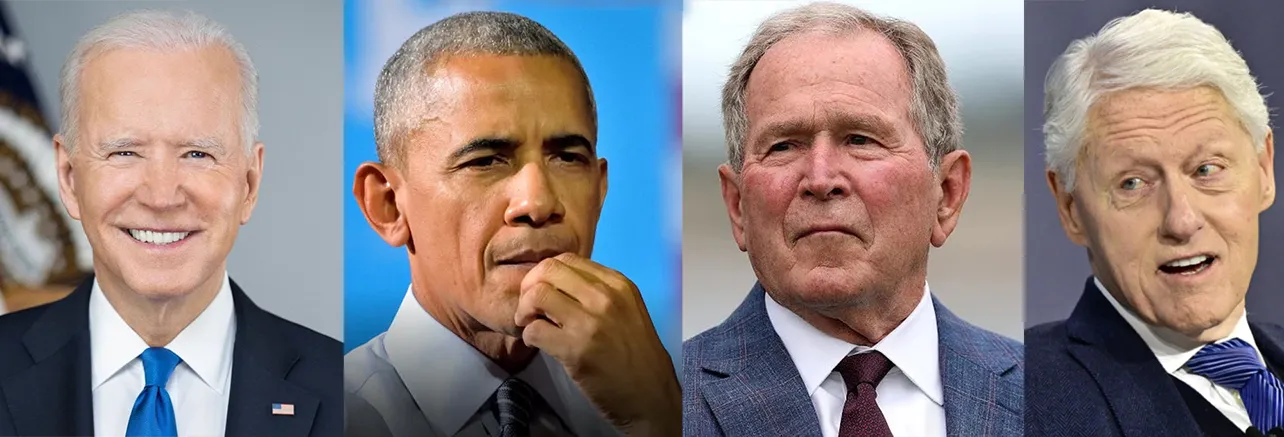

THEY came not as rivals or partisans, but as men who have held the weight of the world’s most powerful office – and what they said, jointly, in a rare gathering on the eve of America’s 250th anniversary, amounted to something closer to a civic alarm than a celebration.
Former presidents Joe Biden, Barack Obama, George W. Bush, and Bill Clinton appeared at a private History Channel event in Philadelphia — “History Talks” — on the weekend of 19-20 April 2026, each speaking individually to NBC’s Jenna Bush Hager in what was subsequently broadcast as a TODAY exclusive. Together, the four span nearly four decades of American executive power. Together, they sounded the same note: the republic they each led is under strain it has not seen in living memory, and its survival depends not on government but on citizens.
The intervention carries weight precisely because it is unusual. Former American presidents rarely speak in collective public terms about the health of their democracy. That four of them chose to do so now — with the current incumbent, Donald Trump, conspicuously absent from the gathering though separately engaged with the same broadcaster on an America 250 project — speaks to the gravity with which Washington’s elder statesmen view the current moment.
The Democracy Argument
At the core of each former president’s message was a defence of democratic process as the load-bearing wall of American society — not policy, not ideology, but the architecture of civic participation itself.
Obama, whose 2008 campaign placed hope at the centre of a national movement, offered the sharpest analytical framing. He reminded audiences that hope has never been synonymous with naivety. Difficult periods, he argued, are precisely the conditions under which genuine hope is forged — and American history, he said, is a record of emerging from such periods more resilient than before. His message for the 250th anniversary was unambiguous: the republic belongs to its citizens, not its rulers, and its future depends on whether those citizens meet their responsibilities to one another and to the constitutional project.
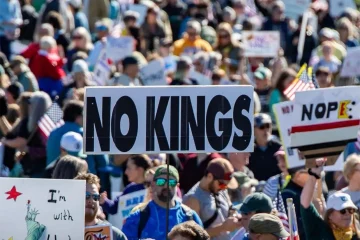
“We don’t have rulers, we don’t have kings, or monarchs, or aristocracies. We have citizens.”
Barack Obama
Clinton, at 79, distilled the argument to its constitutional essence: freedom of speech, freedom of vote, and freedom of political participation are not merely rights but the structural mechanisms through which democracy sustains itself. Without compromise, he warned, the system breaks. The word carried particular resonance from a president whose two terms were defined by divided government — and who nonetheless navigated a period of relative economic stability through cross-aisle negotiation.
Biden, whose single term ended in January 2025 amid deep partisan acrimony, pushed back on the dominant narrative of irreversible national division. The proportion of Americans genuinely committed to democratic rupture, he suggested, is far smaller than the political noise implies. Most Americans, in his reading, instinctively understand the constitutional safeguards they inhabit — even if they do not always articulate them.
The Citizen, Not the Spectator
George W. Bush — whose own presidency was marked by the September 11 attacks, two wars, and the contested 2000 election — offered the most explicitly civic message of the four. His formulation was deliberate: be a citizen, not a spectator. Participation in the democratic process, he argued, is inseparable from the social fabric of voluntary service and neighbourly solidarity that, in his view, holds American society together below the level of political institutions.
On the question of national unity — the most politically charged of the exchanges — Bush was notably forward-looking. The 250th anniversary, he argued, is itself an opportunity: a moment to redirect national attention toward shared history and shared freedoms, including press freedom and freedom of worship, rather than toward the fault lines that presently dominate public discourse. His confidence in the long-term health of the democracy rested on a reading of history: the republic has survived periods of intense political rage before, and done so through the self-correcting mechanism of the democratic process itself.
“If you don’t like what’s going on, vote. And that’s how America heals itself.” — George W. Bush
The Absent President and What That Signals
The political subtext of the Philadelphia gathering is impossible to ignore. Donald Trump — the sitting president, the man each of the four former presidents has, in varying degrees, criticised or clashed with — was not present. He is, separately, producing America 250 content with the same History Channel that hosted the event, an arrangement that underlines the extraordinary fracture in American institutional life: the living former presidents and the sitting president cannot share the same civic stage.
The letter that Jenna Bush Hager raised in her exchange with Clinton — the note that her grandfather, George H.W. Bush, wrote to Clinton upon losing the 1992 election, and which Clinton then passed forward to George W. Bush in 2001 — has assumed new weight in the current climate. It is cited now not as a charming historical footnote but as evidence of a norm of democratic transition that has been placed under extraordinary pressure. Clinton’s response — that America is bigger than any single person’s ambitions — was itself a pointed, if diplomatically phrased, commentary on the present.
A Global South Reading
From the vantage point of the Global South, the spectacle of four former American presidents publicly reinforcing the basics of democratic governance — the rule of law, freedom of the press, peaceful transitions of power — is an arresting one. These are precisely the standards that Washington has long invoked to judge, sanction, and at times destabilise governments across Africa, Asia, and Latin America.
The irony is not lost on observers across the continent: the same democratic architecture that American foreign policy has weaponised as a conditionality tool is now being defended, from the inside, by the men who themselves wielded that power. The 250th anniversary of the United States falls in a year when its democratic credibility is under scrutiny not only at home but in every multilateral forum from the United Nations to the African Union.
For African nations navigating a complex post-unipolar world — balancing relationships with Washington, Beijing, Moscow, and their own regional blocs — what happens to American democracy in 2026 is not a distant concern. It reshapes the global environment in which African sovereignty is either respected or ignored, in which African debt is negotiated or coerced, and in which African institutions are either supported or undermined.
Analysis: What the Moment Tells Us
Four former presidents, two Democrats and two Republicans, representing every American administration from 1993 to 2025, collectively chose to use the platform of America’s 250th anniversary not to celebrate national greatness but to defend national foundations. That is a significant editorial choice, and it reflects a sober institutional judgment: the foundations need defending.
Their message was not partisan. It was constitutional. And constitutionalism — the idea that power is bound by law and accountable to citizens — is not a Democratic or Republican value. It is the precondition for both. In speaking together, even if separately, Biden, Obama, Clinton, and Bush reminded Americans that the 250th anniversary is not an occasion for triumphalism. It is an occasion for reckoning.
The question for July 4, 2026, and for the years beyond, is whether the citizens these four men addressed will rise to the responsibilities they described — or whether the republic’s third half-century will open with the foundations they celebrated under active contest.