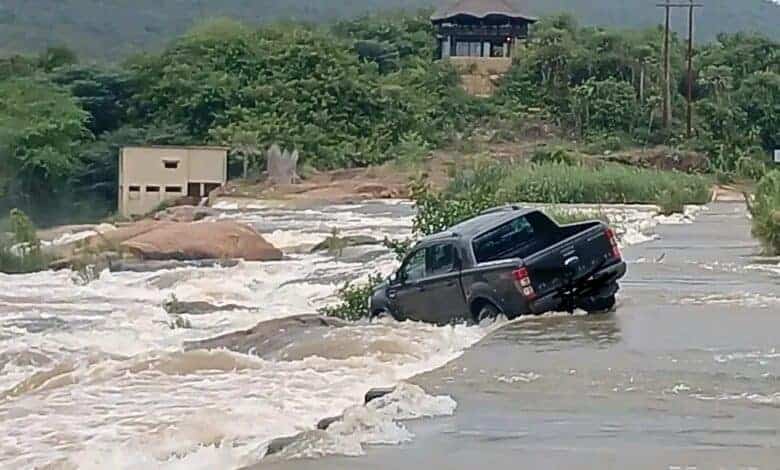
THE bridge at Komatipoort does not forgive. Flat and low, it squats a few inches above the Komati River on good days – close enough to the water to seem safe, far enough from common sense to have claimed lives before. On the morning of Monday, 27 April 2026, a 59-year-old businessman known to the small Lowveld town pulled up to it in his black Ford Ranger. The river was running high and angry after heavy rains, its brown skin churning with purpose. He crossed anyway.
He never came out the other side.
Within hours, police and search-and-rescue teams were at the bank. The Ford Ranger was still there – recovered from the water, empty, its doors mute witnesses to whatever struggle had preceded its abandonment. Of the man himself: nothing. Not a shoe, not a cry, not a ripple that could be called human.
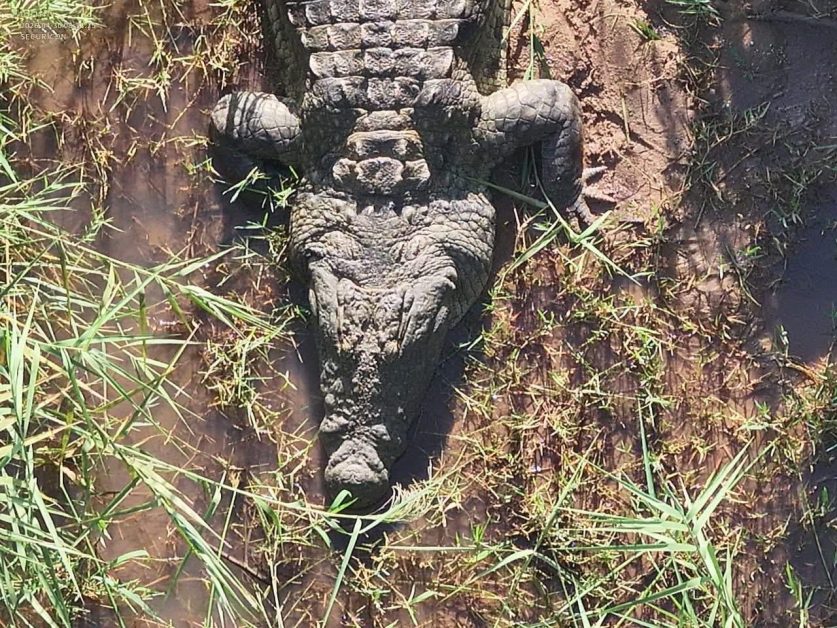
Captain Pottie Potgieter of the Ehlanzeni Diving Unit – a man who has pulled the river’s secrets up from the deep more times than most would care to count – was honest about what they faced. The Komati was not merely flooded. It was occupied. A float of crocodiles, some of them enormous, had colonised the stretch of water around the recovery site, drifting between the banks with the patient indifference of apex predators who answer to no one. Hippos added their own menace. For human divers, the water was simply off-limits.
So the search went vertical. A South African National Parks helicopter swept low over the olive-green canopy of the river margins. Drones from Securicon Komatipoort buzzed the surface, their cameras probing every sandbank and snag. Each morning at first light the operation resumed. Each evening at dusk it stopped – because even drones cannot see in the dark, and because whatever moved on that river after nightfall moved on its own terms.
A Bridge With a Memory
The bridge has been here before, in the worst sense. Just months ago – on Christmas Day, 2025 – two members of the South African National Defence Force were swept away at this same low-lying crossing while conducting border patrols en route to the Lebombo Border Post. Their vehicle was taken by the current when heavy rains sent the Komati surging over the bridge deck. One soldier’s body was recovered the following day. For the second, the search stretched six days before remains were found near the Mozambique border, ultimately confirmed by DNA testing at Tonga Hospital.
The community of Komatipoort had barely finished grieving those soldiers when the businessman’s Ford Ranger nosed onto the same bridge in the same rising water. There is a particular cruelty in repetition – in a community being forced to learn the same lesson twice, in the same place, in the same season.
The Komati is not a river to be trifled with. Rising 800 kilometres away in the highlands of Mpumalanga, it threads through Eswatini and empties eventually into Mozambique, gathering volume and velocity along the way. Near Komatipoort it is joined by the Crocodile River – the name itself a warning – before squeezing through the Lebombo Mountains in the dramatic gorge from which the town takes its name. In flood, the Komati is a different creature entirely: wide, fast, and full of things with teeth.
The Crocodile That Could Not Be Ignored
By day four of the search, the aerials had yielded nothing conclusive. Then the experts on the ground began to watch the crocodiles more carefully – not as obstacles, but as witnesses. Among the animals moving along the banks and through the shallows, one stood out. It was not its aggression, exactly, though it had that too. It was its size.
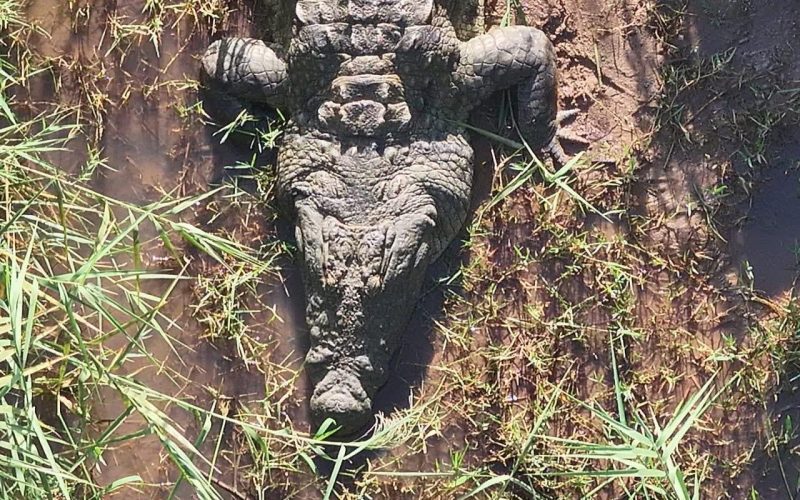
Wildlife specialists and conservation authorities noted that one particularly large crocodile appeared visibly distended – its belly swollen in a way that spoke of a significant, recent meal. Something sizeable had been consumed. The animal also moved differently, behaving in a way that experts described simply as notable – a shift in temperament and pattern that experienced observers of these reptiles recognised as consistent with a creature that had fed heavily and recently on large prey.
One crocodile stood out — its belly distended with a sizeable meal. The way it moved, the way it behaved: the experts took note.
A decision was made that was not taken lightly. Police snipers were positioned along the bank. The shot, when it came, was precise and final. The massive crocodile was killed at the water’s edge.
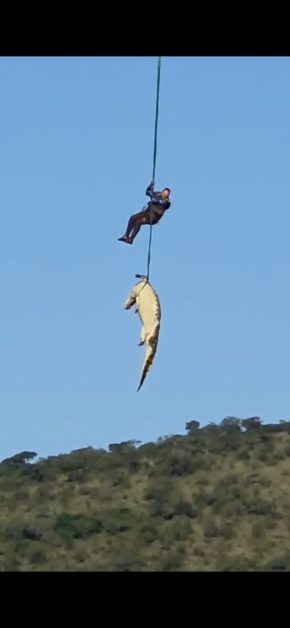
What came next was an image that will stay with those who witnessed it: the animal hoisted by a SANParks helicopter, swaying above the brown water of the Komati, its prehistoric bulk dangling against the Mpumalanga sky. Captain JC Potgieter – known to his colleagues and to this river as “Sbali” – was photographed alongside the suspended animal, one arm out, a man of the water next to a creature of the water, brought together by tragedy.
The crocodile was taken away. It was opened up. Inside, searchers found human remains – body parts consistent, in the assessment of those present, with the missing 59-year-old businessman.
Closure and Its Costs
For the family of the businessman, five days of not knowing ended in the hardest possible way. There is a particular torture in ambiguity – in not knowing whether to grieve, whether to hope, whether to hold a burial or hold vigil. The recovery of remains, however devastating, carries within it the mercy of certainty. The family could begin the work of mourning. They could hold a funeral. They could say goodbye with a name attached to the loss.
For the conservation and environmental community, the resolution brought a different and more complicated grief. The crocodile had done nothing wrong. In the mathematics of the wild, a large mammal in the water is prey. A Nile crocodile – and the Komati holds specimens of considerable age and size – operates on instinct refined over 200 million years of evolutionary history. The animal had not transgressed; it had simply been what it was.
Environmentalists expressed sadness that the animal had to be put down. There are those who will note that the killing of a large, mature crocodile represents an ecological loss – that these are slow-growing animals, that a specimen of that size represents decades of survival, and that the Komati’s crocodile population, though robust, is not infinite. The creature was, in a sense, a victim of the same human error that caused the tragedy in the first place.
The crocodile had done nothing wrong. It had simply been what it was, in the river that was its home.
The Bridge That Will Not Learn
What remains, after the helicopter has landed and the river has moved on and the family has gathered, is the bridge. It is still there. Low-lying, ungated, unmarked by anything sufficient to convey what it is capable of in flood season. It has now taken, or been complicit in the taking of, at least three lives in the span of five months – two SANDF soldiers on Christmas Day, and a businessman on the last Monday of April.
The question of whether low-lying bridges in flood-prone areas require mandatory physical barriers, automated water-level sensors, or – at minimum – signage that does justice to the danger, is not a new question in South Africa. It is asked after every tragedy of this kind, from the Lowveld to the Eastern Cape, and it has not yet produced a satisfactory national answer. The Komatipoort bridge is not unique. It is simply, at this moment, the most recently deadly.
In the offices of Mpumalanga’s traffic authorities and infrastructure departments, there are files and reports and protocols. In the towns alongside South Africa’s low-water crossings, there are families who have lost people to water that rose faster than anyone expected. The gap between those two things – bureaucratic process and irreversible loss – is measured, in Komatipoort this week, in a black Ford Ranger recovered without its driver, a helicopter carrying a crocodile into the sky, and a family finally, terribly, allowed to begin to grieve.