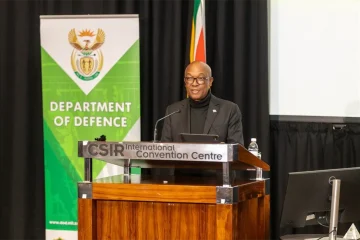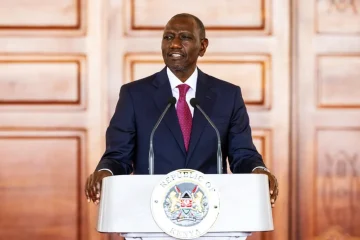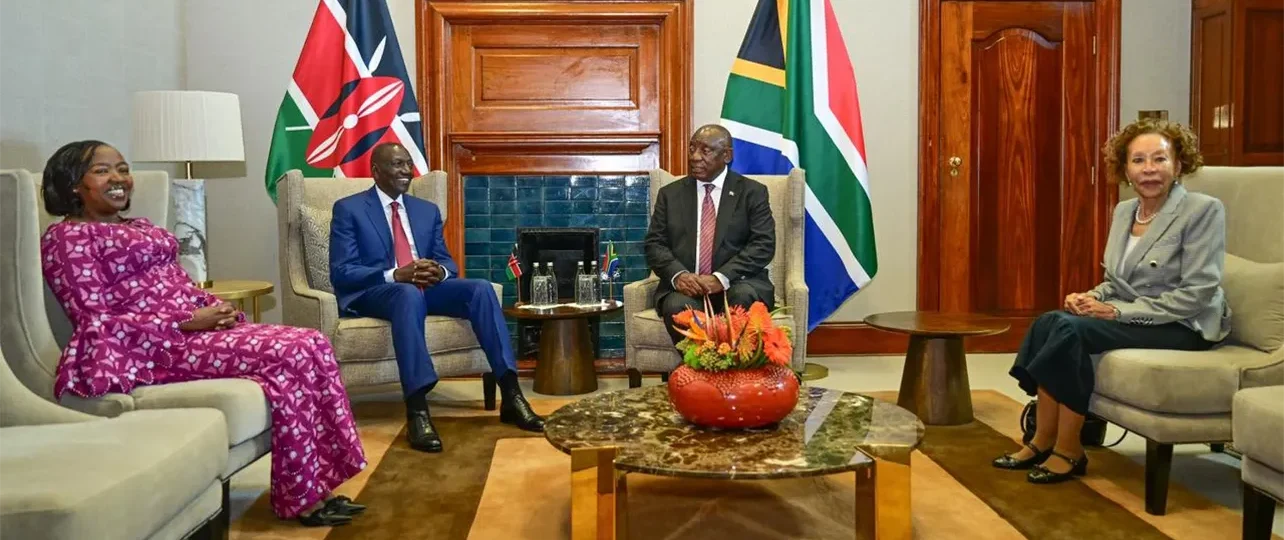

IN the language of African statecraft, a state visit to the Union Buildings is never merely ceremonial. When President Cyril Ramaphosa stood before his Kenyan counterpart, Dr William Ruto, on Thursday morning and declared that “Africa must speak with one voice, guided by our own interests and aspirations,” he was doing something more pointed than protocol demanded. He was issuing a continental summons.
The Reciprocal State Visit – South Africa’s response to Ramaphosa’s November 2022 trip to Nairobi – comes at a moment of accelerating global disorder. The wars in Ukraine and the Middle East continue to ripple through African economies in the form of inflation, supply chain disruption and constrained growth. The multilateral order that was supposed to protect smaller states is visibly fraying. And Africa, despite representing 54 of the United Nations’ 193 member states, remains without a single permanent seat on the Security Council.
It is against this backdrop that the Pretoria summit – backed by a full programme of official talks, multiple memoranda of understanding and a joint business forum at Gallagher Estate in Midrand – carries weight that extends far beyond the South Africa-Kenya bilateral relationship.
The Sovereignty Argument: Dialogue Over Confrontation
Ramaphosa’s remarks were careful in their diplomatic register, but unmistakable in their target. “Our position is clear: dialogue and diplomacy must prevail over confrontation,” he said. “Partnerships with the world must be based on respect, equality and shared prosperity.”
The language echoes what African Union Commission Chairperson Mahmoud Ali Youssouf told the UN Security Council in January this year – that Africa knows from hard experience that global challenges, whether conflict, climate change or pandemics, cannot be solved by any single state acting alone, and that international law must be applied with an awareness of the colonial legacies that continue to structure African disadvantage.
The Ezulwini Consensus – the AU’s longstanding common position demanding at least two permanent seats and five non-permanent seats on the Security Council for Africa – remains the reference point. Yet as repeated AU summits have acknowledged, the push for reform is only as strong as the continent’s ability to stay unified. Fragmentation, driven by competing bilateral interests with external powers, has historically blunted Africa’s leverage in New York. The DRC and Liberia’s election as non-permanent UNSC members for the 2026-2027 term, welcomed by the AU Commission in June last year, represents a moment of marginal but real African presence – not a structural solution.
This is the political subtext of what Ramaphosa and Ruto are performing in Tshwane: two of Africa’s most diplomatically active heads of state, from the continent’s two most economically significant sub-regions, demonstrating that solidarity is actionable, not aspirational.
Trade as Politics: AfCFTA Takes Centre Stage
If the geopolitical messaging was pointed, the economic architecture being built around it is concrete. Ramaphosa singled out a milestone that deserves more attention than it has received: South Africa and Kenya were the first countries to launch consignments under the AfCFTA Guided Trade Initiative, the practical mechanism designed to test the agreement’s legal and logistics frameworks.
“This shows that the AfCFTA is not just an aspiration. It is a living instrument that is already transforming intra-African trade,” Ramaphosa said – a claim that the data broadly support, even as structural challenges persist.
According to the African Export-Import Bank’s 2026 outlook, intra-African trade is forecast to grow ten percent this year to reach $230 billion, up from $210 billion in 2025 — growth driven largely by accelerating AfCFTA implementation. The manufacturing and agri-food sectors are expected to account for between 48 and 50 percent of intra-African trade flows, displacing commodities as the primary driver. At 16 percent of the continent’s total trade, intra-African commerce has doubled its share from less than 10 percent two decades ago — but it remains anemic when compared with the 60 to 70 percent intra-regional trade ratios that characterise the European Union or ASEAN.
The AU’s own 2025 Africa Integration Report was blunt about the gap between ambition and execution. Commissioner Francisca Tatchouop Belobe noted that protocols on free movement remain under-ratified, and that industrialisation and value addition are still in their infancy. “Without implementation, regional frameworks remain promises on paper,” she warned.
Kenya is, by almost any measure, one of Africa’s most digitally innovative economies, a continental leader in fintech, mobile money and agro-tech. South Africa brings industrial depth, port infrastructure, automotive manufacturing capacity and Africa’s most sophisticated financial sector. The combination is not merely complementary — it is potentially transformative for the sub-regions they anchor. Southern and East Africa together represent the primary engine of intra-continental trade, and deeper integration between them has a multiplier effect across the rest of the continent.
Ramaphosa’s welcome of the proposed South Africa-Kenya Joint Business Council — which would formalise private-sector engagement in shaping trade and investment policy — is significant in this respect. African integration has too often been a government-to-government project that bypasses the productive economy. A dedicated business council anchored by the continent’s two most entrepreneurially dynamic capitals could begin to change that dynamic.
Connectivity and People: The Visa Dividend
One of the visit’s unheralded success stories is the 2022 agreement granting Kenyans visa-free access to South Africa for up to 90 days. Ramaphosa acknowledged on Thursday that the decision has already yielded measurable results — increased tourism, business travel and cultural exchange. This is not a trivial point. The free movement of people remains one of the most under-implemented commitments in African integration, even as economic evidence consistently shows that reducing mobility barriers accelerates trade, investment and knowledge transfer.
The expanding partnership between Kenya Airways and South African Airways — both carriers that have weathered turbulent years of near-collapse and restructuring — also matters more symbolically than its market share might suggest. Air connectivity between African capitals remains one of the continent’s most stubborn structural weaknesses, with many intra-African flights still routed through European hubs. Every direct link established between Nairobi and Johannesburg shortens a supply chain, lowers transaction costs and makes the AfCFTA’s promise fractionally more real.
The Strategic Calculus: What This Visit Really Signals
South Africa’s designation of Kenya as a strategic partner — a status reserved for relationships of elevated diplomatic significance — reflects a considered foreign policy calculation. Kenya is East Africa’s pre-eminent economic and diplomatic actor. South Africa is Southern Africa’s. Together, they represent a north-south continental axis that, if properly institutionalised, gives the African Union’s integration agenda its most credible bilateral anchor.
More than 60 South African companies currently operate in Kenya. Kenyan exports to South Africa are expanding. The seventh session of the South Africa-Kenya Joint Trade Committee in Pretoria in April laid the groundwork for a more balanced trade relationship — one that moves beyond the historical pattern of Southern African industrial exports displacing East African manufacturing. The MOUs expected to be signed on Thursday, covering agriculture, tourism, ICT, energy, transport and maritime cooperation, give that ambition institutional expression.
The reference to artificial intelligence, fintech and cybersecurity as areas of potential joint continental leadership is also worth noting. Africa’s digital transformation is accelerating — Kenya’s M-Pesa ecosystem has already demonstrated that African innovation can set global standards. South Africa’s growing tech sector and its status as the continent’s most sophisticated financial market create the conditions for a south-south knowledge partnership of genuine depth.
The Weight of the Moment
African summitry has sometimes been accused of generating declarations that outlast the political will to implement them. The Ramaphosa-Ruto engagement stands a better chance than most of escaping that fate, for several reasons.
Both leaders are under domestic economic pressure. Ruto has navigated a bruising period of public unrest over taxation and fiscal austerity. Ramaphosa leads a government of national unity whose coherence depends on economic delivery. For both, the optics of continental ambition require the substance of commercial results. That alignment of political incentives — unusual in African diplomatic history — gives the bilateral architecture being built in Tshwane a durability it might otherwise lack.
Ramaphosa’s call for Africa to “speak with one voice” is, at its root, a statement about power. A continent of 1.4 billion people — with a combined GDP exceeding $3 trillion, resources that the global green energy transition cannot proceed without, and the world’s youngest workforce — possesses latent leverage that its fragmentation consistently fails to translate into actual influence. Every bilateral partnership like this one, every AfCFTA consignment shipped, every visa barrier dismantled between African states is a building block of the unified continental posture that alone can make that leverage real.
Thursday’s proceedings at the Union Buildings will not, by themselves, deliver that transformation. But they have added something meaningful to the architecture: proof that Africa’s two most influential sub-regional powers are willing to co-author a continental strategy, not merely coordinate one.