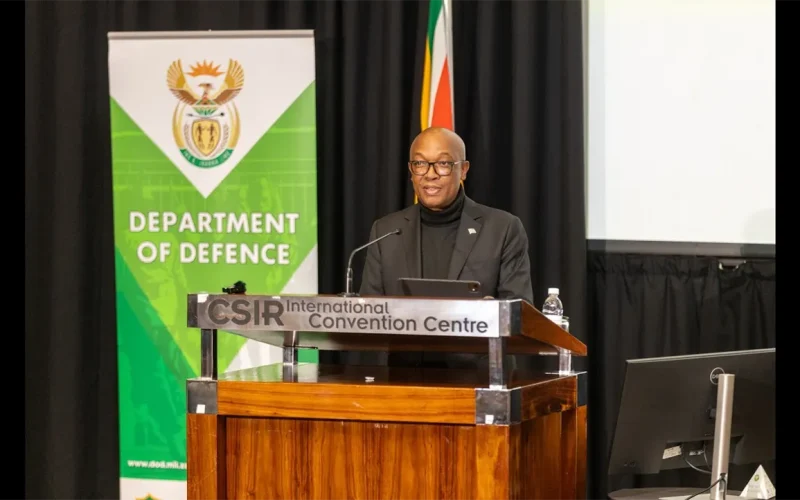
SOUTH Africa’s defence industry, once ranked among the most sophisticated on the continent, has shed close to 90 percent of its workforce and more than 96 percent of its state acquisition budget over the past thirty-five years, Trade, Industry and Competition Minister Parks Tau told the Defence Industry Lekgotla on Monday, in an unusually blunt admission of institutional failure from a sitting Cabinet minister.
Speaking to nearly 300 delegates drawn from government, industry, labour and academia, Tau said the sector’s decline was not a story of lost capability but of lost coordination – and he used the platform to press for a formal “South Africa Inc” governance model that would bind together ten government departments and five state entities behind a single industrial strategy for the first time.
A SECTOR IN FREEFALL
The numbers Tau placed on record were stark. Domestic defence force acquisition from local industry collapsed from R26.2 billion in 1989/90 to just R850 million by 2017, measured in constant terms — a fall of more than 96 percent. Research and development funding fell over the same period from R6.1 billion to roughly R500 million. Employment across the value chain dropped from approximately 130 000 people spread across 3 000 companies in 1990 to around 13 000 people across 600 companies today.
Tau was explicit about what that decline has cost the country beyond jobs: institutional memory. Instability at state-owned arms manufacturer Denel, he said, has pushed experienced engineers and technicians out of the sector altogether — expertise that, once lost, “does not return quickly.” He described arresting that skills exodus as the central risk facing the industry going forward.
THE CASE GOVERNMENT IS NOT MAKING OFTEN ENOUGH
Yet Tau’s address was as much a defence of the sector’s remaining strength as an accounting of its losses. He noted that South Africa retains manufacturing and systems-integration capability across air, sea, land, cyber and space domains — a range he called rare among industrialising economies — and that the country ranked 21st globally among exporters of major conventional arms between 2018 and 2023, according to Stockholm International Peace Research Institute data, despite fielding one of the smallest defence budgets among nations with a fully established defence industrial base.
More than 600 companies now make up the sector, Tau said: state-owned Denel with its four operating divisions, more than 250 private firms with a significant defence focus, and a further 350-plus companies supplying components and services into defence value chains. Global manufacturers including Saab, Thales, Rheinmetall, Hensoldt, Damen, Aselsan, Embraer, Airbus and Safran have all located operations or joint ventures inside South Africa’s borders — a vote of confidence, Tau argued, in the country’s engineering and technical base.
Exports, he said, now account for more than 80 percent of total industry revenue, reaching over 115 countries including more than 40 African markets, citing figures from the Aerospace, Maritime and Defence Industries Association. Munitions exports alone rose from R907 million in the first quarter of 2025 to R4.9 billion in the second quarter, according to National Conventional Arms Control Committee reporting cited by the minister.
AFRICA’S ARMS MARKET IS THE PRIZE — AND THE WARNING
Tau framed the stakes in explicitly continental terms. Global defence spending is rising sharply amid geopolitical competition, export controls and supply chain disruption, he said, and Africa’s own defence acquisition market is forecast at approximately 136 billion United States dollars. Countries that retain sovereign design, manufacturing and maintenance capability will capture that demand; those that do not will simply buy from others.
It is a framing consistent with a wider pattern across the continent’s strategic posture this year, as African governments from the Sahel to southern Africa have moved to assert greater control over security procurement and industrial sovereignty rather than remain dependent on external suppliers. For South Africa, a country whose defence-industrial base was for decades a source of regional influence, the message from Tau was unambiguous: sit out this cycle, and lose the market permanently to competitors prepared to coordinate their industrial policy more effectively.
TEN DEPARTMENTS, ONE PLAN
Tau’s central institutional proposal was the adoption of a “South Africa Inc” implementation model, drawing together the dtic, the Department of Defence, the Department of International Relations and Cooperation, the South African Police Service, the State Security Agency, Defence Intelligence, the Department of Science and Innovation, National Treasury, and the Department of Public Works and Infrastructure, alongside public entities including Armscor, the South African National Space Agency, the CSIR, the Industrial Development Corporation and the Export Credit Insurance Corporation.
He pointed to structural blockages that sit precisely at the boundary between departments and have gone unresolved for years: permit turnaround times under the National Conventional Arms Control Committee that affect export delivery timelines; a regulatory posture at the South African Civil Aviation Authority that constrains the growing drone industry; and the continued absence of bilateral recognition agreements with the European Union Aviation Safety Agency and the United States Federal Aviation Administration, which he said closes off entire export markets to South African aeronautical products regardless of their quality.
Cabinet’s approval in May of the SANDF’s own thirty-year force modernisation strategy, dubbed Journey to Greatness, was cited by Tau as a first step toward giving industry the long-term, predictable demand signal it has lacked for three decades. He called on government to now match that with equally long-term industrial planning, including joint acquisition and offset planning between Defence and the DTIC “from the outset, rather than in sequence.”
THE INSTITUTIONAL MACHINERY ALREADY IN MOTION
Tau catalogued a range of existing instruments he wants folded into a coordinated push: the Aerospace Industry Support Initiative, marking twenty years of operation in 2026; the National Industrial Participation Programme, which converts state procurement obligations into localisation and export outcomes; and the South African Aerospace, Maritime and Defence Export Council, a joint DTIC-industry initiative. The department has approved a National Pavilion at Africa Aerospace and Defence in 2026 and is exploring an Aerospace and Defence Special Economic Zone cluster in the Western Cape, home to a significant concentration of the country’s aerospace and space capabilities.
The Industrial Development Corporation, Tau said, has adopted its own Defence Industry Development Plan built around innovation spillovers, sovereign capability and defence as a demand pathway for upstream suppliers, and has already identified a substantial pipeline of investable opportunities across munitions, uncrewed systems, sensing, electronic warfare, satellite payloads and maintenance and repair.
ANALYSIS: A TEST OF POLITICAL WILL, NOT TECHNICAL CAPACITY
What Tau’s address ultimately reveals is a government conceding, in public and on the record, that South Africa’s defence-industrial decline was administrative rather than technological — a failure of coordinated political will sustained across three decades, not a shortage of engineering talent. That is a significant admission for a Cabinet minister to make before an audience of the industry’s own leadership, investors and the SANDF’s most senior command structure.
Whether the “South Africa Inc” model survives contact with the ordinary friction of South African governance — competing departmental budgets, overlapping mandates, and the historical difficulty of holding ten government entities to a shared timeline — will determine whether Monday’s Lekgotla marks a genuine turning point or another entry in a long record of strategy documents that outpaced implementation. For a continent watching how its largest defence-industrial base repositions itself for a $136 billion opportunity, the answer will matter well beyond South Africa’s own borders.