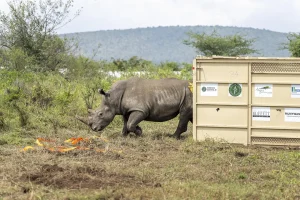
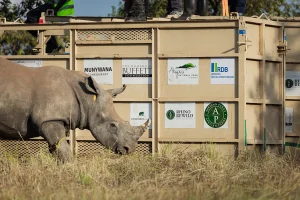
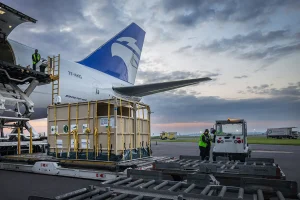
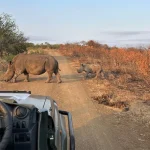
ON Tuesday, the tenth of June, Rwanda welcomed dozens of four-footed new residents to the country as dozens of metal crates holding 70 southern white rhinos touched down on Rwandan soil.
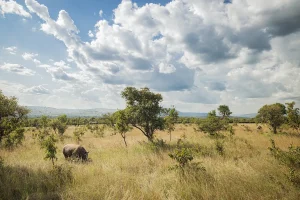
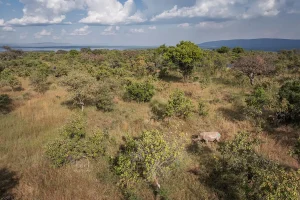
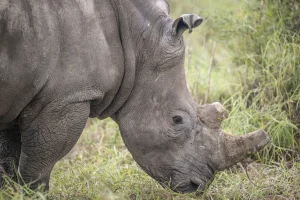
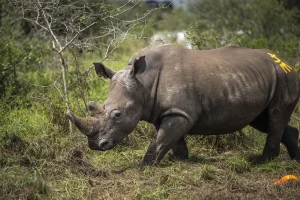
Rwanda’s Akagera National Park is the new home for the transplanted rhinos. They will graze on the park’s shrubs and gradually acclimatise to the environment.
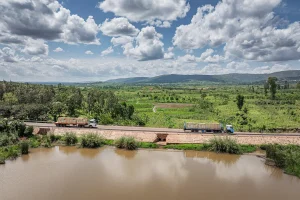
The rhinos’ journey took them over 4,000 kilometres via roads and sky, from South Africa’s Munywana Conservancy in KwaZulu-Natal.
The unprecedented translocation marks the largest cross-continental movement of rhinos ever attempted in Africa, helping to flip the continent’s conservation script, which is often headlined with loss of habitats and species.
“This milestone reinforces our dedication to strengthening Rwanda’s protected landscapes and enhancing the country’s appeal as a destination for conservation-based tourism,” said Rwanda Development Board Chief Executive Officer, Jean-Guy Afrika.
Tourism in Rwanda has boomed in recent years, with Akagera becoming a draw for those seeking the Big Five alongside the country’s famed mountain gorillas.
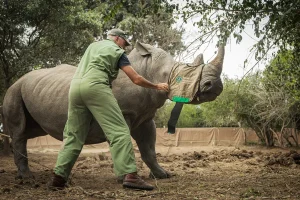
Before crossing South Africa’s borders, the rhinos underwent a “pre-wilding” phase, where they were exposed to Akagera-like conditions to better prepare them for life in Rwanda.
The historic endeavour was done through a partnership between the Rwanda Development Board, African Parks, the Munywana Conservancy, and teams of experts.
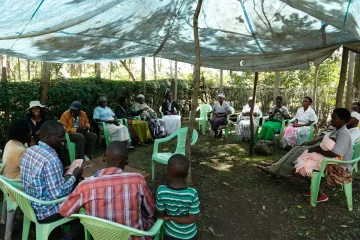
“We know the rhinos – this species – are very endangered, so if we can engage another place to keep them safe… we will be very proud,” said Thokozani Mlambo, Chairman of the Makhasa Community Trust, which helps administer Munywana on behalf of the Makhasa and Mnqobokazi communities.
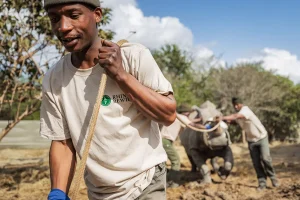
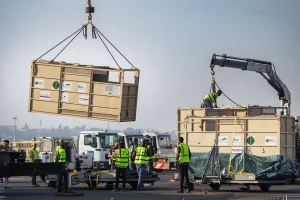
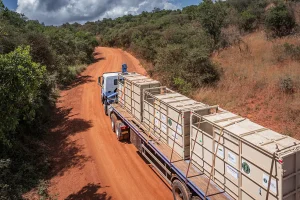
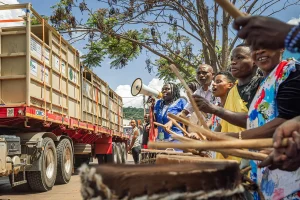
The tranquillised animals had to be loaded into custom steel crates before being hoisted onto flatbeds, trucked to Durban, craned into a cargo jet, flown 3,400 kilometres on a Boeing 747, and then driven across Rwanda’s winding roads to Akagera. A team of veterinarians supervised each effort.
“Conservation collaborations like this rhino move are proving to be increasingly important in ensuring the survival of these special and threatened animals,” said Munywana Conservancy Warden and Conservation Manager, Dale Wepener.
This major move is part of the non-governmental organisation African Parks’ Rhino Rewild Initiative, funded in large part by the Howard G. Buffett Foundation and targeting to rewild over 2,000 rhinos to safe, well-managed protected areas across the continent.
“The arrival of these rhinos to Akagera is just the beginning of this multifaceted, long-term and complex conservation intervention,” said African Parks Chief Executive Officer, Peter Fearnhead.
African Parks manages 23 protected areas in 13 countries covering over 20 million hectares in Angola, Benin, Central African Republic, Chad, the Democratic Republic of Congo, Ethiopia, Malawi, Mozambique, the Republic of Congo, South Sudan, Rwanda, Zambia and Zimbabwe.
In 2021, 30 rhinos were introduced to Akagera. Today, that number stands at 41.
The recent translocation positions Rwanda as a conservation hub and bolsters the country’s tourism attractiveness.
With the expanded rhino population, the park now plays host to one of the most complete savannah ecosystems on the continent.
Transnational wild animal relocations in Africa are becoming increasingly common, though they have mostly been between national parks straddling two countries or between neighbouring countries, to manage their populations and control human-wildlife conflicts.
National relocations are also becoming popular in many countries with either growing or threatened wild animal populations.
In 2022, Malawi translocated 263 elephants and 431 other wild animals from Liwonde National Park to Kasungu National Park in Malawi, following human population surges that were increasingly encroaching into remaining elephant rangelands.
Kenya’s Kenya Wildlife Service (KWS) recently moved eight endangered Rothschild’s giraffes from Soysambu Conservancy to Solai Sanctuary in Nakuru County as part of a giraffe translocation exercise aiming to provide a suitable new habitat for the giraffes.
The historic cross-continental translocation offers lessons to African countries like Botswana, with the largest population of elephants in the world, and Zimbabwe, with the second-largest population of elephants. Both countries have been resorting to killing animals to address growing wildlife populations.
The Munywana Conservancy has a historic foundation. 9,085 hectares of land were returned to their ancestral owners, the Makhasa and Mnqobokazi communities in 2007 as part of South Africa’s land restitution process. Both communities requested that the land continue to be kept under conservation.