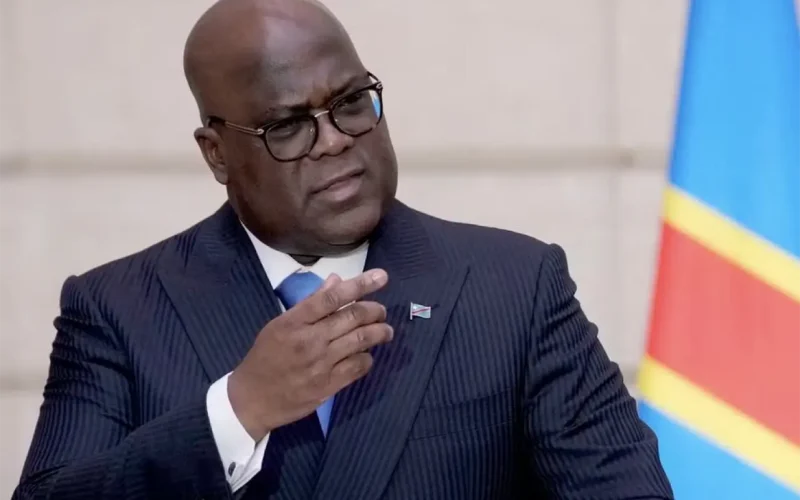
IN a country already bleeding from one of the continent’s most devastating armed conflicts, the government of Félix Tshisekedi has chosen to open a second front – this one directed inward, against the men and women who report, protest, organise, and dissent. The Democratic Republic of Congo is silencing its own conscience.
That is the damning conclusion that emerges from a comprehensive Human Rights Watch investigation covering the period between January and May 2026. Across Kinshasa, Kisangani, Bunia, Kalemie, and Matadi, the pattern is consistent and chilling: speak critically of the government, and the security apparatus will find you.
The timing is not accidental. As M23 forces — backed, the United Nations and independent investigators have established, by the Rwandan military — continue to hold major cities in eastern Congo, President Tshisekedi is simultaneously exploring a constitutional revision that would allow him to extend his presidency beyond the two-term limit enshrined in Congolese law. He aired this ambition on a nationally televised press conference as recently as 6 May 2026. It is in this combustible political moment that the state’s tolerance for dissent has collapsed.
“Congolese citizens have the right to express their opinions and concerns without fear of repression, but doing so is becoming increasingly difficult.”
A Pattern of Repression, Not Isolated Incidents
What distinguishes the current crackdown from ordinary security overreach is its breadth. It is not targeted at one party, one region, or one method of expression. It reaches journalists who question constitutional change, activists who march for clean water, opposition politicians who exist as organised rivals, and civil society organisations whose only offence is monitoring what the government does with public power.
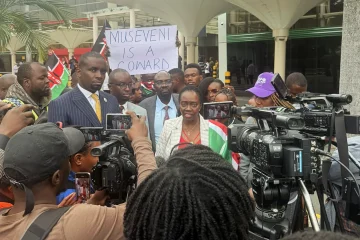
On 24 March, police in Kinshasa fired tear gas and deployed violence against peaceful demonstrators protesting the proposed constitutional changes. Fifteen were arrested; ten spent a night in detention. That same week, intelligence agents went hunting for two journalists at their apartments — not because the journalists had broken any law, but because they had spoken critically of government policy on the air. Both went into hiding.
On 3 March, Serge Sindani, a journalist and director of Kis24.info, was detained for ten days without charge, subjected to questioning about alleged ties to the M23. This is a pattern that requires close reading: the M23 has become a catch-all charge, a legal device wielded against anyone inconvenient. In a country at war, the accusation of rebel complicity is not merely an allegation — it is a social death sentence, a mechanism for delegitimising critics before any trial begins.
“The M23 has become a catch-all charge — a legal device wielded against anyone inconvenient.”
The Disappeared: Enforced Disappearances and Shadow Detention
Perhaps the most alarming dimension of the HRW findings concerns the National Cyber Defense Council — the CNC — which operates, it appears, as a parallel detention architecture beyond the ordinary criminal justice system. HRW has documented 17 cases of enforced disappearances of political figures and human rights activists, many of whom were found, sometimes months later, in CNC custody.
Among those still held: Aubin Minaku, former president of the National Assembly, detained since 18 January 2026; and Emmanuel Shadary, permanent secretary of the PPRD party aligned with former President Joseph Kabila, held since 16 December 2025. These are not obscure figures. Their detention without due process — through a security structure that operates in the margins of legality — is a statement about who holds power in Congo and how that power is exercised.
Jordan Saidi Atibu’s case is emblematic of the cruelty embedded in this system. The civil society coordinator was arrested on 9 January by National Intelligence Agency agents. His crime, it appears, was his appointment to lead a civic monitoring organisation in Kisangani. He spent 40 days in a cell without access to light. No charge. No trial. He was eventually released, carrying the experience of state darkness — literal and metaphorical — with him.
The Constitutional Subtext: Why This Moment Matters
Press freedom scholars have long understood that the canary in the coalmine for democratic backsliding is not the moment when elections are stolen or constitutions are rewritten. It is the moment before — when dissent is made costly, when journalists are made to fear, when civil society is systematically weakened so that, when the decisive blow falls, there is no organised voice left to resist it.
Congo is at that moment. President Tshisekedi’s public flirtation with extending his mandate creates a direct interpretive frame for every arrest, every intelligence visit, every tear gas canister fired at peaceful protesters. The state apparatus is being calibrated — not against external threats, but against the internal democratic ecosystem that would make constitutional manipulation harder to achieve.
Three separate opposition party structures — ECiDé, Action pour la démocratie et le développement au Congo, and Ensemble pour la République — have all reported attacks on their headquarters. On the night of 21 February, in the Kimbanseke municipality of Kinshasa, young men identifying themselves as supporters of the ruling UDPS party vandalised an opposition headquarters. HRW verified video evidence. The governing party has not faced accountability for this.
“The governing party apparatus is being calibrated not against external threats, but against the internal democratic ecosystem.”
Civil Society in the Crosshairs
The citizens’ movement Lucha — Lutte pour le Changement — has emerged as a particularly consistent target. On 9 May, a military court convicted three Lucha members of threatening state security for organising a peaceful protest demanding safe drinking water in Bunia, Ituri province. Read that again: a demand for clean water, met with a military court conviction for threatening state security. They were released for time served — but the conviction stands as a warning to every Congolese citizen who might consider organised civic action.
In Kalemie, four Lucha activists were arrested on 20 January for demonstrating about insecurity. In Matadi, ten demonstrators were detained after marching for electricity access on 23 March. The pattern could not be clearer: the very act of demanding basic services from the state is being treated as a security threat to the state.
International Law and the Obligations Congo Has Chosen to Ignore
The DRC is a signatory to both the International Covenant on Civil and Political Rights and the African Charter on Human and Peoples’ Rights. Both instruments are unambiguous: arbitrary arrest and detention are prohibited. The rights to freedom of expression, peaceful assembly, association, and fair trial are guaranteed.
These are not aspirational standards. They are binding commitments — obligations ratified by Congo’s own government. Every journalist detained without charge, every activist convicted in a military court for demanding water, every opposition figure disappeared into a CNC cell represents a specific, documented breach of those obligations.
The African Mirror’s Assessment
This publication has covered press freedom crises across this continent — from the junta’s suspension of TV5Monde in Burkina Faso to the long imprisonment of journalists in Eritrea and Tunisia. We recognise the grammar of repression when we see it. Congo is not experiencing a security response. It is experiencing a systematic pre-emptive suppression of democratic life.
What is happening in the DRC is an urgent warning — not only for Congolese citizens, but for the entire African democratic project. When a government under external military pressure reaches inward to silence its own citizens rather than upward to protect them, it reveals something essential about its priorities. And when the instrument used to silence critics is an accusation of rebel complicity — in a country where that accusation can mean years of extrajudicial detention — the weaponisation of security is complete.
The African Union’s silence on this trajectory is deafening. The silence of the international community is complicit. And the silence being imposed on Congolese journalists, activists, and ordinary citizens demanding water and electricity is a scandal that belongs on the front page of every newspaper on this continent.
HRW is right to call it an urgent warning sign. The African Mirror adds its voice to that call — and names it for what it is: the criminalisation of Congolese citizenship itself.