OCTOBER 8, 1995
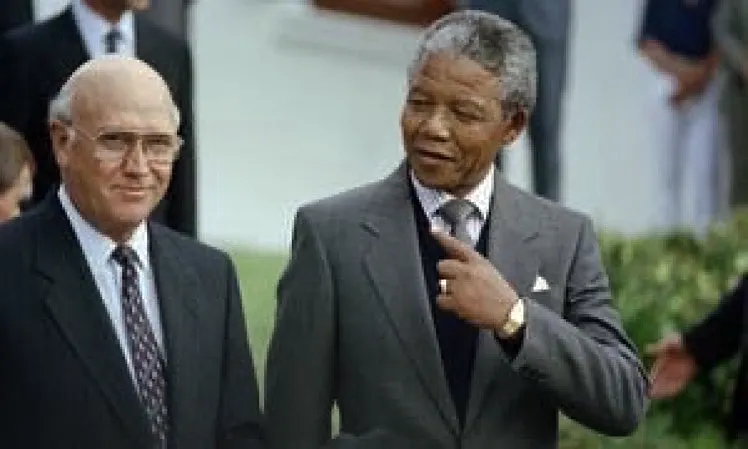
If ever there was a symbol of the birth of the new South Africa, and of its subsequent trials and tribulations, it is the personal relationship between Nelson Mandela and FW de Klerk.
It has been an epic affair: tumultuous, angry, respectful, bitter, and forgiving. It has run the gamut of emotions from triumph to despair, and by surviving, it has inspired the nation and intoxicated the world.
Following the latest recent spat in downtown Johannesburg on a warm September night, it is easy to forget how frequently the two statesmen have clashed – and how, usually sooner rather than later, they have returned to a comfortable orbit.
Countless times, fizzing, long-distance telephone calls or one-on-one meetings between the two have served to avert what appeared to be an imminent national disaster (“The all-important summit on violence,” the Star reported in September 1992, “has been rescued by personal contact between President De Klerk and ANC leader Nelson Mandela”) just as frequently as they have disdained each other with petulance and irritability (“President De Klerk and ANC leader Nelson Mandela had an ugly public clash yesterday,” the Star reported from Philadelphia in the United States in July 1993).
As we wait now to see the fall-out settle from this latest episode, which De Klerk described this week as the emergence of “fundamental philosophical differences”, it is worth reminding both, and the nation, of the words spoken by De Klerk to Mandela during his Nobel prize acceptance speech in December 1993:
“We will be called upon often to rise above our differences and find ways of bridging them and finding consensus. We must make reconciliation work. We cannot build the future on hate and retribution. We can build the future only if we put the past behind us.”
And to quote Mandela’s words to De Klerk, taken from the famous live television pre-election debate: “I am proud to hold your hand. Let us go forward together, let us work together to end division and suspicion.”
None would argue the point that both men have been subject to the whims of political and natural forces beyond their control or ken. De Klerk has had to contend with the bitter paradox of being both deputy president and opposition party leader. Mandela has had to ride the accusations of excessive latitude toward the former oppressors while feeding the expectations of a newly enfranchised populace.
Throw into the pot the Bisho and Sebokeng massacres, a referendum, and a general election, together with all the other slings and arrows of a nation in transition, and it is extraordinary that they are still even talking to each other.
But it is worth gazing back briefly at some of the high and low points of the relationship and to put the current dispute in context.
Within hours of his release in February 1990, Mandela’s comments from the balcony at the Grand Parade in Cape Town, particularly on the continuation of the armed struggle, alarmed De Klerk. This was despite Mandela calling De Klerk a man of integrity and honour.
Matters came to a head in December that year at the opening session of the Convention for a Democratic South Africa (Codesa). In what pundits described as “an extraordinary gloves-off exchange” that stunned delegates and dignitaries, De Klerk issued an ultimatum to the ANC to dismantle its armed wing. Mandela assumed the platform and harangued De Klerk for half an hour.
“He can do what he likes,” Mandela told the gathering. “We are not going to disband Umkhonto weSizwe.”
In April 1992, a new rumpus erupted when Mandela accused De Klerk of being directly involved in the violence sweeping the country. Laws permitting the carrying of traditional weapons had given certain parties within the country free rein to slaughter ANC members, Mandela argued.
“When De Klerk unbanned the ANC, shortly thereafter he authorised the carrying of these dangerous weapons … He was giving capacity to certain people, to certain organisations, to carry weapons of death and to murder innocent people.”
By September 1992, the cordial relations between the two men, “which had been in tatters for months,” had been restored, and full bilateral negotiations at the World Trade Centre in Kempton Park were resumed.
However, a squabble over sanctions caused further difficulties a few months later while the two leaders were visiting the United States to receive their Philadelphia Liberty medals. The Washington Post, noting that both men studiously avoided each other during the trip, carried the headline: “De Klerk and Mandela, Alone Together”.
Though this was soon sorted out, a South African Defence Force raid on Umtata in late 1993 caused great friction, with Mandela accusing De Klerk of terrorism before their joint award of the Nobel Peace Prize caused gushings of mutual admiration.
“Whatever criticisms I have against Mr De Klerk … it would not have been possible for us to reach this stage without his contribution. He has played an important role,” Mandela told guests at the Oslo ceremony.
The spirit of this moment was to be carried through to the “great debate”, when De Klerk and Mandela had their first live debate on television. In an inspired moment, Mandela reached out his hand to De Klerk. “I am proud to hold your hand,” Mandela told his old adversary.
With the successful conclusion of the April 27, 1994, election, more words of gratitude were forthcoming. De Klerk’s speech at National Party headquarters, in which he conceded defeat, was a classic gesture of reconciliation.
“During the past four years, we have proved that we can work together. Despite our differences, our relationship has become a symbol of the ability of South Africans from widely different backgrounds to co-operate in the national interest,” he said.
Mandela was equally magnanimous, calling De Klerk during his inauguration speech “one of the greatest sons of Africa” and a man of great personal courage and integrity.
Since then, the dynamics of the government of national unity have apparently taken their toll, with new splits and new starts characterising the on-off relationship.
With such a history, however, there is surely little doubt that the De Klerk-Mandela epic has a good few episodes left to run.
*This is an extract from the book “Christmas with Mandela” by Adrian Hadland, due to be launched in Cape Town, South Africa, on 4 June at Exclusives (V&A) at 5.45 pm
The book details are as follows:
Author: Adrian Hadland
Title: Christmas with Nelson Mandela: An eyewitness account of South Africa’s first years of democracy.
Publisher: Low Battery Books
Availability: Most bookshops in SA, Amazon