
TO understand why we gather tonight for the children of the Boys & Girls Clubs of South Africa, I want to take you back more than a hundred years, to one man. In the year 1913, a young man boarded a ship off the coast of this continent and pointed himself toward a country he had never seen. He carried almost nothing. He came from a village called Manzana, in the Transkei, where the only schooling open to a Black child was a mission classroom, and where the world had already decided exactly what a Black South African was permitted to become. The world was wrong. That young man’s name was Alfred Bitini Xuma. And the distance he travelled – not the ocean, but the distance between what he was told he could be and what he made of himself – is the reason we gather in his name tonight.
Let me tell you how far he went. He landed in America with no money and no guarantees. He worked night shifts in the Alabama steel mills so he could study by day. He enrolled at Tuskegee University, the school built by Booker T. Washington, and graduated near the top of his class. From there he went north to the University of Minnesota, and in 1920 he walked away with a Bachelor of Science degree. But he was not finished. He earned his Doctor of Medicine from Northwestern. Then he crossed another ocean – to Budapest, to Glasgow, to Edinburgh – adding qualification upon qualification until he held credentials that few men of any colour, on any continent, could match. And then he did the bravest thing of all. He came home. He came home to a South Africa that did not want him to exist – a country whose laws told him where he could walk, where he could live, and whether his learning counted for anything at all. He opened a surgery in Sophiatown, one of the only places a Black man was allowed to own the ground beneath his feet, and he became the first Black South African to qualify and practise as a medical doctor. The first.
But here is what tells you who he truly was. In 1930, the city asked him to serve as the part-time Medical Officer of Health for Alexandra – a poor, overcrowded township north of Johannesburg – and he held that post for more than twenty-five years. A quarter of a century tending the people the state had written off as a problem to be managed rather than a people to be healed. And he refused to stop treating them. He documented what poverty was doing to their bodies – the tuberculosis, the hunger, the babies who never saw a first birthday – and he carried those facts into government commissions and white lecture halls and said it plainly: a nation that lets its poor sicken and die is a nation indicting itself. He put it in writing. In Africans’ Claims, he declared it the duty of the state to provide health and medical care for the whole population, and named the neglect that had let African health – in his words – “deteriorate to an alarming extent.” He understood, long before the world had the phrase for it, that health is not charity. Health is justice. A man who could have practised anywhere on earth, kneeling in a township clinic – because the people there were his people.
- –
Now — let me tell you the part that belongs to us. In 1919, at the University of Minnesota, Alfred Xuma was initiated into the Mu Chapter of Alpha Phi Alpha Fraternity, Incorporated. Think about what that meant in 1919. Our fraternity was barely thirteen years old – born at Cornell in 1906 out of a refusal to let racism define the limits of Black scholarship. And here, into that young brotherhood, walked a son of the Transkei. An African, taking the oath of the first of all, alongside men who would go on to remake their world. He was a brother to that generation. He shared their fire. And here is what should make every Alpha in this room sit up straight tonight: he did not leave that fire behind at the water’s edge. Our aims are Manly Deeds, Scholarship, and Love for All Mankind. Our objective – written plainly into who we are – is “to aid downtrodden humanity in its efforts to achieve higher social, economic, and intellectual status.” Most men recite those words. Alfred Xuma carried them across an ocean and lived them on a continent where doing so could cost you everything.
Scholarship? He was the most educated Black man in his country, and he turned that scholarship into a weapon for the powerless. Manly deeds? In 1940, he took the helm of an African National Congress that was broke, fractured, and fading – and he rebuilt it with his bare hands. He balanced its books. He regularised its membership. In 1943 he drove through a new constitution that stripped away the old privileges of chiefs, gave women equal standing in the movement for the first time – opening the door to the ANC Women’s League – and centralised the organisation into something that could actually fight. A young lawyer named Nelson Mandela came to Xuma’s home in Sophiatown in 1944 and later wrote how impressed he was: how grand the house was, yes, but more than that, how Xuma had brought the movement back to life. The ANC that would later carry Mandela, Sisulu, and Tambo to history was standing on a foundation that Dr. Xuma poured.
And here is the part that should make the sorors in this room rise. The very first woman to walk through that door – the founding president of the ANC Women’s League – was his own wife. Her name was Madie Hall Xuma. She was an American, born in Winston-Salem, North Carolina, the daughter of the only Black doctor in that town — an educator with a master’s degree from Columbia, and a member of Alpha Kappa Alpha Sorority. She could have lived a comfortable life in the United States. Instead, in 1940, she boarded a ship to Cape Town to marry a man and to adopt a struggle. South Africans would come to call her uMama weSizwe – a Mother of the Nation. She organised African women when the movement had no place for them; she fought for their full membership and their vote; and she built the Zenzele self-help clubs so that ordinary women could learn, lead, and lift themselves.
An Alpha man and an Alpha Kappa Alpha woman – brother and sister of the two oldest houses we have – building a home, and a movement, on the far side of the world. Love for all mankind? That same year he authored Africans’ Claims in South Africa – a document modelled on the Atlantic Charter, demanding a Bill of Rights and full citizenship for every African. It was one of the earliest demands in this country’s history that the freedoms the world was fighting a war to protect should belong to Black South Africans too. And he refused to let that struggle be a narrow one. In 1947 he signed the Doctors’ Pact with Dr. Yusuf Dadoo and Dr. Monty Naicker – three physicians, African and Indian, declaring that their peoples would stand together. Love for all mankind was not a slogan he wore on a pin. It was a pact he signed with his own name.
And then came the moment where every thread of this man’s life pulled tight into a single knot. In 1946, the government of Jan Smuts went to the brand-new United Nations to ask permission to swallow South West Africa – the land we now call Namibia – whole. And Dr. A.B. Xuma got on a ship and went to New York to stop him. He did not go alone. Waiting for him in America was a brotherhood.
The organisation that hosted him, that sponsored his delegation, that put the case of his people before the world, was the Council on African Affairs. Its chairman was Paul Robeson – an Alpha man. Its vice-chairman, the towering scholar who had been writing about Africa’s freedom for half a century, was Dr. W. E. B. Du Bois – an Alpha man. On its board sat Adam Clayton Powell Jr. and Alain Locke – Alpha men, both. Do you hear what I am telling you? On the floor of the United Nations, in the fight to keep a piece of Southern Africa free, the gold-and-black thread that began in a small room at Cornell in 1906 reached all the way across the Atlantic and tied itself to the hand of an African president.
Robeson and Du Bois stood with Xuma. Brother stood with brother. And the United Nations rejected Smuts’s annexation. They held the line – and South West Africa would, in time, become a free Namibia. That is not a footnote in our history. That is our history at its very best – brotherhood that does not stop at a border, scholarship turned into power, and love for mankind carried onto the world stage.
I will not pretend the story ends in triumph for him personally. The same Sophiatown that gave him a home was bulldozed by the apartheid state in the 1950s, and Xuma – a doctor, a former president, a man of letters – was forced from his house like everyone else and made to move to Soweto. When the younger generation pushed for a more radical campaign in 1949, he judged it too hasty and stepped aside rather than lead where his conscience could not follow. History moved past him. He returned to his patients. He died in 1962 and South Africa later honoured him with the Order of Luthuli. He did not live to see freedom. Like Moses, he saw the country from the mountain and was not permitted to enter it.
But hear this clearly: the Bill of Rights he demanded in 1943, when it was dangerous and lonely to demand it, is now written into the Constitution of a free, democratic, non-racial South Africa. The dignity he insisted upon when the law called him a problem is now the law of the land. He lost the battles of his own lifetime and won the argument of the century.
So why do we gather — and why do we give? Because the truest monument to a man like Alfred Xuma is not a statue. Statues stand still. Tonight moves. Tonight we honour his name – and we turn that honour into something a child can hold: every cent we raise goes to the Boys & Girls Clubs of South Africa. And think about where those clubhouses stand. In Soweto – the very ground apartheid forced Alfred Xuma onto at the end of his life. For more than twenty-five years he was a doctor to the children of the township. And tonight, in those same townships, the Boys & Girls Clubs open their doors after school and give a child exactly what he gave his life to: a safe place, a meal, a mentor, someone watching over their health and their homework and their dreams. We are not starting something new tonight. We are picking up his bag and walking the round he began. Hear the rhyme of it. He carried American training home to heal his people. His Madie carried the American club home to lift its women. And tonight we stand with a movement that carries that same idea – the Boys & Girls Club – to a new generation of this nation’s children. The circle has not broken. We are still inside it.
But I did not come here only to look back – or even only to give. I came to put a dream into this room, and to ask you to hold me to it. Alfred Xuma was a bridge between two nations. He carried American medicine home to heal South Africans, and he carried South Africa’s cause across that same ocean to the conscience of the world. He spent his whole life proving that the distance between our two countries is not a wall. It is a road.
So tonight, I am putting a new dream into the world – the Dr. A. B. Xuma Innovation and Health Disparities Dialogue: a standing partnership that brings the finest minds of the United States and South Africa to one table – doctors, researchers, innovators, and young leaders – working side by side on the health inequities that still decide, in both our countries, who lives and who dies. It is the work he began in a single Alexandra clinic, raised to the scale of two nations. And I am not asking someone else to carry it. This is a dream I will personally set out to build – and I am asking every one of you to build it with me.
So let me leave you where we began. In 1913, a boy walked away from a village called Manzana with almost nothing in his hands, and the world told him exactly what he could never become. Somewhere in a clubhouse in Soweto tonight sits another child the world is already trying to write off. He could be the next Xuma. She could be the next Madie. And the only question – the only question that has ever mattered – is whether someone believes in them before the world teaches them to stop believing in themselves. Tonight, brothers and sisters, we are that someone.
So to every child in a Soweto clubhouse tonight – we are coming. To everyone in this room who gave – you have just stepped into his story. And like the brother whose name is on this night, the son of the Transkei who healed the poor, built a movement, and stood before the world and would not bend.
We shall transcend all.
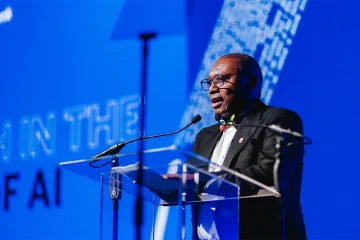
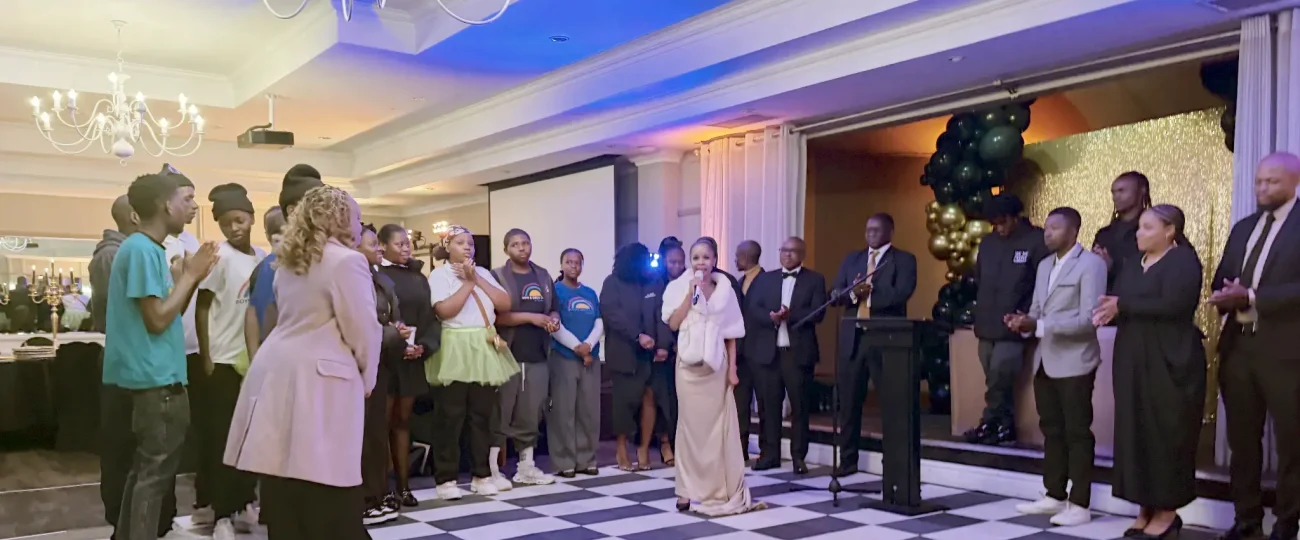
- This is an edited version of remarks by Reginald Shaver, a board member of the Boys & Girls Clubs South Africa and 2nd President of the Rho Phi Lambda at the Inaugural Dr AB Xuma Black and Gold Scholarship dinner, where deserving four pupils from BGCSA were awarded scholarships.