GREETINGS from the snow of Mount Kilimanjaro, the highest freestanding mountain in the world.
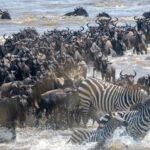
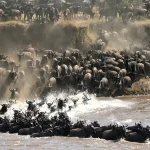
Greetings from the great plains of the Serengeti, where the wildebeest migration rights one of nature’s oldest and most magnificent stories. And greetings from the Spice Island of Zanzibar.
Tanzania and Russia share a longstanding partnership that spans more than 66 years. In December this year, our two countries will commemorate 65 years of diplomatic relations.
Certainly, we do not take this milestone for granted. We treat it as an enduring testament of strong commitment to a mutually beneficial partnership that seeks to uplift the lives of our people. Tanzania is one of the fastest-growing economies in Africa.
Our economic growth currently stands at six percent and is projected to expand to 6.3 percent by the end of this year. The goal is to attain an upper middle-income economy status with a per capita income of around 7,000 United States dollars in line with the Tanzania Vision 2050. In order to achieve this goal, we are building three pillars at once.
We are prioritizing construction of transport infrastructure, including the Standard Gate Railway, with plans to connect the Dar es Salaam port to the land-linked countries of Rwanda, Burundi and the Eastern Democratic Republic of Congo.
On the same note, the Five-Year Development Plan 2026-2031 outlines plans to extend the railway networks connecting Tanga port in the north of Tanzania to Musoma port in Lake Victoria and this is to facilitate transportation facilities in Lake Victoria to the neighboring countries. The Southern Corridor Railway, which is going to connect Tanzania to Malawi and Mozambique, is another railway project.
We have successfully completed the construction of the Julius Nyerere hydropower project, which has added more than 2,000 megawatts to our national grids. Plans to generate 8,000 megawatts by 2030 and 70,000 megawatts by 2050 are underway. On the other hand, we joined hands with Uganda in implementing the East African oil pipeline that will transport crude oil through our territories to global markets.
Similarly, we are expanding the soft infrastructure by increasing the broadband coverage to more than 95 percent, also building more data centers and extending cross-border fiber as part of our national ICT broadband project. This project stretches beyond our borders and connects to the neighboring countries of Kenya, Uganda, Rwanda, Burundi, Zambia, Mozambique, and Malawi, positioning Tanzania as a regional digital hub for land-linked countries. Excellencies, allow me now to narrate a thought that I believe deserves a place in this forum.
By 2050, one in four human beings in this planet will be African. Africa will be the only continent on Earth still adding workers to the global labor force on a large scale. Africa will host nine of the world’s 20 fastest-growing economies.
Africa’s middle class will exceed one billion people, and the African continental free trade area, when fully operational, will constitute the largest single market in the world by population. This is not just a forecast, but an arithmetic. Africa is destined to grow.
The question, however, is on what terms, with which partners, and whose model of growth. Africa somehow has charted its own development model. It is clearly articulated in the African Union’s Agenda 2063, operationalized through the African continental free trade area, the Program for Infrastructure Development in Africa, and the development plans in our regional blocks.
To date, talking of our bilateral relations between Tanzania and Russia, relations between our investment authorities, the Russian Ross Congress, and the Tanzania Investment Authority, have been formalized through the signing of a memorandum of understanding, which will open a new bridge of business to Tanzania. Concrete steps have been taken to review our laws and regulations for the purpose of creating a favorable investment environment and, henceforth, attracting more capital investment. In 2025, we created a one-stop center for all investors coming to Tanzania.
New companies can now register online within 24 hours. And this has transformed Tanzania into the fastest-growing investment destination in Africa, receiving around $12 billion worth of foreign direct investment in 2025, compared to merely $3 billion in 2021. We are proud to see Russian enterprises have contributed to this growth trajectory.
Our trade has equally remained steady at around $4 million annually. Tanzania is challenged to export more to Russia, and Russia is exporting more to Tanzania. Ladies and gentlemen, at this juncture, allow me to mention five main projects which we are here to seek partnership from the international business community.
First, we are delighted to inform you that Tanzania is embarking on one of the most ambitious port infrastructure developments, encompassing a special economic zone. And this is being done just four kilometers north of our commercial city, Dar es Salaam. We are turning a small historic trade vicinity into a global hub of commerce, manufacturing, and maritime sector development.
The Bagamoyo Special Economic Zone is our number one flagship project of which we welcome international enterprises to partner with us. Moreover, we are developing a complex Manga Pwani port, a transshipment port in our beautiful island of Zanzibar. The visibility studies for both ports are ready, and we are eagerly encouraging partners to join us in investments.
Second, on mining and mineral beneficiation, we have endeavored to ensure that the existing wealth of gold, uranium, nickel, graphite, helium, niobium, and other rare earth elements brings us massive economic returns. Our national policy is clear. We intend to move steadily from being a producer of raw materials to a producer of finished products.
We invite partners to invest with us in industrial parks that will give a real meaning to mining beneficiation. Third is tourism. Tanzania is one of the world’s most renowned tourist destinations.
Our remarkable hospitality industry continues to dominate the global tourism platforms. Last year, for the second time, the Serengeti National Park was named the leading African national park at the World Travel Awards in December 2025. At the same time, Tanzania has also been crowned as Africa’s leading destination, and Zanzibar was awarded Africa’s best corporate retreat destination.
As part of our plan to attract tourists from Russia, we have designated our national carrier, Air Tanzania, the wings of Kilimanjaro, to begin direct flights between Dar es Salaam, Moscow, and Zanzibar. This is going to begin. The first flight is expected to be on July 2 this year.
We aim to increase the number of Russian visitors to Tanzania to 500,000 by the year 2030, and a million shortly after. Fourth, as part of efforts to transform the agriculture sector and enhance food security, we have prioritized local fertilizer production to sustain our growing domestic demand. Since Russia is the world’s largest exporter of fertilizer, Tanzania highly encourages the establishment of local fertilizer plants geared to serve the country and the region at large.
Fifth, in the critical area of energy generation, Tanzania has huge deposits of uranium. Our main target is to use some of it in generating nuclear energy to meet the growing demands, which is expected to reach 8,000 megawatts by 2030, and subsequently 70,000 megawatts by 2050. It is in this context that Tanzania is advancing to nuclear energy as part of our long-term strategy to diversify our energy mix and support sustainable economic growth.
To guide this effort, we have developed an ambitious national roadmap for nuclear power development, including the use of small modular reactors in our long-term energy strategy. Here, the Rosatom campaign of Russia has shown great interest, and we are in discussion with them. In conclusion, it suffices to say that the world is moving faster, but necessitates that developing countries keep pace.
We must go where the wind blows. Indeed, this is a time for partnership, clarity, and trust. Above all, it is a time for us to take charge and realize our full potential.
In this situation, I dare say that Tanzania is open for business. Tanzania is ready for new ideas and innovation. Tanzania is open for collaborations with international partners.
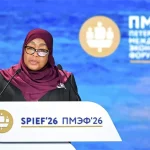
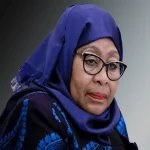
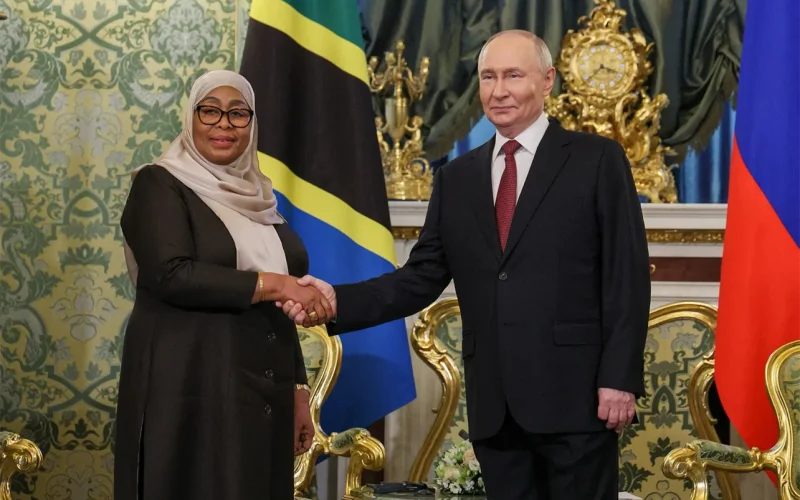
*This is an edited version of a keynote address by President of the United Republic of Tanzania, Samia Suluhu Hassan, during her historic visit to Russia, where she spoke at the SPIEF 2026 | AC1G