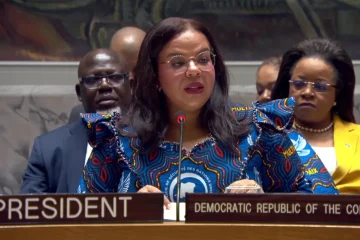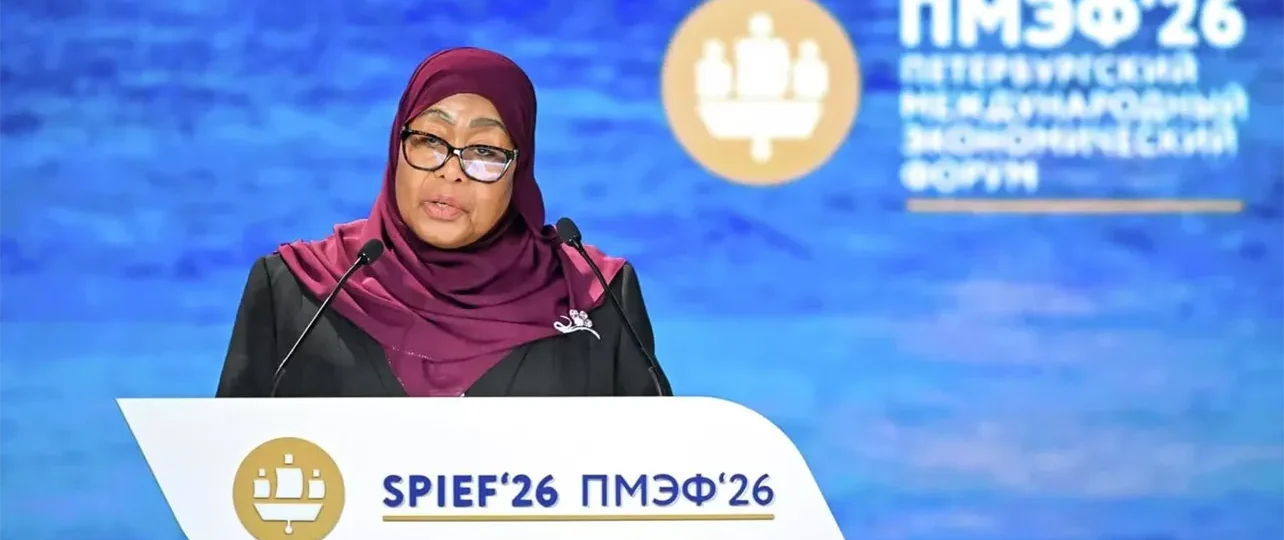

WHEN President Samia Suluhu Hassan rose to address the plenary of the 29th St. Petersburg International Economic Forum on 5 June 2026, she opened not with economic data but with imagery — the deliberate, considered imagery of a continent tired of being abstractly referenced and determined to be concretely present.
“Greetings from the snow of Mount Kilimanjaro, the highest freestanding mountain in the world. Greetings from the great plains of the Serengeti, where the wildebeest migration rights one of nature’s oldest and most magnificent stories. And greetings from the Spice Island of Zanzibar.”
President Samia Suluhu Hassan, SPIEF 2026 Plenary
It was a masterstroke of diplomatic communication — anchoring Tanzania in the universal language of natural wonder before pivoting to the language of capital. She was speaking to a hall that included Russian President Vladimir Putin, Uzbekistan’s Shavkat Mirziyoyev, and China’s Vice President Han Zheng. The moderator was India Today’s Foreign Affairs Editor Geeta Mohan. This was the Global South in plenary session, and Hassan had the floor.
The backdrop was equally significant. SPIEF 2026, running from 3 to 6 June under the theme “Pragmatic Dialogue: The Path to a Stable Future,” drew more than 20,000 participants from approximately 130 countries. Tanzania and Russia were marking 65 years of diplomatic relations — a milestone that Hassan, with characteristic precision, situated not as nostalgia but as foundation.
“We do not take this milestone for granted. We treat it as an enduring testament of strong commitment to a mutually beneficial partnership that seeks to uplift the lives of our people.”
President Hassan
THE ECONOMIC FUNDAMENTALS: NUMBERS THAT COMMAND ATTENTION
Before presenting Tanzania’s investment pitch, Hassan laid out the macroeconomic case with a clarity that left no room for the condescension Africa too often receives in international economic forums. Tanzania, she said, is growing at six percent annually — with a projection of 6.3 percent by year-end — and is targeting upper-middle-income status with a per capita income of around $7,000 under Tanzania Vision 2050.
The investment trajectory she cited is the headline number that stops conversations in rooms like SPIEF: foreign direct investment into Tanzania rose from approximately $3 billion in 2021 to $12 billion in 2025. In four years, Tanzania quadrupled its FDI attraction — a compound growth rate that few emerging markets anywhere in the world can match. New companies, she told the forum, can now register online within 24 hours, following the 2025 launch of a one-stop investment centre.
“This has transformed Tanzania into the fastest-growing investment destination in Africa, receiving around $12 billion worth of foreign direct investment in 2025, compared to merely $3 billion in 2021.”
She also flagged the bilateral trade relationship with Russia directly — and honestly. “Our trade has equally remained steady at around $4 million annually. Tanzania is challenged to export more to Russia, and Russia is exporting more to Tanzania.” The candour was deliberate. Hassan was not pitching a finished product. She was inviting partners into a transformation in progress.
THREE PILLARS, ONE VISION
Before unveiling her five flagship projects, Hassan set out the structural architecture of Tanzania’s development model — three simultaneous pillars that distinguish her administration’s approach from the single-sector development traps that have historically constrained African economies.
The first pillar is physical connectivity. Tanzania is building the Standard Gauge Railway (SGR) to connect the Dar es Salaam port to the landlocked countries of Rwanda, Burundi and the eastern Democratic Republic of Congo. The Five-Year Development Plan 2026–2031 extends this ambition further: a northern railway corridor connecting Tanga port to Musoma port on Lake Victoria, facilitating movement into neighbouring states; and a Southern Corridor railway linking Tanzania to Malawi and Mozambique.
The second pillar is energy. The Julius Nyerere Hydropower Project has been completed, adding more than 2,000 megawatts to the national grid. Tanzania is targeting 8,000 megawatts by 2030 and 70,000 megawatts by 2050. The East African Crude Oil Pipeline, developed jointly with Uganda, will transport crude oil through Tanzanian territory to global markets.
The third pillar is digital infrastructure. Broadband coverage is being expanded to more than 95 percent nationally. Tanzania is building data centres and extending cross-border fibre optic connectivity to Kenya, Uganda, Rwanda, Burundi, Zambia, Mozambique and Malawi.
“This project stretches beyond our borders and connects to the neighboring countries of Kenya, Uganda, Rwanda, Burundi, Zambia, Mozambique, and Malawi, positioning Tanzania as a regional digital hub for land-linked countries.”
President Hassan
THE AFRICA 2050 ARGUMENT: ARITHMETIC, NOT ASPIRATION
Midway through her address, Hassan shifted register — from Tanzania’s national story to the continental macro-argument that undergirds it. What followed was arguably the most analytically powerful passage of her speech, and deserves to be read in full rather than summarised.
“By 2050, one in four human beings on this planet will be African. Africa will be the only continent on Earth still adding workers to the global labor force on a large scale. Africa will host nine of the world’s 20 fastest-growing economies. Africa’s middle class will exceed one billion people, and the African Continental Free Trade Area, when fully operational, will constitute the largest single market in the world by population. This is not just a forecast, but an arithmetic. Africa is destined to grow.”
President Hassan, SPIEF 2026 Plenary
She then posed the question that every African leader should be pressing on every international platform: “The question, however, is on what terms, with which partners, and whose model of growth.” It is a question that reframes the entire investment conversation — away from aid and extraction toward agency and design.
Her answer was equally direct: Africa has already charted its own development model, articulated in the African Union’s Agenda 2063, operationalised through AfCFTA, the Programme for Infrastructure Development in Africa (PIDA), and the development plans of Africa’s regional blocs.
THE FIVE FLAGSHIP PROJECTS: TANZANIA’S INVESTMENT OFFER TO THE WORLD
Hassan then presented five specific investment opportunities — each with named sectors, institutional frameworks and measurable targets. Together, they constitute the most detailed and ambitious investment pitch Tanzania has made on an international stage.
| # | Project | Estimated Value | Key Sectors / Partners | Economic Impact |
| 1 | Bagamoyo Eco-Maritime City & Special Economic Zone (BSEZ) — including new Bagamoyo port and Manga Pwani transshipment port, Zanzibar | Up to $10 billion (full build-out) | Port infrastructure, manufacturing, logistics, maritime services. Open to all international partners. | East Africa’s premier maritime gateway; 9,800 ha zone; 24 investors secured by May 2026; export platform targeting US and European markets; anchor for SGR freight corridor |
| 2 | Mining & Mineral Beneficiation — gold, uranium, nickel, graphite, helium, niobium and rare earth elements; industrial park development for value-added processing | $1.2 billion (Mkuju River uranium project alone; Rosatom/Mantra Tanzania) | Rosatom (uranium); open to global partners for industrial parks in gold, graphite, niobium, REEs | Transition from raw material exporter to finished-goods producer; 44,000+ tonnes proven uranium reserves; Mkuju River main complex commissioning 2029; jobs in beneficiation industries |
| 3 | Tourism Infrastructure Expansion — direct Air Tanzania flights Dar es Salaam–Moscow–Zanzibar from 2 July 2026; Serengeti and Zanzibar destination marketing | Not disclosed (target: 500,000 Russian visitors by 2030; 1 million shortly after) | Air Tanzania (national carrier); hospitality sector; travel trade partnerships | Serengeti: Africa’s Leading National Park (World Travel Awards 2025); Tanzania: Africa’s Leading Destination 2025; Zanzibar: Best Corporate Retreat 2025; tourism a top foreign exchange earner |
| 4 | Fertiliser Manufacturing — local production plants to reduce import dependence and serve regional markets under AfCFTA | Not disclosed (Russia is world’s largest fertiliser exporter; partnership model proposed) | Russian fertiliser companies; Tanzania gas sector (57 tcf natural gas reserves as feedstock potential) | Food security for Tanzania and region; agricultural transformation under Vision 2050; reduces forex drain from fertiliser imports; positions Tanzania as regional agri-input hub |
| 5 | Nuclear Energy — Small Modular Reactors (SMRs); national nuclear power roadmap; underpinned by Tanzania’s domestic uranium reserves | Long-term (framework; Rosatom discussions active; Mkuju River $1.2bn uranium supply chain) | Rosatom (Russia); IAEA frameworks; domestic uranium from Mkuju River project | Target: 8,000 MW by 2030; 70,000 MW by 2050; clean energy transition; energy security for industrialisation; potential uranium exporter status |
PROJECT 1 IN DETAIL: BAGAMOYO — THE MARITIME FLAGSHIP
“Tanzania is embarking on one of the most ambitious port infrastructure developments, encompassing a special economic zone, just four kilometres north of our commercial city, Dar es Salaam. We are turning a small historic trade vicinity into a global hub of commerce, manufacturing, and maritime sector development. The Bagamoyo Special Economic Zone is our number one flagship project, and we welcome international enterprises to partner with us.”
President Hassan
The Bagamoyo Eco-Maritime City (BEMC) spans 9,800 hectares on Tanzania’s Indian Ocean coast and is managed by the Tanzania Investment and Special Economic Zones Authority (TISEZA). As of June 2026, 24 investors had secured land within the zone. A Chinese-backed textile manufacturing facility targeting export markets in the United States and Europe is set to begin production imminently on a 21-hectare site.
Hassan also unveiled a new project within the Bagamoyo complex at SPIEF: the Manga Pwani transshipment port on the island of Zanzibar — a project whose feasibility studies are complete and which is now open to international investment partners. Together, the Bagamoyo port and Manga Pwani represent Tanzania’s bid to become the logistics spine of East and Central Africa.
PROJECT 2 IN DETAIL: MINING — FROM RAW MATERIALS TO FINISHED GOODS
“We have endeavored to ensure that the existing wealth of gold, uranium, nickel, graphite, helium, niobium, and other rare earth elements bring us massive economic returns. Our national policy is clear: we intend to move steadily from being a producer of raw materials to a producer of finished products. We invite partners to invest with us in industrial parks that will give real meaning to mining beneficiation.”
President Hassan
The mineral portfolio Hassan listed is striking in its breadth — gold, uranium, nickel, graphite, helium, niobium and rare earth elements. Each represents a distinct global supply chain where Tanzania’s reserves, if beneficiated domestically rather than exported as concentrate, could generate multiples of the current economic return. Tanzania’s Mkuju River uranium deposit alone holds more than 44,000 tonnes of explored reserves, according to Rosatom’s own assessment.
PROJECT 3 IN DETAIL: TOURISM — AND A FLIGHT THAT CHANGES THE GAME
“As part of our plan to attract tourists from Russia, we have designated our national carrier Air Tanzania — the wings of Kilimanjaro — to begin direct flights between Dar es Salaam, Moscow, and Zanzibar. The first flight is expected on July 2 this year. We aim to increase Russian visitors to Tanzania to 500,000 by the year 2030, and a million shortly after.”
President Hassan
The tourism pitch was reinforced with recent accolades: the Serengeti National Park won Africa’s Leading National Park at the World Travel Awards in December 2025 for the second consecutive time; Tanzania was crowned Africa’s Leading Destination; and Zanzibar was awarded Africa’s Best Corporate Retreat Destination. The Air Tanzania announcement — with a specific launch date of 2 July 2026 — transformed what might have been a generic tourism pitch into a concrete bilateral deliverable with an imminent timeline.
PROJECT 4 IN DETAIL: FERTILISERS — FOOD SECURITY AS INVESTMENT OPPORTUNITY
“As part of efforts to transform the agriculture sector and enhance food security, we have prioritized local fertilizer production to sustain our growing domestic demand. Since Russia is the world’s largest exporter of fertilizer, Tanzania highly encourages the establishment of local fertilizer plants geared to serve the country and the region at large.”
President Hassan
The fertiliser pitch is strategically layered. Africa currently imports the vast majority of its fertilisers despite holding the agricultural land, natural gas feedstocks and demographic growth curves to justify domestic production at scale. A Russian-Tanzanian fertiliser plant — leveraging both Russia’s technical expertise as the world’s largest fertiliser exporter and Tanzania’s gas reserves and Indian Ocean port access — could serve not only Tanzania’s domestic market but the entire East and Central African region under AfCFTA’s emerging trade facilitation architecture.
PROJECT 5 IN DETAIL: NUCLEAR — THE MOST CONSEQUENTIAL BET
“Tanzania has huge deposits of uranium. Our main target is to use some of it in generating nuclear energy to meet the growing demands, which is expected to reach 8,000 megawatts by 2030, and subsequently 70,000 megawatts by 2050. We have developed an ambitious national roadmap for nuclear power development, including the use of small modular reactors in our long-term energy strategy. Rosatom of Russia has shown great interest, and we are under discussion with them.”
President Hassan, SPIEF 2026
This is Tanzania’s most strategically consequential SPIEF announcement — and the least covered by mainstream Western media. A country that mines its own uranium, processes it domestically (Mantra Tanzania’s Mkuju River pilot facility launched in 2025; main complex commissioning scheduled for 2029), and then uses it to power small modular reactors on its own soil has achieved a degree of energy sovereignty that most African states can only theorise about.
“Tanzania possesses explored uranium reserves exceeding 44,000 tonnes at the Mkuju River deposit alone — enough to underpin both domestic nuclear generation and potential export status as a uranium supplier to global markets.”
The nuclear roadmap is not a distant aspiration. The institutional groundwork is advanced. Rosatom’s subsidiary Mantra Tanzania has been on the ground for years. The pilot processing facility is operational. What SPIEF did was signal, publicly and on a global stage, that Tanzania has made the strategic decision to pursue nuclear energy — and has chosen Russia as its primary partner in doing so. Tanzania’s Minerals Minister Anthony Mavunde confirmed after the visit that the SPIEF engagement had given fresh impetus to the Mkuju River project.
THE NON-ALIGNMENT DOCTRINE: DEFYING THE WESTERN NARRATIVE
No account of Hassan’s St. Petersburg visit can avoid the geopolitical subtext. Her presence at SPIEF — sharing a platform with Putin — drew predictable scrutiny in Western capitals where attendance at a Russian forum is increasingly read as political alignment. On the sidelines, she addressed this with characteristic composure.
“We work with everyone. We don’t choose who to work with. By coming to Russia, we are simply expanding the scope of those with whom we closely cooperate.”
President Hassan, speaking to journalists on the sidelines of SPIEF 2026
On the plenary stage itself, moderator Geeta Mohan raised the question of sanctions — an unusual intrusion of geopolitical provocation into an economic forum. Hassan’s response was emphatic and unequivocal: “I want to assure you that Tanzania is not under sanctions. We are not under sanctions at all, and we are continuing to organise ourselves to develop our country.”
The exchange is instructive. Tanzania’s non-alignment posture is rooted in the Nyerere tradition, hardened by decades of colonial experience, and now — under Samia — being actively monetised as a strategic asset. By maintaining strong relations simultaneously with the United States, China, the EU, India, the Gulf states and Russia, Dar es Salaam has positioned itself as a neutral node that every major power has reason to cultivate. That positioning is itself an economic instrument.
CONCLUSION: WORDS THAT CARRY WEIGHT
Hassan closed her SPIEF address not with diplomatic pleasantries but with a declaration of intent — three sentences that distil Tanzania’s new posture in the world economy.
“I dare say that Tanzania is open for business. Tanzania is ready for new ideas and innovation. Tanzania is open for collaborations with international partners.”
President Hassan, closing remarks, SPIEF 2026 Plenary
The harder question, as always with Tanzania, is execution. Bagamoyo carries a decade of delays in its history. The Mkuju River uranium project was suspended for years before Rosatom relaunched it. Bureaucratic over-regulation remains, by the government’s own admission, an unresolved challenge. Whether the TISEZA reforms, the investment momentum, and the diplomatic offensive translate into sustained structural transformation — rather than another cycle of ambitious announcements — will be the real test.
But the numbers Hassan brought to St. Petersburg — $12 billion in FDI, 915 registered projects, a quadrupling of investment inflows in four years, 24 investors already in Bagamoyo, a nuclear processing facility commissioned and a reactor roadmap published — are not the numbers of a country performing development. They are the numbers of a country doing it.