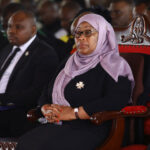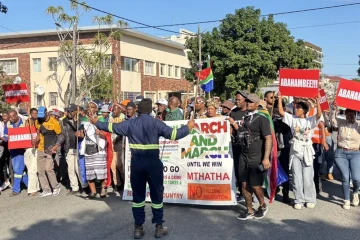

PRESIDENT Samia Suluhu Hassan has announced executive clemency for 1,787 people convicted in connection with post-election violence that shook Tanzania in late October, as she pledged a path toward national healing following what she described as “unprecedented incidents” that left the country reeling.
Speaking at the annual Diplomatic Sherry Party relocated to the capital for the first time, Hassan outlined her administration’s “4Rs” framework – Reconciliation, Resilience, Reforms, and Rebuilding – to address the aftermath of the October 29, 2025, unrest that has cast a shadow over the East African nation’s democratic credentials.
While the president did not specify casualty figures in her address to ambassadors and international organisation heads, the reference to “unprecedented” violence and the pardoning of nearly 1,800 convicts signal the scale of the crisis that gripped Tanzania following last year’s elections.
“Tanzania is a nation that has learned from its past and is strictly focused on its future,” Hassan told the diplomatic gathering at Chamwino State House. “We invite you to engage with us in a spirit of transparency and inclusivity as we build a nation that is both prosperous and at peace with itself.”
The announcement comes as Tanzania attempts to move forward from one of the darkest chapters in its post-independence history. Hassan’s administration has established an Independent Inquiry Commission to investigate the violence and ensure accountability, though critics have questioned whether the body possesses sufficient independence from state influence.
Beyond clemency, the president promised a structured roadmap toward constitutional reforms through what she termed “inclusive reconciliation mechanisms,” suggesting fundamental changes to Tanzania’s governance framework may be under consideration.
The timing of Hassan’s remarks appears calculated to reset Tanzania’s international image as the country seeks to attract foreign investment. She reported that Tanzania registered 927 new investment projects valued at $11.09 billion as of December 2025, projects expected to generate over 162,000 jobs.
Hassan’s administration is positioning the country for what it calls “Sovereign Pragmatism,” moving away from traditional aid dependency toward trade partnerships. The president emphasised Tanzania’s “non-aligned but multi-engaged” stance, seeking to balance relationships between Western donors and Eastern infrastructure partners, particularly China.
The speech came as Hassan formally launched Tanzania Development Vision 2050, an ambitious blueprint targeting double-digit economic growth through the development of the country’s natural gas reserves, critical minerals, and strategic position as a logistics hub for Southern and East African trade blocs.
Tanzania recorded 5.9 percent GDP growth in 2025 with inflation at 3.3 percent, figures Hassan highlighted as evidence of macroeconomic stability despite the political turbulence. Public debt remains within sustainable thresholds, according to government data, with favourable sovereign credit ratings.
The relocation of the diplomatic reception from Dar es Salaam to Dodoma symbolises the government’s commitment to the capital transition, a project that has accelerated under Hassan’s leadership since she assumed office in 2021 following the death of President John Magufuli.
Hassan urged the international community to “look beyond transient headlines to witness the profound structural reforms currently underway,” a plea that reflects ongoing international concern about democratic backsliding in Tanzania.
The Independent Inquiry Commission is expected to deliver preliminary findings in the coming months, though no timeline was provided for the constitutional review process Hassan promised. Human rights organisations and opposition parties are likely to scrutinise both the composition and mandate of these mechanisms as Tanzania attempts to turn the page on the October violence.
The pardoning of 1,787 convicts marks one of the largest acts of executive clemency in recent Tanzanian history, though questions remain about how many others remain imprisoned in connection with the unrest and what charges the pardoned individuals originally faced.