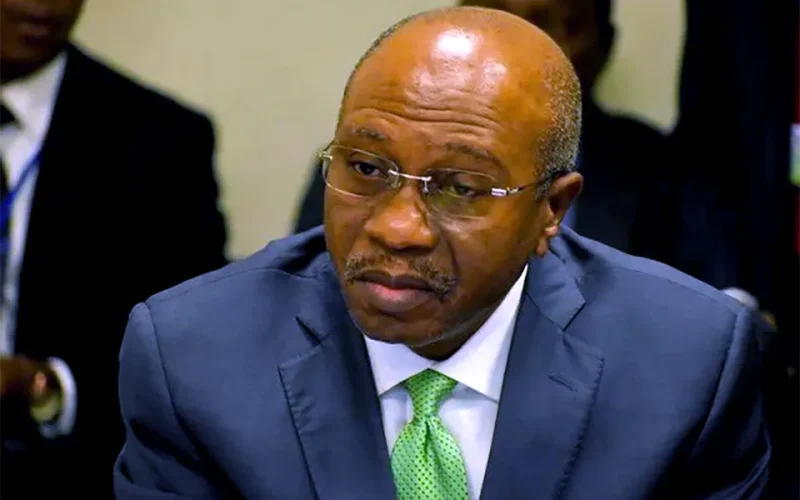
FOR six years, Godwin Emefiele held the keys to Nigeria’s reserves. As Governor of the Central Bank of Nigeria from 2014 to 2023, he was the institution’s chief guardian, the man entrusted with defending the naira, setting interest rates, and safeguarding the country’s foreign exchange from misuse. Nigeria’s Supreme Court has delivered a verdict that reads like an inversion of that mandate: the very system Emefiele once policed has now permanently stripped him of seven properties, $2,045,000 in cash, and a portfolio of share certificates, ruling that the assets were reasonably suspected to be proceeds of unlawful activity.
A five-member panel led by Justice Ibrahim Mohammed Saulawa set aside a Court of Appeal judgment that had briefly handed Emefiele a reprieve, and restored the final forfeiture order originally issued in November 2024 by Justice D.I. Dipeolu of the Federal High Court in Lagos. The Economic and Financial Crimes Commission, EFCC, had pursued the assets as a civil action in rem – a forfeiture proceeding brought against the property itself rather than requiring a criminal conviction – under Nigeria’s Advance Fee Fraud and Other Fraud Related Offences Act.
The forfeited estate reads like a map of Lagos’s most exclusive addresses: a duplex on Hakeem Odumosu Street in Lekki Phase 1; a nearly 2,000-square-metre vacant plot on Oyinkan Abayomi Drive in Ikoyi; a bungalow on the same street; a four-bedroom duplex on Probyn Road; eight apartment units on Adekunle Lawal Road; a full duplex on Bank Road; and an industrial complex under construction across 22 plots in Agbor, Delta State. Alongside the properties, the court ordered forfeiture of the cash sum and share certificates belonging to Queensdorf Global Fund Limited, an entity investigators linked to Emefiele.
The Supreme Court’s ruling closes a legal loop that began when the EFCC’s Director of Public Prosecutions, Rotimi Oyedepo, SAN, first secured the trial court’s forfeiture order on the strength of an affidavit from investigating officer David Jayeoba. Emefiele’s successful appeal to the Court of Appeal had briefly reversed that outcome, only for the apex court to side unanimously with the Commission and the Federal High Court.
“The custodian who stood between the nation’s wealth and those who would plunder it is now the subject of forfeiture orders running into millions of dollars.”
The forfeiture ruling lands as Emefiele fights a far larger battle in two separate criminal trials that go to the heart of how the naira and the nation’s foreign reserves were managed under his watch. At the Special Offences Court in Ikeja, Lagos, he and co-defendant Henry Omoile face a 19-count charge alleging abuse of office, corruption, receiving gratification, unlawful acceptance of gifts through an agent, and fraudulent property transactions running to roughly $4.5 billion and ₦2.8 billion. Both men have pleaded not guilty. Emefiele’s lawyers had fought to keep extra-judicial statements he gave the EFCC in late 2023 out of evidence, arguing they were extracted under duress during a detention by the Department of State Services that stretched beyond five months. That objection was dismissed on July 9, 2026, when the trial judge, Justice Rahman Oshodi, held that none of the statements amounted to an admission of the facts in issue, clearing them for use as the trial resumes in October and November.
A parallel case at the Federal Capital Territory High Court in Abuja has drawn its own damaging testimony. A police witness told the court in June that $6.23 million released by the CBN, ostensibly to fund a foreign election observer mission, amounted to outright theft, with investigators alleging the funds were released on Emefiele’s instruction without adequate justification and collected by a man carrying a fabricated staff identity card.
The Guardian Becomes the Accused
Taken together, the Supreme Court’s forfeiture order and the grinding criminal trials mark one of the most consequential accountability sagas in Nigeria’s recent institutional history. A central bank governor occupies a position of trust unlike almost any other in a modern economy: he is meant to be the custodian who stands between the nation’s wealth and those who would plunder it. That the same office is now the subject of forfeiture orders running into millions of dollars, and criminal allegations running into billions, is a reminder – for Nigeria and for the wider continent – of how easily the guardianship of public wealth can curdle into its exploitation when oversight fails.
For a region where central banks and finance ministries remain the last line of defence against capital flight and looted reserves, the Emefiele forfeiture is more than a Lagos courtroom story. It is a test case for whether Africa’s anti-graft institutions – the EFCC among them – can make asset recovery stick even against the continent’s most powerful economic gatekeepers, and whether accountability, once set in motion, can outrun the delay tactics available to those it targets.
The Supreme Court’s judgment on the seven properties, the $2.045 million and the share certificates is final. The criminal trials, and the larger question of what happened to the money passing through the Central Bank of Nigeria during Emefiele’s tenure, continue.