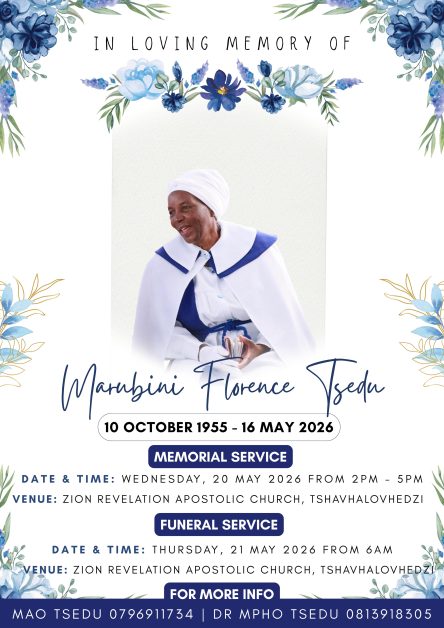
A Farewell to Florence “Florah” Tsedu, returned to the earth at Tshavhalovezhi
The rain knew. It came softly, in quiet intervals, as though the sky itself had been briefed – as though heaven was preparing the earth to receive something precious. At Tshavhalovhezhi, in Venda, Limpopo, beneath those rolling skies and above that valley whose memory is long and whose soil does not forget, we laid to rest Florence “Florah” Tsedu: a beautiful soul, a magnificent woman, a presence that had coloured this world in ways that no single telling can fully contain.
Heartbreak and celebration moved together on that day as though they had rehearsed it, as though grief and joy had long ago agreed to stop pretending they were opposites. And in the most profound sense, they are not. To weep for someone is to say that they mattered. To sing for them is to say they still do. At Tshavhalovezhi, both truths rang out – and the valley held them both.
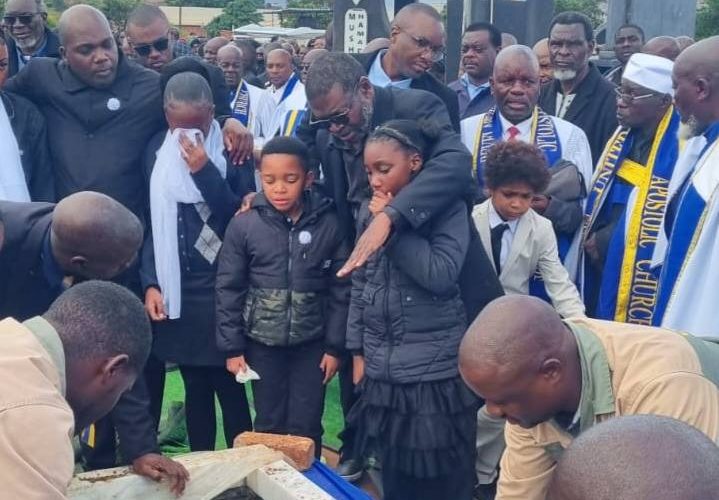
The Zion Revelation Apostolic Church opened itself fully for Florah, and why not? She was born into this congregation. Her blood was blue and white. Its rhythms were her rhythms. Its spirit was her spirit. The walls and the rafters and the open air beyond the doors had known the timbre of her presence across decades, and now they gathered close around her one final time, as family does.
They Sang for Florah
The singing was not ceremonial. It was not performance. It rose from somewhere below the chest, from that ancient and irreducible place where love and memory fuse into something that words cannot reach but music can. They sang for Florah, and the drumbeats – old, certain, unhurried- rolled out across the valley like a proclamation. The drumbeats said: She was here. The drumbeats said: She mattered. The drumbeats said: We remember.
And the congregation moved. Men and women. Young and old. Possessed, as the blessed sometimes are, by something larger than themselves – some current of love and spirit that dissolved the careful boundaries between bodies and made of that gathering a single, swaying, breathing testament. They went wherever that spirit led them, and wherever it led them was the right place.
Words Carefully Chosen
The speeches were worthy of her. The words had been chosen with care, with love, with the seriousness that a life of substance demands – and they adorned the occasion like offerings placed at a shrine. Not flattery. Not the hollow cadences of obligation. These were words that had cost something to speak: words excavated from the depths of real relationship, real memory, real love.
A proud son stood and spoke of his mother and to his mother – because the dead do not simply stop listening. He gathered himself, and he gave her everything language could carry. He spoke of who she was to him: the first landscape, the original north star, the woman whose voice had calibrated his sense of the world. In that church, on that day, a son honoured his mother the way only a son who truly knew her could. And he did so on behalf of his siblings.
A daughter-in-law rose and spoke of the intimacies that build quietly over years: the small exchanges, the glances, the phone calls, the shopping excursions, the in-between moments that accumulate into a bond you did not plan and cannot explain but would not surrender for anything. She spoke of love that had been freely given and freely returned. She spoke of Florah as a woman who let you in, who made room for you, who expanded rather than contracted as the family grew around her.
And then the grandson spoke – and sang – and twirled. He twirled, as is tradition in the ZRAC, in that beautiful spinning devotion that is at once prayer and poetry and pure physical joy. He twirled for his grandmother, and the moment was incandescent. It was the kind of moment that does not need explaining because it transcends explanation: a young man turning and turning in the spirit, offering his body as testimony, saying with his movement what words could not say and silence could not hold. Grandma’s love was that kind of love – the kind that sets you spinning with the sheer luminous weight of it.
Among those who spoke was Mosebudi Mangena, a family friend of five decades – a man whose friendship with Florah, her husband Mathatha and her family had been forged not in the easy seasons but across the long arc of a shared life. He spoke of bonds of love and loyalty, of the particular warmth that comes only from knowing someone across time, from watching them change and remain themselves simultaneously.
He spoke, too, of the moment the call came through – the frantic call from Mathatha, the urgency in the voice, the terrible news that Florah had collapsed on what would be her last outing. In that detail – small, specific, achingly human – the full weight of loss arrived. She had been out in the world, living, moving, being Florah, and then she was not. The world she inhabited continued; she did not. And so those who loved her were left to carry her in the only way the living can carry the dead: in story, in song, in the spinning of a grandson who learned how to love from her.
Florence “Florah” Tsedu was returned to the earth at Tshavhalovezhi as the rain came down in its soft, knowing way. She left behind a congregation that knew her name, a family that carries her imprint in the way they love, a grandson who twirls with her spirit alive in him, and a valley that will hold the echo of those drumbeats long after the afternoon has passed.
She was a mother. A grandmother. A daughter of that church and that land. She was warmth made human, love made visible, memory made permanent. She was so many things to so many people – and they all came to say so, in song, in word, in movement, in tears, in the dignified and colourful and deeply African ceremony of a farewell that matched the magnitude of a life.
The valley remembered her. It always will.