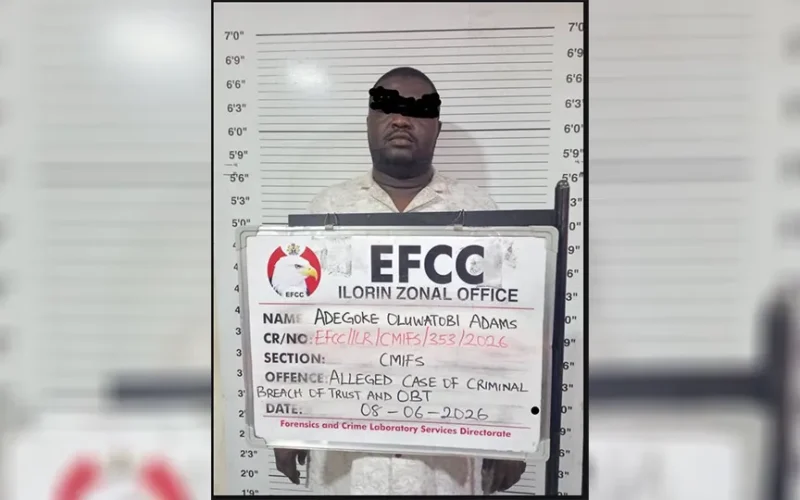
OPERATIVES of the Economic and Financial Crimes Commission’s (EFCC) Ilorin Zonal Directorate have arrested a Nigerian-American businessman, Adegoke Oluwatobi Adams, over an alleged cross-border vehicle import fraud that investigators say drained more than $320,000 — roughly ₦434.88 million — from two Nigerians who believed they were buying a brand-new 2024 Mercedes-Benz G63 AMG from the United States. The vehicle, the EFCC says, never arrived. Neither, in the end, did any vehicle at all.
Adams, who holds dual citizenship of Nigeria and the United States, is being investigated for alleged criminal breach of trust and obtaining money by false pretence, the anti-graft agency said in a statement issued on Friday, 19 June 2026, through its Media and Publicity Unit, headed by Dele Oyewale. He was picked up by EFCC operatives in Ilorin immediately upon his return to Nigeria — a detail that points to a wider, recurring problem for Nigerian law enforcement: diaspora-based suspects who operate from US soil, beyond the immediate reach of local prosecutors, until they choose to come home.
The case is not an isolated one. It is the latest in a lengthening file of diaspora-linked import frauds in which dual citizenship, a US address, and the simple fact of having “made it abroad” are weaponised as instruments of credibility — used to convince Nigerians to wire large sums for vehicles, goods or services that, investigators say, exist mainly on a phone screen.
How the Scam Allegedly Worked
According to the EFCC’s preliminary findings, the fraud followed a pattern that has become disturbingly familiar in Nigeria’s diaspora vehicle-import economy, but with a twist that magnified the damage. Investigators say the scheme unfolded in four stages:
• The bait: While resident in the United States, Adams allegedly advertised and circulated photographs of a 2024 Mercedes-Benz G63 AMG — one of the most coveted luxury SUVs among status-conscious Nigerian buyers — to prospective purchasers back home, positioning himself as someone with the capacity to buy and ship the vehicle from America.
• The credibility transfer: His dual citizenship and physical presence in the US did the persuasive work that documentation should have done. Victims were not shown a bill of sale, a dealership invoice, a VIN-verified title, or shipping paperwork — they were shown photographs and a promise, backed by the assumption that a Nigerian-American “connect” in America was inherently more trustworthy than a local dealer.
• The double-dip: The most striking feature uncovered by investigators is that two separate victims allegedly paid for what was presented as the same vehicle. Ikechukwu Osita Ifeabunike reportedly paid $145,000 through an intermediary, while Godson Azubuike Amans is said to have paid $175,000 — a combined $320,000 for one car. Running parallel transactions on a single advertised vehicle, without either buyer aware of the other, is a classic marker of import fraud: it lets a syndicate collect full or near-full payment more than once on an asset it may never have owned or intended to ship.
• The vanishing act: No vehicle was delivered. No refund followed. It was only after the promised G63 AMG failed to materialise that the victims’ complaints reached the EFCC, triggering the investigation that ended in Adams’s arrest in Ilorin.
A Suspect Already Known to US Authorities
Perhaps the most damning element of the EFCC’s findings is not the alleged fraud itself but what investigators say they found when they looked into Adams’s background: a prior criminal record in the United States allegedly connected to the illegal acquisition of vehicles. If substantiated in court, that history would suggest this was not a first venture into vehicle-related deception but a continuation of an established method — one that had already drawn the attention of American law enforcement before two Nigerian victims lost a combined ₦434.88 million.
That detail raises an uncomfortable question for Nigeria’s diaspora investment and remittance economy: how many similar operators, with histories already flagged in the jurisdictions where they live, continue to market themselves to Nigerian buyers who have no practical means of checking a US criminal record before wiring six-figure sums?
Part of a Widening Enforcement Pattern
The Adams case lands amid a visibly intensified EFCC enforcement push against cross-border and diaspora-linked financial crime. In May, the commission arrested a former Minister of Power, Saleh Mamman, in connection with an alleged ₦33.8 billion fraud linked to the Mambilla and Zungeru hydropower projects. In April, operatives arrested a Cameroonian national, Bekono Marc Eric, over an alleged ₦1.5 billion bank fraud in Lagos. Taken together with the Adams arrest, the cases point to a commission increasingly willing to pursue suspects whose alleged schemes straddle Nigeria’s borders — even when, as in this case, the most damaging conduct allegedly took place thousands of kilometres away, in the United States.
For Nigeria’s anti-graft architecture, such cases also test the limits of cross-border cooperation. Adams’s arrest was only possible because he returned voluntarily to Nigeria; had he remained in the United States, his prior American record and the alleged Nigerian fraud might have sat in parallel jurisdictions indefinitely, each unable on its own to compel his appearance in either country’s courts.
Why Diaspora Vehicle Deals Remain a Soft Target
Nigeria’s appetite for imported “Tokunbo” and brand-new American vehicles, particularly German luxury marques, has long made vehicle importation a fertile ground for fraud — from fake customs auction schemes circulated on social media to, as in this case, individuals who lean on real or claimed diaspora status to sell vehicles that do not exist or were never theirs to sell. What distinguishes the Adams case is the scale of a single transaction and the apparent ease with which two buyers were separately persuaded to pay for the same advertised vehicle without either party verifying the other’s claim, the seller’s import licence, or the existence of any actual purchase order with a US dealership.
RED FLAGS IN DIASPORA VEHICLE PURCHASES
• Payment requested before any verifiable bill of sale, dealership invoice or VIN-matched title is produced.
• Reliance on photographs and personal assurances rather than independently verifiable shipping or bill-of-lading documentation.
• Payment routed through a personal intermediary rather than a traceable, named commercial channel.
• Trust placed primarily in a seller’s diaspora status or dual citizenship, rather than in documentary proof of the transaction.
What Happens Next
The EFCC says investigations are ongoing and that Adams will be arraigned in court once they are concluded. As with all matters currently before the commission, the allegations against him remain unproven, and he is entitled to the presumption of innocence until a court determines otherwise. The case will nonetheless be watched closely by a Nigerian public increasingly wary of diaspora-marketed vehicle deals – and by an anti-graft commission signalling that returning home no longer guarantees safe distance from allegations accumulated abroad.