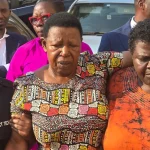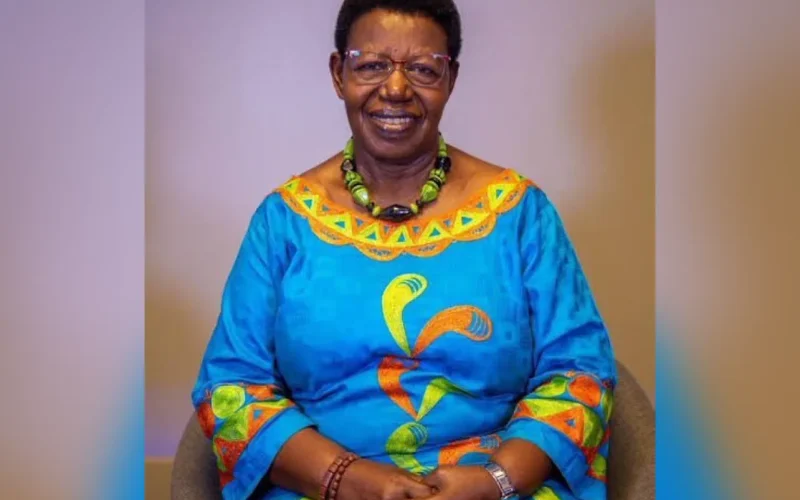
There is a particular kind of courage that belongs almost exclusively to those who have nothing left to prove and nothing left to lose. At 72, Dr Miria Rukoza Koburunga Matembe has spent more than three decades demonstrating exactly that kind of courage, and this week it appears to have cost her her freedom.
Matembe disappeared after security operatives raided her Luzira home while she was out on her regular morning walk. Days of uncertainty followed, marked by an emotional televised appeal from a former member of parliament, statements of concern from women’s rights organisations and opposition leaders, and a stony silence from the authorities. That silence ended when Gen. Muhoozi Kainerugaba, the army chief whose conduct she had just finished criticising on national television, confirmed on social media that he was holding her.
A Daughter of Bwizibwera
Matembe was born on 28 August 1953 in Bwizibwera, a farming village in Kashaari, Mbarara, the fourth of nine children. Her early education took her through Rutooma Primary School, Bweranyangi Girls for her O-Levels, and Namasagali College, before she went on to Makerere University, where she trained in law, the discipline that would shape the rest of her public life.
She belongs to the generation of Ugandan women who came of age politically in the upheaval of the 1980s, and who went on to do something few of their counterparts elsewhere on the continent were given the opportunity to do: help write a new constitution from first principles. As a delegate to Uganda’s Constituent Assembly in the early 1990s, Matembe was among the women who fought to entrench gender equality provisions and protections for women’s political participation in the 1995 Constitution, work that earned her recognition as one of the founding mothers of Uganda’s modern women’s movement.
She went on to serve as Uganda’s Minister of Ethics and Integrity, a portfolio that placed her, often uncomfortably for those in power, at the centre of the country’s fight against corruption. Colleagues and admirers describe her today as the matriarch of Uganda’s women’s movement, the moral authority whose decades of consistency and personal cost have opened space for younger generations of women in politics and civil society.
From Insider to Conscience
Matembe’s journey from a trusted figure inside Museveni’s ruling movement to one of its most consistent critics has unfolded gradually and publicly. In recent years, she has used television interviews and public platforms to warn, repeatedly, that Uganda’s institutions, Parliament, the judiciary, and the police are being hollowed out by the growing political and personal power of one man: Gen. Muhoozi Kainerugaba, the Chief of Defence Forces and son of President Museveni.
Her central argument, made on camera in the days before her disappearance, was a constitutional one rather than a personal one, even though it landed as deeply personal. She argued that nothing in Uganda’s constitution, the same constitution she helped draft, gives an army commander the power to order the arrest of any citizen without even the knowledge of the Inspector General of Police, whose mandate that constitutionally is. The growing pattern of abductions and detentions carried out at the apparent instruction of the military chief, in her telling, represents the de facto suspension of the rule of law by a man who has never been elected to anything.
She was equally direct about what she saw as the roots of Kainerugaba’s conduct. Matembe argued that he had never known want, having been a child of roughly eleven or twelve when his father seized power in 1986, and that everything he has commanded since, the soldiers, the resources, the platform, was built on the country’s wealth rather than his own. That lifelong absence of hardship, she suggested, had produced a man who respects no one, because he has never had to earn anything he holds.
She addressed President Museveni directly in the same interview, asking him to recognise her not as an unstable provocateur but as a longstanding comrade whose record in Uganda’s liberation movement and whose sacrifices for the country he himself knew well. It was, in effect, an appeal from one elder of the movement to another, made on the record, days before soldiers came looking for her at home.
Not Afraid of Death
Asked whether she feared the consequences of speaking so openly against the country’s most powerful soldier, Matembe gave an answer that has since circulated widely on Ugandan social media: that death comes to everyone regardless of what they do or say, and that fearing it was therefore pointless. She framed her own silence, by contrast, as the only thing genuinely within her control, and said she saw no reason to practise it inside her own home about matters she has spent her adult life fighting for.
That posture, more than any single policy position, is what has made her a reference point for Ugandans frustrated with the deepening militarisation of political life. A former opposition leader of Uganda’s national assembly described her, in the days following her disappearance, as one of the most consistent voices the country has produced, someone who has challenged injustice for decades without regard for the political cost to herself. Civil society leaders and former officials across the political spectrum, including figures who have themselves clashed with the current government, joined calls for her unconditional release, framing her detention as a test of whether Uganda’s constitutional protections against arbitrary arrest still mean anything in practice.
The Raid
According to her husband, Nehemiah Matembe, the operation against their home unfolded with a deliberate absence of explanation. A mixed team of uniformed soldiers and plain-clothed operatives arrived in a vehicle that residents have taken to calling a “drone”, found Matembe already gone for her walk, and proceeded to search every room of the house, including the couple’s bedroom, before leaving without identifying themselves, without an arrest, and without a word to the family left standing in the wreckage of their own privacy.
Her phones went silent soon after. For days, her family said they had no way of confirming whether she was alive, in custody, or simply hiding. The confirmation came not through any court appearance, charge sheet or police statement, but through a one-line social media reply from Kainerugaba himself, offered with the same offhand confidence he had used hours earlier to announce the closure of Uganda’s largest independent newspaper.
What Comes Next
Matembe’s standing, built across decades of public service, constitution-making and outspoken advocacy, means her detention has become something larger than a personal ordeal. It has become a measure of how far Uganda’s institutions have drifted from the document she helped write, and a test of whether public outrage, however genuine, can still constrain a military commander who answers, by his own account, only to his father.
Whatever happens to her in the days ahead, Miria Matembe has already done what fewer and fewer people in Uganda are still willing to do: she said, on camera, in her own name, what millions of her compatriots say only in private. That she may now be paying the price for it does not diminish the act. If anything, it confirms exactly the point she was making.