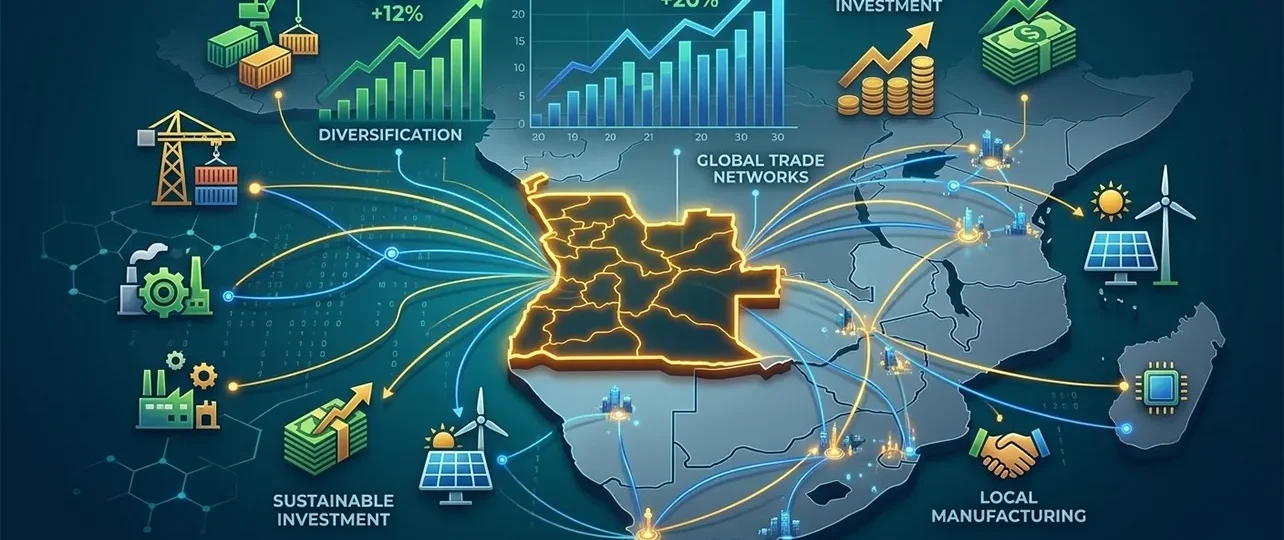

ANGOLA has validated a National AfCFTA Strategy and Action Plan, signalling a shift from commodity dependence toward a trade‑led industrialisation push. The move maps out how Luanda intends to tap a single African market of more than a billion consumers to build regional value chains, scale domestic firms and broaden economic opportunity for women and youth.
Why this matters now
- Scale on the doorstep: AfCFTA gives Angolan producers closer markets and lower transport costs than distant export routes. That matters for manufacturers, agriprocessors and input suppliers seeking faster growth.
- Industrialisation by trade: The strategy ties trade liberalisation to capacity building — the aim is regional supply chains that embed Angolan firms deeper into value creation rather than exporting raw materials.
- Inclusion and resilience: Explicit targets for SMEs, women and youth suggest policymakers see trade as a tool to expand the tax base and stabilise livelihoods, not just boost headline GDP.
What Luanda committed
- A phased Action Plan prioritising productive capacity, regional value‑chain development and private‑sector participation.
- Institutional arrangements designed to coordinate government, business and donors after nationwide consultations running from Sept 2025 to June 2026.
- Partnership backing from ECA’s Southern Africa office and funding support from Global Affairs Canada — a signal that donors will help underwrite technical and financial gaps.
Immediate tests
- Can the government move from plan to delivery? Quick setup of a functional AfCFTA Implementation Committee with clear KPIs and budgets will determine early momentum.
- Will Angola fix supply‑side constraints? Manufacturing scale, skills, reliable energy and logistics must improve for firms to meet regional demand on price and quality.
- Will finance flow to the real economy? SMEs need trade finance, export guarantees and working capital to convert opportunity into shipments.
- Can non‑tariff barriers be cut? Customs delays, inconsistent standards and paperwork can erase tariff gains unless Angola coordinates regionally and digitalises procedures.
How businesses should respond now
- Map quick wins: Exporters should identify regional niches where Angolan inputs or semi‑finished goods are competitive and align supply chains to meet rules of origin.
- Push for practical reforms: Private sector should demand timelines for customs, standards and infrastructure that affect their margins.
- Build partnerships: Manufacturers, financiers and logistics providers should form consortia to share risk, meet regional sourcing rules and scale market entry.
- Prepare financial instruments: Banks and fintechs should launch AfCFTA products — trade lines, guarantees, FX solutions — ideally blended with development capital.
A short playbook for policymakers
- Publish the Action Plan with timelines, costs and KPIs.
- Operationalise the National AfCFTA Implementation Committee and assign accountable leads.
- Target support to SME upgrading, standards compliance, and women‑ and youth‑led enterprises.
- Mobilise blended finance for infrastructure and factory upgrades.
- Work with neighbours to eliminate NTBs and adopt digital single windows.
A concrete example of what’s possible
An Angolan agriprocessor, a Namibian inputs supplier and a Zambian logistics firm pool investment to produce fortified cereals for Southern Africa. They meet rules of origin through regional sourcing, use a digital single window for customs, and tap blended finance to upgrade capacity — cutting costs versus imports and capturing regional market share.
Bottom line
Validation of the AfCFTA strategy is an opening, not a finish line. For Angolan business, the window is now: shape implementation, secure finance and build regional partnerships. If Luanda converts the strategy into fast, practical reforms, the country can move from exporting resources to exporting manufactured value across Africa.