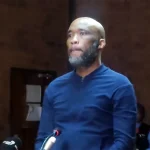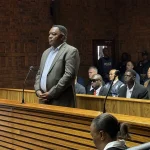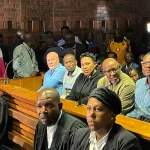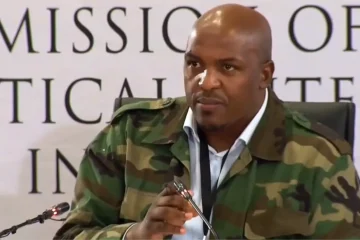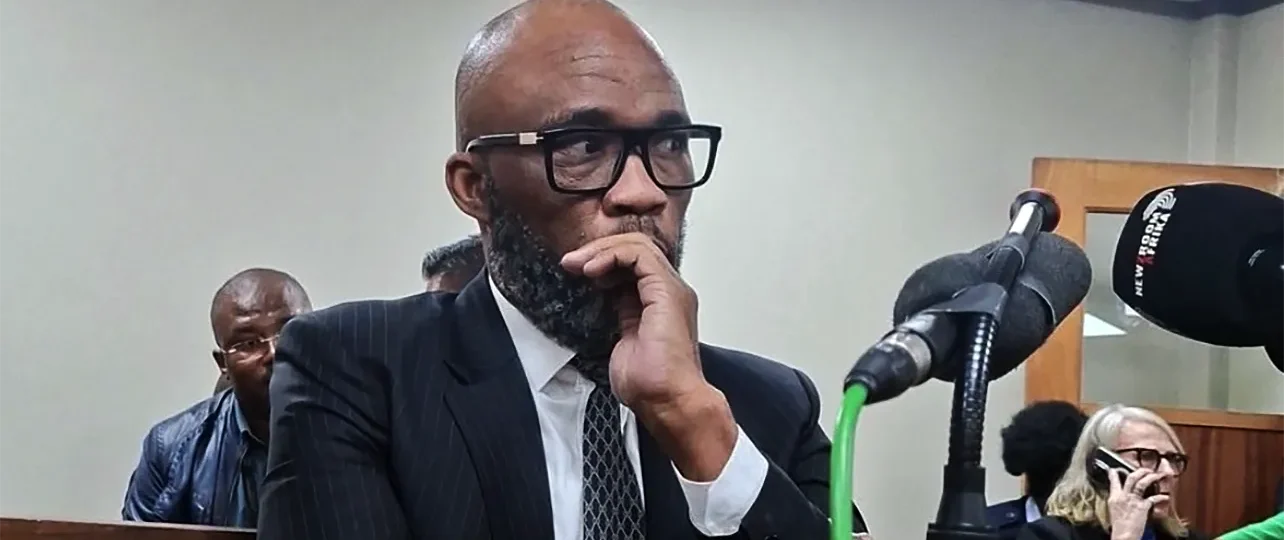

VUSIMUZI “Cat” Matlala walked into the Pretoria Specialised Commercial Crimes Court on Wednesday expecting a quiet formality – the rubber-stamping of an eight-year plea and sentence agreement he had negotiated with the state over two months. He left instead with a warning that his cooperation would cost him four years more than he had bargained for, and with his fate still unresolved.
Magistrate Ignatius du Preez rejected the effective eight-year term the National Prosecuting Authority’s Investigating Directorate Against Corruption (IDAC) had agreed with Matlala, ruling it did not fit the scale of his crimes. In its place, he proposed an effective 12 years: 15 years for fraud, with seven suspended; 10 years each on the corruption and money-laundering counts, with eight years of each running concurrently with the fraud sentence. Matlala’s two companies, Medicare24 Tshwane District and Luxo Africa Brand Investments, would face a combined R4 million fine, doubling the R2 million the plea deal had proposed.
Crucially, none of this is yet final. Du Preez was explicit that Matlala has not been sentenced. Under Section 105A of the Criminal Procedure Act, a court that finds an agreed sentence unjust may propose its own terms, which the accused and the state must then accept or reject in full. The matter was postponed to 13 July for that decision. Accept, and Matlala is convicted and sentenced on the spot. Reject, and he is entitled to withdraw his guilty plea altogether — sending a case built on 17 accused, a cancelled R228 million SAPS tender and a suspended national police commissioner back to square one.
A JUDGE UNCONVINCED BY REMORSE
What made Wednesday’s ruling more than a technical adjustment was the magistrate’s evident scepticism about the motives behind Matlala’s cooperation. He found that Matlala turned state witness only after his March arrest made clear investigators were closing in — not out of genuine contrition — and cautioned against a growing pattern in which plea deals function less as instruments of justice than as bargaining chips for the well-connected.
“I view the accused’s willingness to assist the authorities as a bargaining tool aimed at securing a more lenient sentence.”
Magistrate Ignatius du Preez, Pretoria Specialised Commercial Crimes Court
Du Preez went further, questioning whether South Africa’s justice system should lean as heavily as it does on accused persons to expose the officials who corrupted them in the first place. “The duty to investigate and prosecute those who corrupt the institution of state rests upon the SA Police Service and the National Prosecuting Authority, and not upon the accused,” he said, adding that Matlala’s evidence “cannot be permitted to replace the state’s own diligent efforts.” It was, in effect, a rebuke aimed as much at the NPA’s prosecutorial strategy as at Matlala himself — a signal that the bench, not the negotiating table, will set the price of accountability.
The underlying facts are not in dispute. Matlala pleaded guilty on 25 June to fraud, corruption and money laundering linked to an SAPS health and wellness tender initially pitched at roughly R360 million and ultimately signed for R228 million, awarded to his company, Medicare24 Tshwane District, in June 2024. Around R50 million had already been paid out by the time internal auditors flagged irregularities and the contract was cancelled in May 2025. Twelve senior police officers were arrested in March over their alleged role in helping Matlala secure it; suspended National Police Commissioner Fannie Masemola, one of 17 originally charged in the matter, has had his own case postponed to 28 August.
THE NAMES HE HAS ALREADY PUT ON RECORD
If the court proceedings settle Matlala’s own fate, it is his testimony elsewhere — before Parliament’s Ad Hoc Committee probing the explosive allegations first raised by KwaZulu-Natal police boss Lieutenant General Nhlanhla Mkhwanazi — that has done the most to unsettle the political establishment. There, under oath and away from the tighter evidentiary discipline of a criminal court, Matlala has named names.
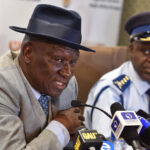
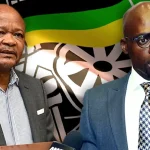
He has told MPs he paid former Police Minister Bheki Cele R500,000 in two instalments — R300,000 and R200,000 — and described a relationship in which Cele allegedly shielded him from police harassment while probing, on separate occasions, how Matlala had landed his tender and whether it was intended to bankroll a presidential bid by suspended minister Senzo Mchunu. Matlala quoted Cele as saying of Mchunu: “He thinks he can be president of the country.” Confronted by EFF leader Julius Malema with Cele’s own sworn evidence — that he kept Matlala close because Matlala was passing him information from Mchunu’s camp — Matlala flatly told the committee that Cele “lied under oath.”
Matlala’s account before the committee has also touched on his alleged closeness to senior police brass, references to businessman Brown Mogotsi, and claims about the planned removal of a senior general, threads the committee chairperson, Soviet Lekganyane, has taken pains to ensure are not lost amid the theatre of the hearings. In his court-supervised plea agreement, separately, Matlala admitted to paying a gratification to Brigadier Rachel Matjeng — who has denied any wrongdoing, describing the money as a “girlfriend allowance” — and who was dismissed from the police service this week for dishonesty, money laundering and receiving gratification.
None of this constitutes a finding of guilt against any of the individuals named. It is testimony — powerful, detailed, and delivered under oath, but testimony from a man the trial court itself has just found to be an unreliable narrator of his own remorse. That tension is precisely what makes the coming weeks so consequential.
WHY THE ADJOURNMENT MATTERS MORE THAN THE NUMBER
The temptation, in a country exhausted by unaccountable elites, is to read Wednesday’s ruling as swift justice finally landing on a well-connected fraudster. There is something to that reading: a magistrate looked at a deal negotiated between prosecutors and a man accused of corrupting the police service, found it wanting, and said so from the bench in unusually blunt terms about the cost corruption exacts — in Du Preez’s words, robbing South Africans “of economic growth, jobs, functioning public services and public trust.” That a court would override a negotiated settlement of this kind, rather than defer to it, is itself notable.
But the more accurate description is not swift justice — it is contested justice, still mid-negotiation. Matlala was arrested in March. The plea deal took two months to negotiate. Sentencing has now been bumped from 1 July to 13 July while lawyers on both sides weigh whether four extra years is a price worth paying to keep the cooperation agreement, and with it, the promised pipeline of evidence against “high-profile” figures, alive. The NPA has been explicit that if the deal collapses, Matlala’s affidavit becomes unusable and the state must build its case against senior officials from scratch.
That is the real stake of 13 July. Should Matlala or the state walk away, the public may never see his allegations tested in a courtroom at all — only debated in the more forgiving arena of a parliamentary committee, where evidence is aired but no one is convicted. Should both sides accept the tougher terms, Matlala’s sentence is fixed and his obligation to testify “fully, truthfully and without retracting” becomes a condition of the seven suspended years hanging over him — a considerably sharper incentive to hold the line under cross-examination than a parliamentary hearing ever provides.
For a public that has watched successive corruption scandals dissolve into inquiry transcripts and column inches with no one held to account, the distinction matters. Parliament’s Ad Hoc Committee can compel testimony and generate headlines, but it cannot convict a police minister, a suspended commissioner, or anyone else Matlala has implicated. Only a court can — and only if the case that depends on his cooperation actually survives to trial. Wednesday’s ruling did not deliver that outcome. It bought the system four more years of leverage over the one man positioned to help produce it, and set 13 July as the date South Africa finds out whether that leverage holds.