FOR a government that spent three years rebuilding its case to international creditors, the timing could not have cut deeper. On May 15, S&P Global Ratings lifted Nigeria’s long-term sovereign credit rating from ‘B-‘ to ‘B’, the country’s first upgrade in fourteen years and the clearest external validation yet of President Bola Tinubu’s reform programme – exchange-rate liberalisation, subsidy removal and tighter capture of petroleum revenue. Six weeks later, Nigerians learned that a man calling himself Prince Adeniyi Adeyemi Matthew had spent roughly a year running an entirely invented federal agency out of an office inside the Federal Secretariat Complex in Abuja.
The contrast is not incidental. It is the story. A state that persuaded global markets it had tightened its fiscal and institutional plumbing is simultaneously explaining how a man with a documented history of impersonation forged his way past the gates of the presidency itself — and, by some accounts, into the federal budget.
THE UPGRADE THAT CHANGED THE NARRATIVE
S&P’s move to ‘B’ — still five notches below investment grade, with a stable outlook — was built on a narrower set of numbers: gross external reserves near $50 billion by March, a current account surplus projected at 5.8% of GDP, oil output climbing toward 1.66 million barrels a day, and the ramp-up of the Dangote Petroleum Refinery easing Nigeria’s fuel-import bill. It followed positive actions from Fitch and Moody’s in 2025, giving Abuja rare multi-agency alignment. Finance Minister Taiwo Oyedele called it validation of the government’s fiscal discipline and market-driven reform agenda.
But S&P’s own note carried a warning embedded in the praise: the gains could unwind if reform momentum stalls, if fiscal discipline weakens, or if the 2027 election cycle tempts Abuja back toward the spending patterns of prior cycles. Ratings agencies measure macro aggregates. They do not measure whether a fictional government agency can operate undetected in the same buildings that produce those aggregates.
A YEAR INSIDE THE MACHINERY OF STATE
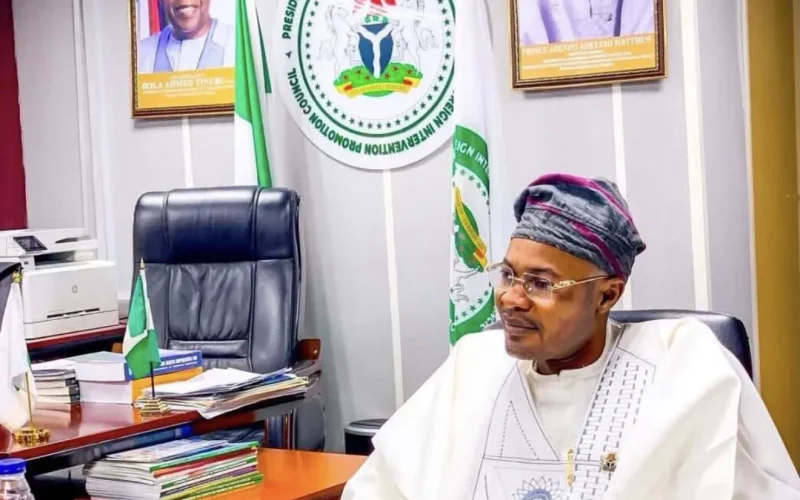
According to a detailed account released by the Presidency and corroborated by the Nigeria Police Force charge sheet, Adeyemi presented himself as Director-General of the Presidential Foreign Intervention Promotion Council — later also styled the Presidential Economic Advisory Council — armed with an appointment letter purportedly signed by Chief of Staff Femi Gbajabiamila. The council secured office accommodation on the second floor of Phase III of the Federal Secretariat Complex, the physical heart of Nigeria’s federal bureaucracy.
From there, the fiction operated with startling reach. Adeyemi hosted ambassadors at a private meeting in Abuja on October 10, 2025, an engagement so far outside normal protocol that the Ministry of Foreign Affairs flagged it as a breach of diplomatic procedure days later. He met government officials and foreign investors as a legitimate agency head. He requested a note verbale from the Ministry of Foreign Affairs to the United States Embassy, seeking to facilitate visas for staff of an agency that, according to the Presidency, never existed in law.
Police investigators say the operation extended into the banking system. Officers allege they uncovered 34 bank accounts linked to Adeyemi, nine of them opened in the names of fictitious government bodies, including one opened with the Central Bank of Nigeria through the Office of the Accountant-General of the Federation using forged documentation. Most consequentially, reporting on the 2026 Appropriation Act shows an entity matching the council’s name allocated more than ₦1.3 billion — roughly ₦803 million for personnel costs, ₦200 million for overheads and ₦300 million for capital expenditure — raising the question of how a body the Presidency insists is fictitious found its way into a budget line at all.
THE PAPER TRAIL THAT UNRAVELLED IT
The scheme began to collapse only after officials of the legitimate Nigerian Investment Promotion Council complained that a rival body appeared to be operating at cross-purposes with their mandate. That complaint prompted Gbajabiamila, on October 17, 2025, to write to the Department of State Services and the police, describing forged appointment letters circulating in his office’s name. Adeyemi was arrested on October 27 at the Secretariat office where he had operated for months; police searches of that office and his home in Suleja recovered what investigators describe as forged documents and other exhibits.
Adeyemi told investigators that one Dolapo Babatunde Tanimola had helped him obtain the forged appointment letter — a claim that could not be tested, since police established that Tanimola had died in a hotel fire in Abuja five days before Adeyemi’s own arrest. On November 27, 2025, the police filed an eight-count charge against Adeyemi and two co-accused, still at large, at the Federal High Court in Abuja, covering conspiracy, forgery of presidential documents, forgery of State House letterheads and impersonation as a Director-General.
A DEFENCE, A COUNTER-ACCUSATION, AND UNANSWERED QUESTIONS
The case might have stayed a police blotter curiosity had Adeyemi not resurfaced. While on bail, he renewed his claim that Gbajabiamila had personally appointed him — a claim that directly contradicted his own statement to investigators months earlier. The Chief of Staff issued a fresh disclaimer on June 8, prompting the Presidency’s spokesman, Bayo Onanuga, to publish an unusually long statement on the affair, tracing the paper trail and branding Adeyemi a serial impersonator whose history stretches back to a 2016 episode in which he falsely claimed to lead a United Nations-affiliated youth body.
Adeyemi has not backed down. In a televised interview and a press conference, he rejected the fraud characterisation outright and pointed to his own access — meetings with ambassadors, heads of agencies and departments — as evidence that the council was real. He went further, alleging that Gbajabiamila had demanded a cut of the agency’s take-off grant and that the fraud accusation was retaliation for his refusal to pay. The Presidency has not directly rebutted that specific allegation beyond its broader denial, and human rights lawyer Femi Falana has publicly argued that the Presidency lacks the constitutional standing to exonerate any official in the matter and has called for an independent investigation of both Gbajabiamila and Adeyemi.
Neither camp has answered the harder institutional question hanging over the case: how a single individual secured physical office space inside the Federal Secretariat, opened a Central Bank account through the Accountant-General’s office, and reportedly obtained a budget line in a national Appropriation Act — without triggering the internal controls those very reforms were supposed to represent to ratings agencies.
JULY 27, AND THE CREDIBILITY QUESTION
Adeyemi and his co-defendants are due back before the Federal High Court in Abuja on July 27. Whatever the court decides about his personal culpability, the episode has already done its institutional damage. It does not undo the macro case S&P made in May — reserves, oil output and refining capacity are real, verifiable figures. But it exposes the gap between macroeconomic credibility, which international markets can price, and institutional credibility, which they cannot. A country can stabilise its currency and rebuild its reserves while a fictitious government agency operates for a year inside the building meant to symbolise the state’s authority.
For a pan-African economy positioning itself as the anchor of investor confidence in the region, the lesson is not that the upgrade was undeserved. It is that credibility, once built on fiscal reform alone, remains only as strong as the institutions asked to defend it — and in Nigeria’s case, those institutions have just been shown, in the most public way possible, how easily they can be walked through.