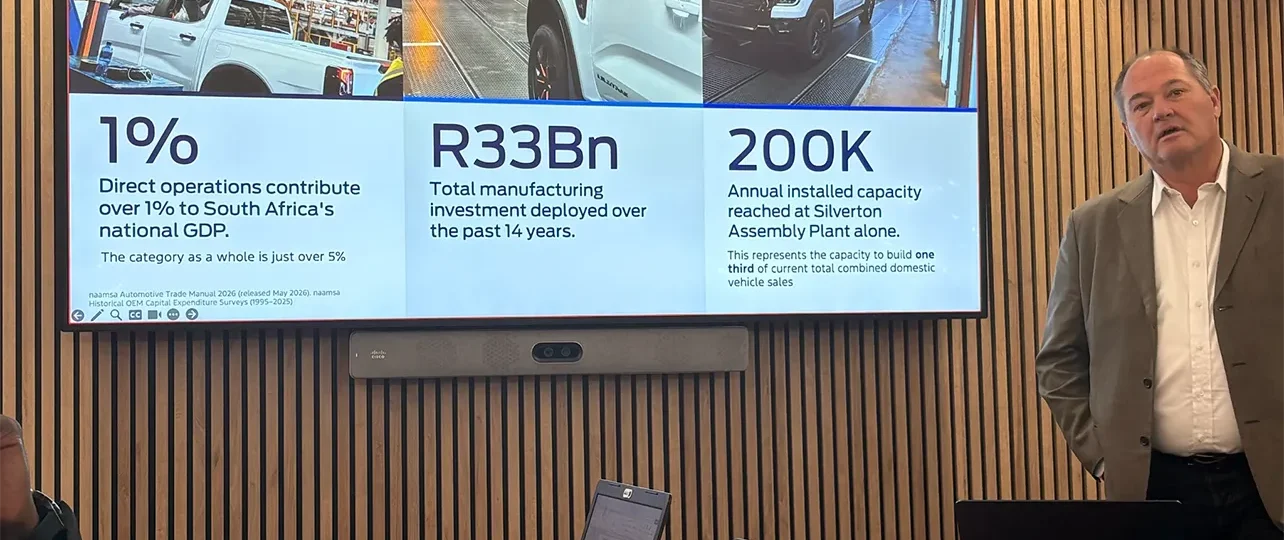

NEALE Hill, President of Ford Motor Company Africa and Managing Director of Ford South Africa, has issued one of the automotive industry’s starkest warnings yet – telling government and business that South Africa risks following Australia into total de-industrialisation unless urgent action is taken to level the playing field against a flood of low-cost Chinese and Indian imports.
Hill said South Africa’s automotive manufacturing sector – the single largest contributor to the country’s export economy and a cornerstone of its industrial identity – is at a crossroads, and could collapse entirely if the government does not move with urgency to correct a market he described as “structurally unsustainable.”
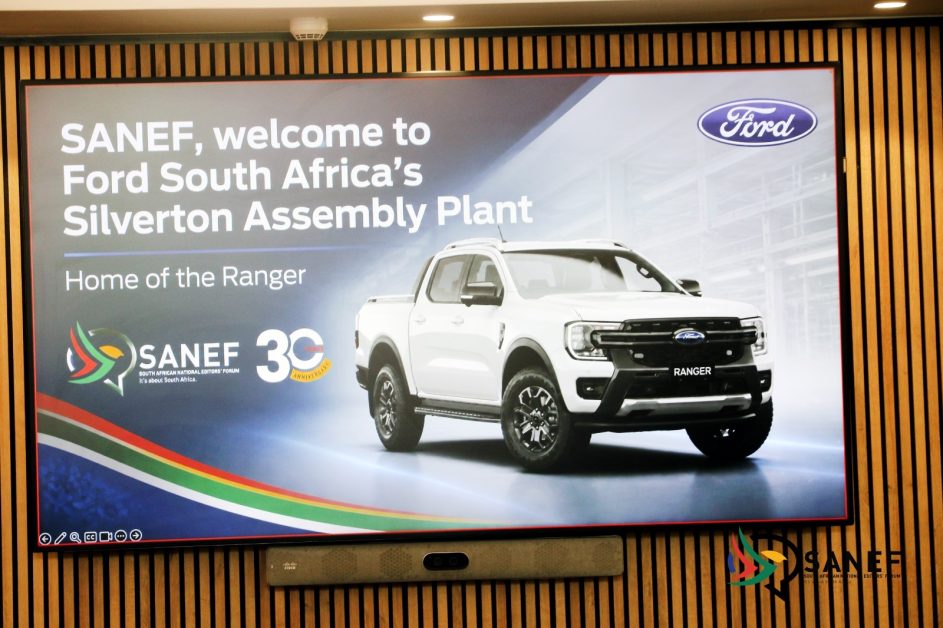
Hill made these remarks in an address to delegates to the South African Editors Forum annual general meeting at Ford’s regional headquarters in Pretoria, where the Silverton Assembly Plant builds the Ford Ranger for the domestic market and more than 100 export markets across Europe, the Middle East, Australasia and the Americas.
Hill delivered a blunt message: South Africa is on the same trajectory that wiped out vehicle manufacturing in Australia a decade ago – and this time, the casualty would not just be an industry, but the structural integrity of the entire economy.
“We cannot afford to lose the high-value, capital-intensive manufacturing sector. I was in Australia from 2013 to 2016 when we took the decision to discontinue manufacturing there. As a result, Australia no longer manufactures any vehicles. It’s a fully imported market.”
NEALE HILL, PRESIDENT, FORD MOTOR COMPANY AFRICA
A MARKET TIPPING TOWARD IMPORTS
Hill’s warning is underpinned by figures he says should alarm policymakers: seven out of every ten light vehicles sold in South Africa today are now built overseas. Vehicles imported from India account for 49.2% of all passenger vehicles sold locally, while Chinese-built imports have climbed to roughly 16% of the market – a combined share that Hill said is turning South Africa into “an import replacement market as opposed to a locally manufactured” one.
“Every imported car that replaces a locally made vehicle chips away at the domestic supply chain and the industrial base that we have in South Africa,” Hill said. “Transactional brands sell cars off a ship. A generational partner anchors a nation’s industrial future through deep investment.”
He was careful to stress that Ford does not oppose competition — describing it as healthy and something that “keeps us on our toes” — but argued that vehicles arriving from heavily subsidised, low-cost manufacturing hubs are competing on fundamentally unequal terms against local manufacturers carrying the full weight of long-term capital investment, empowerment obligations and local-content requirements.
“WE BECOME A BIDDING WAR”
Hill’s most pointed remarks were reserved for how global capital is actually allocated inside Ford. Domestic competition, he explained, is between brands – Ford against Toyota, Volkswagen and others. But investment decisions are made at a different level entirely: country against country.
“Every five to seven years, Ford Motor Company decides where we’re going to invest for the next generation of products, involving billions of dollars in tooling and engineering. It is a bidding war. Executives don’t compare Ford South Africa to Toyota — they compare us to Thailand, to Pacheco in Argentina, and to China.”
NEALE HILL
Hill said the same anxiety is shared across the industry’s leadership – from Toyota’s Andrew Kirby to Volkswagen’s Martina Biene – as each manufacturer fights to justify continued investment in South Africa against competing global sites. He pointed to Morocco’s rapid rise to become Africa’s largest vehicle producer, now manufacturing more than a million vehicles a year against South Africa’s roughly 650,000, as a measure of how quickly the country could be overtaken.
Rising input costs – electricity, water, logistics and labour – combined with port and rail inefficiencies were named as key drags on competitiveness. Hill pointed to one particularly stark anomaly: in South Africa it is cheaper to move vehicles to port by truck than by rail, the reverse of virtually every other manufacturing economy in the world.
WARNING SIGNS ALREADY VISIBLE
Hill said the erosion of the local supply base is no longer theoretical. Goodyear has already ceased local manufacturing, and component suppliers are increasingly choosing to import rather than manufacture in South Africa – the same pattern, he said, that preceded the total collapse of Australia’s vehicle industry, where it was ultimately component suppliers withdrawing that forced OEMs to abandon local production.
The stakes extend well beyond the assembly line. Hill described the automotive sector as a “systemic anchor industry” whose collapse would ripple through steel, plastics, foundries, logistics, rail, and the broader engineering skills base – while also acting as one of the country’s primary training grounds for advanced manufacturing engineers. Ford’s Silverton plant alone runs 257 robots on its chassis line and more than 500 robotic welding stations in its body shop.
THREE DEMANDS FOR GOVERNMENT
Hill laid out a direct set of policy demands, warning that South Africa’s automotive framework “cannot survive on legacy policy frameworks”:
Level the empowerment playing field. Local manufacturers must hold a minimum Level 4 B-BBEE rating to participate in the Automotive Production and Development Programme (APDP) – but importers face no such requirement, and some are reportedly using local agencies to sidestep the rule and still win government tenders.
Close tariff and content loopholes. Hill called for strict enforcement of the 40% local content target under the APDP and a crackdown on “screwdriver plants” – semi-knockdown operations that merely re-bolt components removed at source before import, rather than genuinely manufacturing in South Africa.
Modernise outdated taxes and accelerate reform. Hill singled out the ad valorem luxury tax, introduced in the 1990s when it targeted imported vehicles costing more than R200,000 – a threshold that has never been adjusted and now applies to almost every new vehicle sold in the country. He also urged faster government movement on port, rail and electricity reform, and called for the long-delayed review of the APDP2 policy – authored in 2019, before COVID-19 and before major shifts in global emissions regulation – to finally begin after industry has pushed for it since late 2024.
“WE PLAN TO BE HERE”
Despite the warning, Hill struck a note of commitment, pointing to Ford’s investment in a 200-hectare Special Economic Zone adjacent to the Silverton plant designed to draw supplier operations closer to the factory floor, and to the company’s continued community investment through literacy programmes, mobility donations and disaster-relief partnerships with organisations such as the Nelson Mandela Foundation and Gift of the Givers.
But he was unambiguous that goodwill alone will not keep manufacturing in South Africa. “If the auto manufacturing base is allowed to hollow out due to uncompetitive policies or low-cost imports,” Hill warned, “the structural integrity of South Africa’s entire industrial sector will collapse.”
As Ford marks the start of its second century of operations in South Africa, Hill said the choice facing government and industry is stark and urgent. “We have to prove that South Africa is cost-competitive versus other parts of the world,” he said, “in order to secure the investment that comes to South Africa from Ford Motor Company to tool up for the next generation of vehicle.”